
Sensitive Teeth But No Cavity? Here's What's Actually Going On.

You mention to your dentist that a tooth — or several teeth — have been bothering you. Sharp discomfort when you drink something cold. A twinge when you bite into something sweet. That particular wince when you step outside on a cold morning and breathe in.
The X-rays come back clean. No cavity. "Your teeth are sensitive," the dentist says, and hands you a recommendation for sensitive toothpaste. You try it. It helps a little, maybe. But a few weeks later, the sensitivity is back, and you're left wondering whether you're missing something.
You probably are. Not because anything was done wrong — but because tooth sensitivity is a symptom with multiple possible causes, and treating the symptom without identifying the cause is a short-term solution at best.
Here's what's actually worth knowing.
Why "No Cavity" Doesn't Mean "No Problem"
The intuitive explanation for tooth sensitivity is a cavity — decay that's worked its way close enough to the nerve to cause pain. And that's a real and common cause. But it's far from the only one.
The underlying mechanism of most sensitivity is the same regardless of cause: exposure or stimulation of dentin, the inner layer of the tooth. Dentin contains microscopic tubules — tiny channels that run from the tooth surface to the nerve. When these tubules are exposed or stimulated, fluid movement within them triggers the nerve, producing the sharp, transient pain most people recognize as sensitivity.
What varies is why those tubules are exposed or stimulated. And that "why" determines what will actually fix it.
The Real Causes of Tooth Sensitivity
Gum Recession and Root Exposure
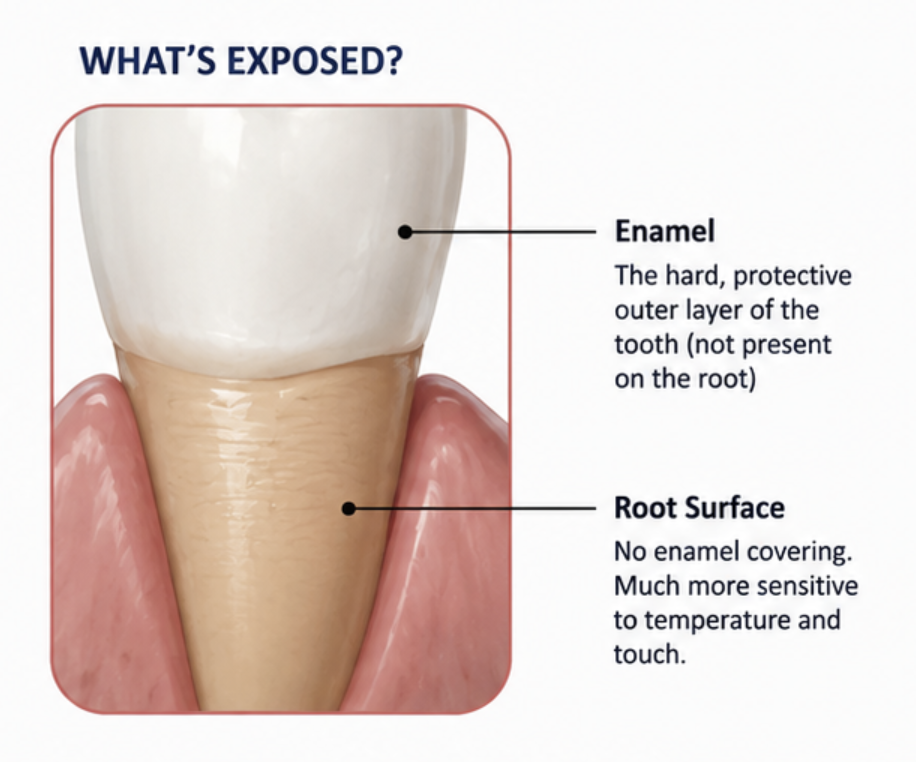
The root of a tooth is not covered by enamel. It's covered by a thinner, more porous material called cementum, which provides far less insulation against thermal and chemical stimuli. When gums recede — from age, from previous gum disease, from aggressive brushing, from grinding — the root surface becomes exposed. That newly exposed surface is significantly more sensitive than the enamel-covered crown of the tooth.
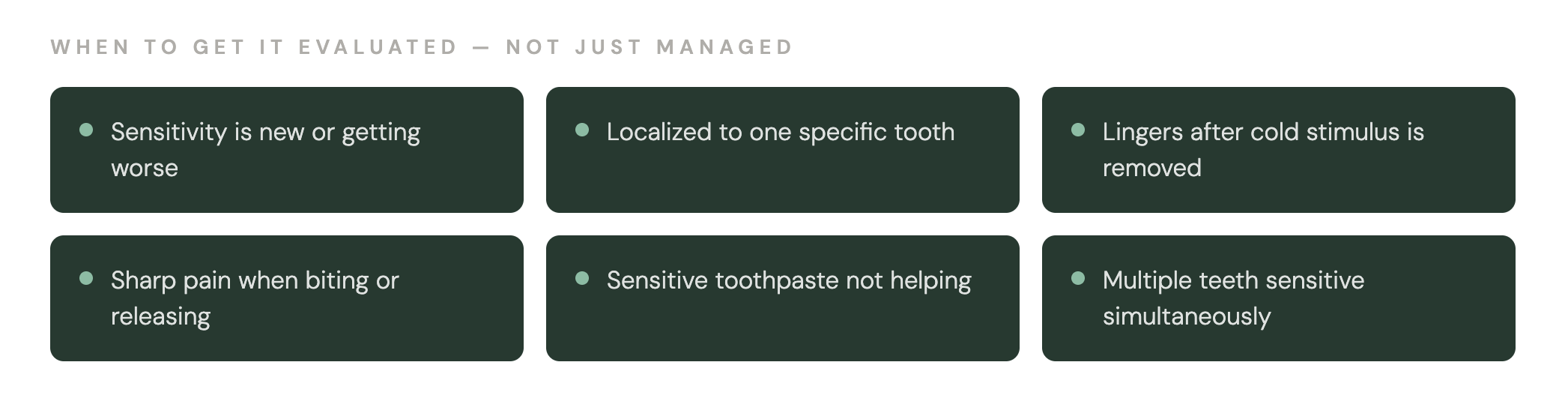
This is one of the most common causes of sensitivity we see, and it's identifiable immediately on examination. The sensitivity is typically localized to specific teeth, often the ones most affected by recession, and it tends to be worse with cold and sweet stimuli.
The fix isn't sensitive toothpaste — it's addressing the recession, whether through improving the cause (brushing technique, gum disease treatment) or in some cases restoring coverage with a gum graft.
Enamel Erosion from Acid Exposure
Enamel is the hardest substance in the human body, but it has a critical vulnerability: acid. Foods and drinks with low pH — sodas, energy drinks, citrus, wine, sparkling water — temporarily soften and gradually dissolve enamel with repeated exposure. Over time, the enamel layer thins. The insulating layer between the tooth surface and the dentin becomes less effective, and sensitivity increases.
What makes this particularly tricky is that enamel erosion is often generalized rather than localized to one tooth. Patients with acid erosion-driven sensitivity frequently describe multiple teeth feeling sensitive, particularly to cold. The pattern often points toward a dietary habit or a condition like acid reflux before any individual tooth is the focus.
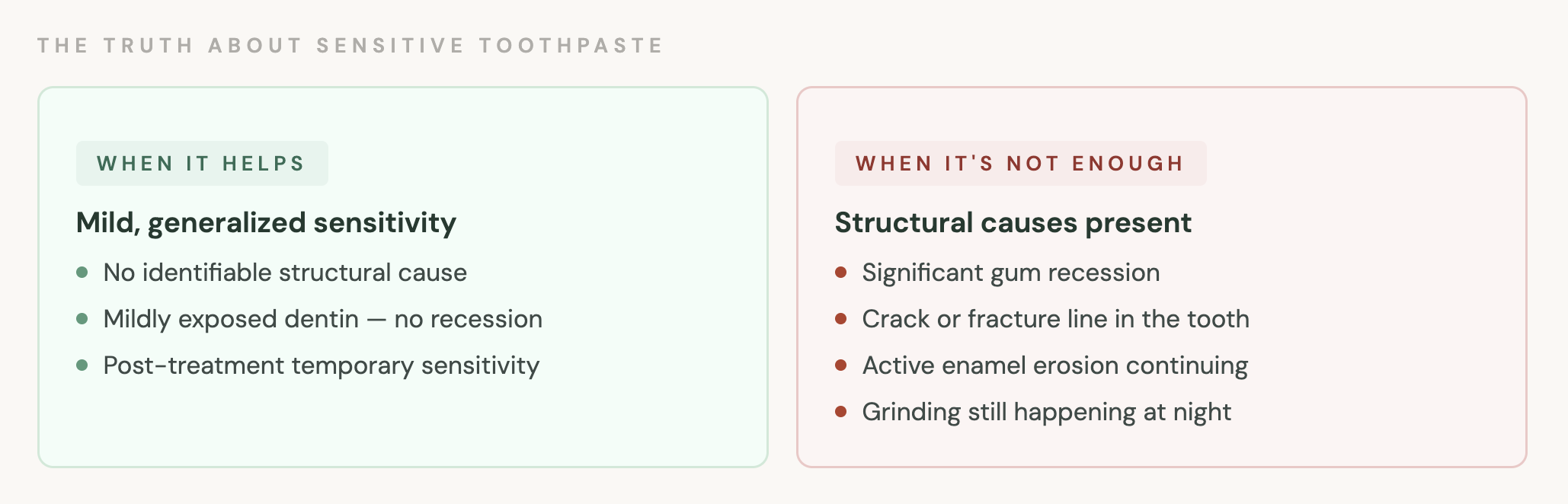
Sensitive toothpaste helps here in a limited way — it can reduce the permeability of exposed dentin temporarily — but it doesn't restore thinned enamel. Fluoride treatments, dietary changes, and in some cases restorative work are the actual interventions.
Micro-Cracks and Craze Lines
Teeth develop hairline fractures over time from the cumulative forces of biting, chewing hard foods, thermal changes, and grinding. Many of these cracks — called craze lines — are superficial and clinically insignificant. Others penetrate deeper into the dentin and create a specific type of sensitivity that's distinct from other causes.
Crack-related sensitivity has a characteristic quality: it's often provoked not just by temperature but by biting pressure, and it may be sharp and sudden rather than lingering. The discomfort is typically most notable when releasing biting pressure rather than when applying it — a pattern that points specifically toward a cracked tooth rather than decay or recession.
These cracks don't show up on routine X-rays. Diagnosis requires a clinical examination with specific tests — biting on a small instrument to isolate which tooth and which cusp is involved, transillumination (shining a light through the tooth to reveal the fracture line), and sometimes a dye test.
Left unaddressed, significant cracks can propagate. A crack that's caught early can often be treated with a crown that holds the tooth together and eliminates the sensitivity. A crack that extends to the root may require extraction.
Teeth Grinding and Clenching (Bruxism)

This is a cause of sensitivity that surprises many patients, because the connection isn't immediately obvious.
When teeth are subjected to the sustained, high-force grinding and clenching that occurs during sleep bruxism, several things happen over time. Enamel wears from the chewing surfaces and edges. The repeated mechanical stress creates or worsens micro-cracks. And the constant pressure generates a physiological response in the pulp — the nerve and blood vessel tissue at the center of the tooth — that makes the tooth generally more sensitive, even without structural damage visible on examination.
Patients who grind often report that multiple teeth feel sensitive simultaneously, that the sensitivity is diffuse rather than localized, and that it's worse in the morning after a night of grinding. A night guard doesn't directly restore enamel or reverse cracks, but it eliminates the ongoing force application that's generating the sensitivity — and prevents further damage while the underlying cause is addressed.
Dentin Hypersensitivity After Dental Treatment
Sensitivity that develops after a filling, crown, or cleaning is common and usually temporary. When a restoration is placed, the tooth goes through thermal and mechanical stress that can cause transient sensitivity. Similarly, professional cleaning can temporarily sensitize exposed root surfaces by removing protective deposits.
This type of sensitivity typically resolves on its own within a few weeks. If it doesn't — or if it's getting worse rather than better — that's worth reporting.
A Note on Sensitive Toothpaste
Sensitive toothpastes work through two primary mechanisms: potassium nitrate, which reduces nerve excitability over time, and stannous fluoride or similar compounds that occlude the dentinal tubules — essentially plugging the channels that transmit sensation.
These are legitimate mechanisms and the products do work, for certain causes and to a certain degree. For mild, generalized sensitivity with no identifiable structural cause, they're a reasonable first step. But they're symptomatic management, not treatment. If a tooth has significant recession, a crack, or ongoing enamel erosion, sensitive toothpaste is managing the output signal while the underlying input continues unchecked.
Think of it this way: if your check engine light is on, putting a piece of tape over it makes it less visible. That's roughly what sensitive toothpaste does when it's the only intervention for a structural problem.
How We Evaluate Sensitivity
When a patient comes in with tooth sensitivity as their primary complaint, the evaluation is more detailed than a quick visual check.
Thermal testing — we apply cold (and sometimes heat) to individual teeth to reproduce the symptom, assess its intensity, and note whether it lingers or resolves quickly. Lingering sensitivity after a cold stimulus points toward pulpal involvement; sharp but brief sensitivity is more consistent with dentin exposure.
Bite testing — biting on a small instrument (a Tooth Slooth or similar) helps isolate crack-related sensitivity by reproducing the discomfort under controlled pressure on individual cusps.
Periodontal assessment — we measure gum pocket depths and recession levels to quantify how much root surface is exposed and where.
X-rays — while cracks don't show on X-rays, bone levels, existing restorations, and proximity of decay to the pulp are all relevant. Bitewing and periapical radiographs give us the structural context.
Visual and tactile examination — transillumination, explorer examination of the tooth surface, and assessment of existing restorations and their margins.
The goal isn't just to confirm that sensitivity is present — it's to identify which specific mechanism is producing it, because that changes the recommendation entirely.
Frequently Asked Questions
Why are my teeth sensitive if there's no cavity?
Cavities are one cause of sensitivity, but far from the only one. Gum recession, enamel erosion, micro-cracks, grinding, and even recent dental work can all produce sensitivity through different mechanisms. A clinical exam that goes beyond X-rays is usually needed to identify the specific cause.
Why isn't sensitive toothpaste fixing my tooth sensitivity?
Sensitive toothpastes reduce the transmission of sensation through exposed dentin — they don't address structural causes like recession, cracks, or enamel erosion. If the underlying cause is structural, toothpaste manages the symptom without changing the situation producing it.
Can grinding my teeth cause sensitivity without any visible damage?
Yes. The pulp — the nerve tissue inside the tooth — responds to sustained mechanical stress with increased sensitivity, even before visible enamel wear or cracks are apparent. Grinding-related sensitivity also tends to be diffuse across multiple teeth rather than localized to one.
Is tooth sensitivity ever serious?
Sensitivity itself isn't dangerous, but some of its causes are. A crack that propagates to the root, recession that leads to root decay, or enamel erosion that reaches dentin are all progressive problems with meaningful consequences if left unaddressed. Sensitivity is the warning signal; the underlying cause is what needs attention.
How long should I wait before seeing a dentist about sensitivity?
If sensitivity is new, worsening, or localized to a specific tooth — especially if it lingers after the stimulus is removed — it's worth getting evaluated sooner rather than waiting. Persistent sensitivity that doesn't respond to a few weeks of sensitive toothpaste is also a reasonable threshold for scheduling an evaluation.
The Thing About Warning Signals
Sensitivity is your tooth's way of telling you something has changed. It's not always urgent, and it's not always serious — but it's rarely nothing.
The patients who do best long-term aren't the ones who found the right toothpaste to mask the feeling. They're the ones who found out what was actually happening while the options were still simple.
If a tooth has been bothering you — even mildly, even intermittently — give us a call. It's a short evaluation, and the earlier we look, the more we can usually do about it.
📍 State Avenue Dental Office — Kansas City, KS (KCK) 🗣 English • Korean • Spanish