
Why Your Mouth Feels Gross Every Morning
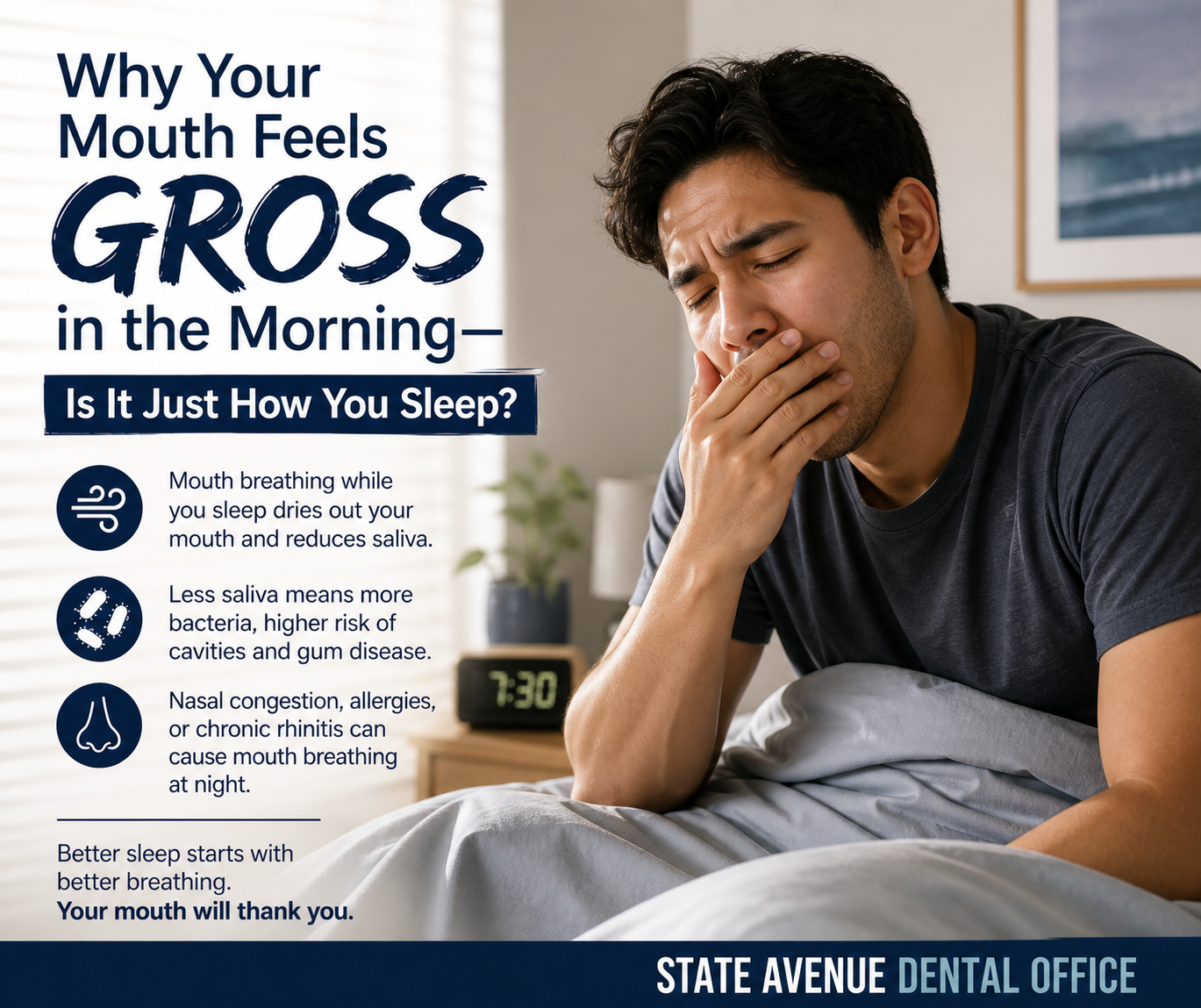
There's a specific kind of morning experience that a surprising number of people share but rarely talk about: you wake up, and before you've done anything else, your mouth already feels stale, dry, slightly thick — like something lived in it overnight. Brushing helps for a while, but tomorrow morning it's back.
Most people chalk it up to just how they sleep, grab some water, and get on with their day.
Here's the thing: that morning feeling is data. And in a meaningful number of cases, it's pointing to something specific — mouth breathing during sleep — that has real implications for your long-term dental health.
What's Actually Happening While You Sleep
During sleep, saliva production drops significantly for everyone. That's normal. What makes some people's mornings noticeably worse than others is what happens to that already-reduced saliva supply during the night.
When you breathe through your mouth while sleeping, the airflow accelerates evaporation of saliva from the oral tissues. The mucous membranes that line your cheeks, tongue, and palate dry out. The thin film of saliva that normally coats your teeth — providing a continuous protective barrier — is gone or severely diminished by morning.
This matters because saliva isn't just moisture. It's an active biological fluid with multiple protective functions:
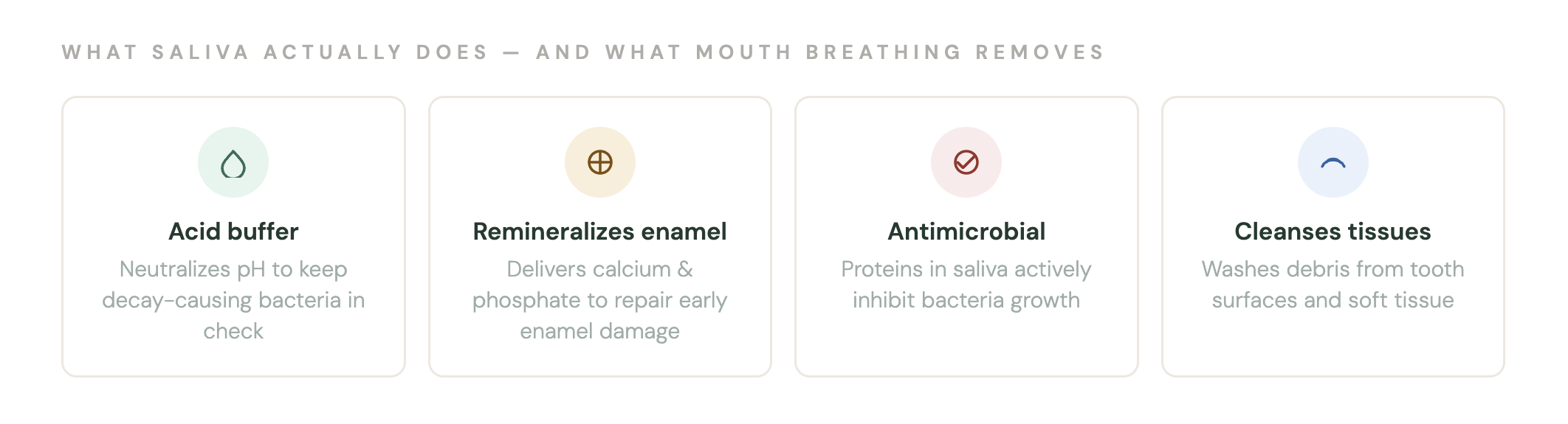
Acid neutralization — saliva buffers the pH of the mouth, keeping it in a range that's hostile to decay-causing bacteria
Remineralization — it delivers calcium and phosphate ions to tooth surfaces, repairing early enamel damage continuously through the night
Antimicrobial action — proteins in saliva inhibit the growth of cavity-causing and gum-disease-causing bacteria
Mechanical cleansing — it washes food debris and dead cells from tooth surfaces and the soft tissue
When mouth breathing eliminates this protective layer for six to eight hours every night, the mouth spends a significant portion of each 24-hour cycle in exactly the environment bacteria love most: warm, dry, acidic, and largely undefended.
The Dental Consequences of Chronic Mouth Breathing
This isn't an abstract risk. The pattern shows up consistently in clinical practice.
Accelerated cavity formation. Patients who are chronic mouth breathers — whether they know it or not — tend to present with decay in locations and patterns that differ from typical cavity profiles. Cavities concentrated along the gumline, on the front teeth, or in areas that would normally be well-protected by saliva flow are characteristic. When we ask about sleep habits and patients mention they often wake with a very dry mouth, it frequently connects.
Gum inflammation and periodontal risk. The gingival tissue — the gums — is directly affected by nighttime drying. Patients who mouth breathe often have chronically inflamed gum tissue, particularly in the front of the mouth where airflow is most direct. This isn't periodontitis in the classic sense, but sustained gingival inflammation is a risk factor for progressive gum disease over time.
Morning bad breath that brushing doesn't fully resolve. The staleness most people notice in the morning is largely bacterial. Overnight, bacteria metabolize proteins and produce volatile sulfur compounds — the primary chemical source of bad breath. In a normal saliva environment, this process is inhibited. In a dry mouth, bacteria multiply unchecked for hours. The result is the distinctively thick, stale morning breath that no amount of careful brushing the night before fully prevents.
Increased sensitivity. Chronic dry mouth from any cause — including nighttime mouth breathing — accelerates enamel erosion by removing the saliva that would otherwise buffer acid exposure. Over time, this manifests as generalized tooth sensitivity that patients often attribute to other causes.
Who's Most Likely to Be Mouth Breathing at Night
The critical part of this conversation is that most people who breathe through their mouths during sleep have no idea they're doing it. It happens unconsciously, and they don't have a sleep partner who mentions it, or they've simply normalized the morning dryness.
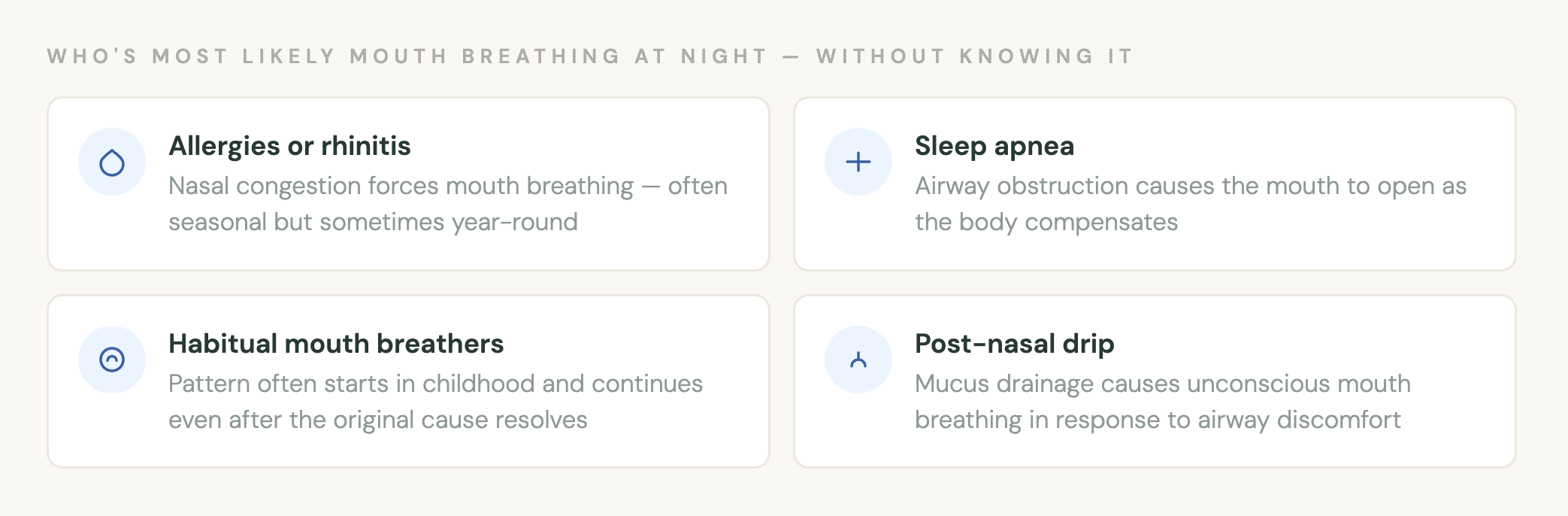
Several conditions make nighttime mouth breathing significantly more likely:
Nasal congestion from allergies or rhinitis. If the nasal airway is partially or fully obstructed — from seasonal allergies, chronic rhinitis, or a structural issue like a deviated septum — the mouth becomes the path of least resistance during sleep. This can be intermittent (worse during allergy season) or year-round.
Sleep apnea. Obstructive sleep apnea involves partial or complete airway obstruction during sleep, which often causes the mouth to open as the body compensates. Morning dry mouth is one of the most consistent patient-reported symptoms of undiagnosed sleep apnea — and it's one of the reasons we ask about it.
Habitual mouth breathing. Some people develop mouth breathing as a habit during childhood — often following a period of chronic nasal congestion — and continue it into adulthood even after the original cause resolves. The pattern becomes default.
Post-nasal drip. Mucus draining into the throat overnight can trigger mouth breathing as an unconscious response to airway discomfort.
Why Your Dentist Asks About Your Sleep
When we ask patients about their sleep habits, nasal congestion, or whether they wake with a dry mouth, it's not small talk. It's part of understanding the full oral environment — because a patient's cavity risk or gum health can't be accurately assessed without knowing what's happening to their mouth for the six to eight hours a day they're asleep.
A patient who brushes and flosses diligently but mouth breathes every night is working uphill. The nighttime drying undoes a meaningful portion of the protection that good daytime hygiene provides. We want to understand that dynamic so we can give advice and treatment recommendations that actually match the patient's real situation.
This is also why we look carefully at the pattern of any dental problems we find. Decay and gum inflammation that's clustered in areas consistent with nighttime drying tells a different clinical story than the same findings distributed elsewhere — and that story points toward a different intervention.
What You Can Do About It
Identify and address the nasal cause. If nasal congestion is driving the mouth breathing, treating the congestion is the most direct path to improvement. For allergy-driven congestion, antihistamines or nasal corticosteroid sprays (many available over the counter) can make a significant difference. For structural issues like a deviated septum, a referral to an ENT is appropriate. For seasonal issues, being proactive during allergy season — rather than reactive after symptoms are established — tends to work better.
Nasal strips. Over-the-counter nasal dilator strips can help keep the nasal airway open during sleep, particularly for patients with mild structural narrowing. They're not a solution for significant obstruction, but they're a low-barrier, inexpensive option worth trying.
Hydration and humidification. Drinking adequate water throughout the day supports saliva production. A bedroom humidifier can reduce the drying effect of breathing on oral tissues during sleep — not a fix, but a meaningful mitigator.
Mouth taping. This is a more direct intervention — placing a small piece of medical-grade tape over the lips during sleep to encourage nasal breathing. It sounds unusual, but it's increasingly supported by research and reported positively by patients who try it. We'd recommend discussing it with your physician before trying, particularly if you have any concerns about your airway.
Fluoride and saliva support. For patients who are managing chronic dry mouth — whether from mouth breathing or other causes — prescription-strength fluoride toothpaste and saliva-stimulating products (xylitol gum, lozenges, or oral moisturizing gels) can provide meaningful protection. These don't solve the underlying cause, but they significantly reduce the dental consequences.
Sleep apnea evaluation. If morning dry mouth is accompanied by daytime fatigue, snoring reported by a partner, or frequent nighttime waking, sleep apnea should be ruled out. A sleep study is the definitive evaluation. This matters both for overall health and for dental health — treating sleep apnea often resolves the associated mouth breathing.
Frequently Asked Questions
Why does my mouth feel so dry and gross every morning even though I brush before bed? Nighttime saliva production drops naturally, and if you're breathing through your mouth during sleep, airflow dries out what little saliva remains. The result is a dry, bacteria-friendly environment for hours — regardless of how well you brushed before bed.
Can mouth breathing at night cause cavities? Yes, and it's more common than most people realize. Saliva buffers acid, remineralizes enamel, and inhibits bacterial growth. Nighttime mouth breathing removes that protection for six to eight hours every night, creating conditions that significantly increase cavity and gum disease risk over time.
How do I know if I'm breathing through my mouth at night? Consistent morning dry mouth and bad breath are the most common indicators. A partner noticing open-mouth sleeping or audible mouth breathing is another. Waking with a sore throat, chapped lips, or a very dry palate also points in this direction.
I've had morning bad breath forever. Is it really a dental issue? Morning breath has a bacterial component that's normal — but persistent, notable morning dryness and bad breath that doesn't respond well to good hygiene is worth looking at clinically. The cause is often identifiable and addressable.
Should I tell my dentist I think I'm mouth breathing at night? Absolutely — and if you're not sure, mention the morning symptoms and we'll ask the right follow-up questions. It directly affects how we evaluate your cavity risk, gum health, and what we recommend for your care.
The Thing About Symptoms You've Normalized

Morning dry mouth is one of those things people live with for years — sometimes decades — because it's unpleasant rather than painful, and it goes away once you drink some water and brush your teeth.
But the environment that creates that feeling is running in the background every single night. The dental consequences accumulate quietly: a little more enamel erosion, a little more gum inflammation, a cavity that shows up in a location that doesn't quite make sense given otherwise good hygiene habits.
If this sounds familiar, it's worth mentioning at your next visit. It's a short conversation, and it can meaningfully change the clinical picture.
Give us a call.
📍 State Avenue Dental Office — Kansas City, KS (KCK) 🗣 English • Korean • Spanish