
Why Food Keeps Getting Stuck Between Your Teeth
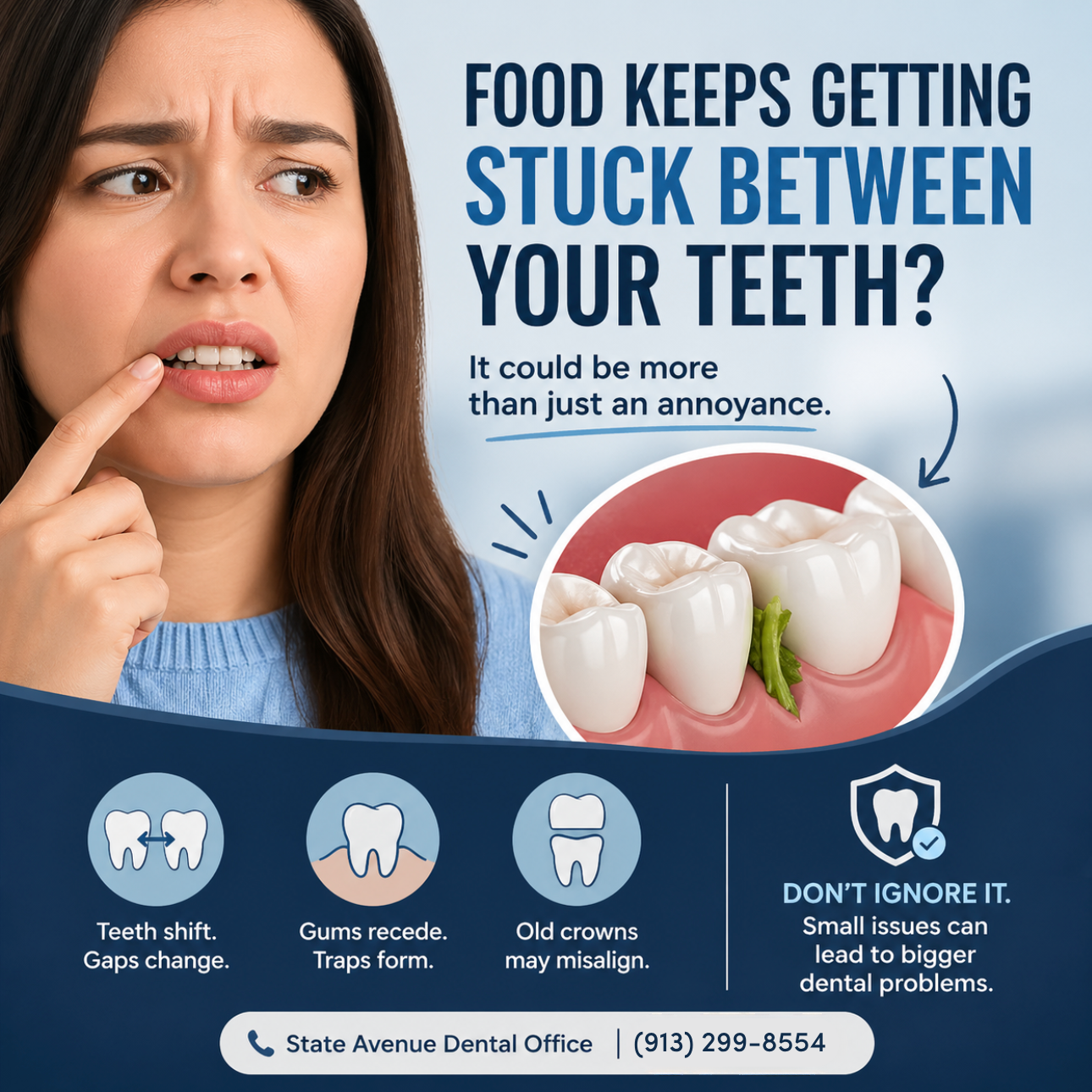
There's a specific kind of frustration that comes with reaching for a toothpick after every meal — not because you're not taking care of your teeth, but because the same spot keeps catching food no matter what you do. You floss. You rinse. And tomorrow it happens again, in exactly the same place.
Most people file this under "minor annoyance" and move on. That's understandable. But in practice, persistent food trapping in a specific location is something we take seriously — because it's rarely just about hygiene, and it's almost always telling you something.
It's Probably Not About How Well You're Cleaning
Let's start here, because it changes the entire way you should think about this.
If food is getting stuck in the same spot consistently — despite brushing twice a day and flossing — the problem isn't your technique. A hygiene issue tends to be diffuse: buildup in multiple areas, generalized gum sensitivity, overall plaque accumulation. A food trap that returns to exactly the same location, every time, points to something structural.
The mouth is not static. Over the course of years, small but meaningful changes accumulate — and those changes can create spaces where none existed before, or alter how existing spaces interact with food during chewing.
What's Actually Creating the Trap
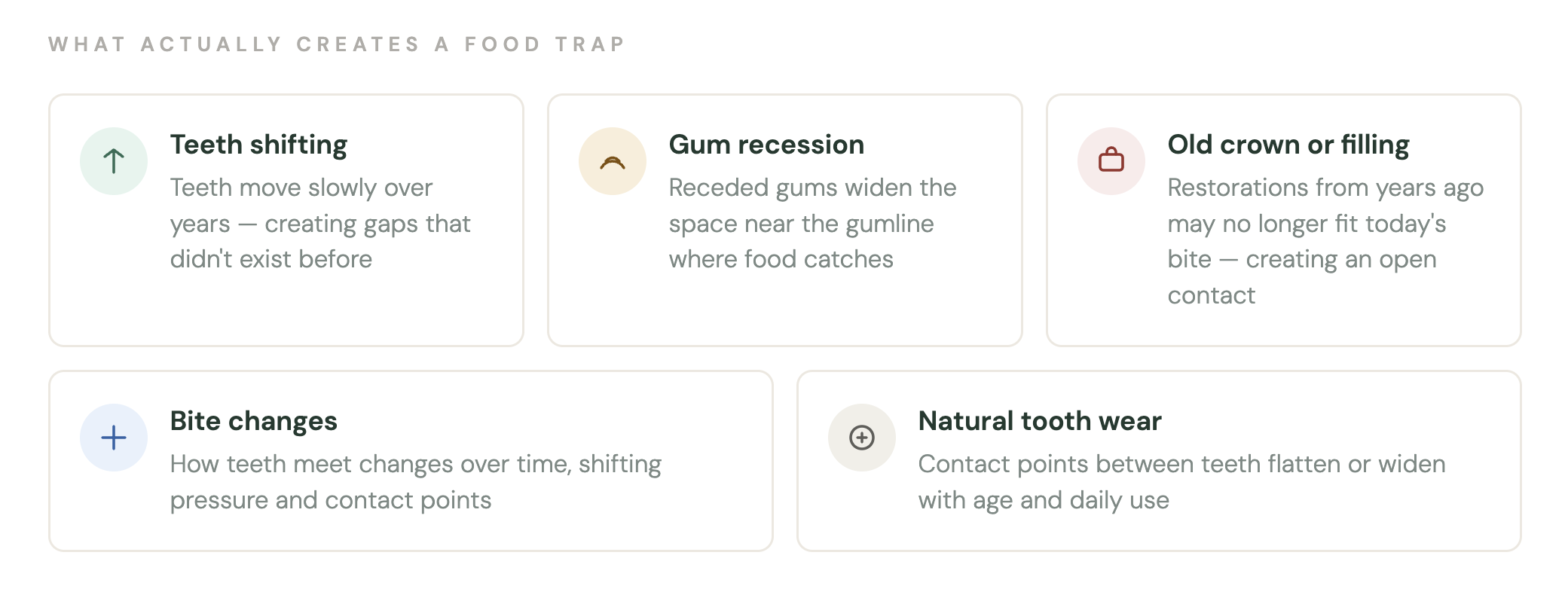
Several structural factors can cause food to reliably collect in a specific interproximal space (the area between two teeth):
Gradual tooth movement. Teeth are not fixed in place. They shift slowly throughout life in response to bite forces, changes in the surrounding bone and gum tissue, tooth loss elsewhere in the mouth, and other factors. Even small positional changes can create or enlarge gaps between teeth — gaps that become reliable food collection points. This isn't always visible to the naked eye, but it's detectable on examination and in X-rays.
Gum recession. As gum tissue gradually recedes — from age, from previous gum disease, from aggressive brushing — the shape of the space between teeth changes. The area near the gumline becomes wider and more exposed. Food, particularly fibrous or stringy food, catches in these newly enlarged spaces with much more regularity.
Restorations that no longer fit the bite. A crown, filling, or inlay placed five or ten years ago was made to fit your bite at that time. Bites change. The opposing tooth wears differently, adjacent teeth shift, the restoration itself may wear or settle slightly. When the contact between a restoration and its neighboring tooth is no longer tight — what dentists call an open contact — food passes through that gap with every bite. This is one of the most common structural causes of food trapping we see, and it's entirely fixable.
A crown or filling with an altered shape. Beyond fit, the actual contour of a restoration matters. A filling that's slightly overfilled or underfilled in a specific area, or a crown whose shape doesn't match the natural emergence profile of the tooth, can create ledges or gaps that food consistently catches on.
Natural tooth wear. Over time, the chewing surfaces of teeth wear down, and the contact points between neighboring teeth change shape. What were once tight, well-formed contacts can become wider or more irregular — leading to food impaction that didn't exist years ago.
Why This Is More Than Inconvenient
This is the part worth sitting with.
The areas where food consistently gets trapped are, by definition, areas that are harder to clean and that stay contaminated longer between cleaning attempts. That persistent food debris feeds bacteria, which produce acid. The result:
Interproximal cavities. Decay between teeth — often invisible until it's caught on an X-ray — is one of the most common findings in areas with chronic food impaction. The cavity forms in exactly the spot that's hardest to see and hardest to clean, which is also why it tends to progress further before it's detected.
Gum inflammation. Food debris caught near the gumline creates a sustained bacterial environment that drives gum inflammation. This can progress from simple gingivitis to localized periodontitis — bone loss around the affected tooth — if left unaddressed over time.
Accelerated wear. When food is repeatedly forced into a tight space by chewing, it can create lateral pressure on the teeth. Over time, this contributes to wear patterns that compound the original problem.
The path from "minor annoyance" to a cavity, a filling, or a periodontal intervention is shorter than most people expect when the underlying cause goes unaddressed.
What a Dental Evaluation Actually Looks For
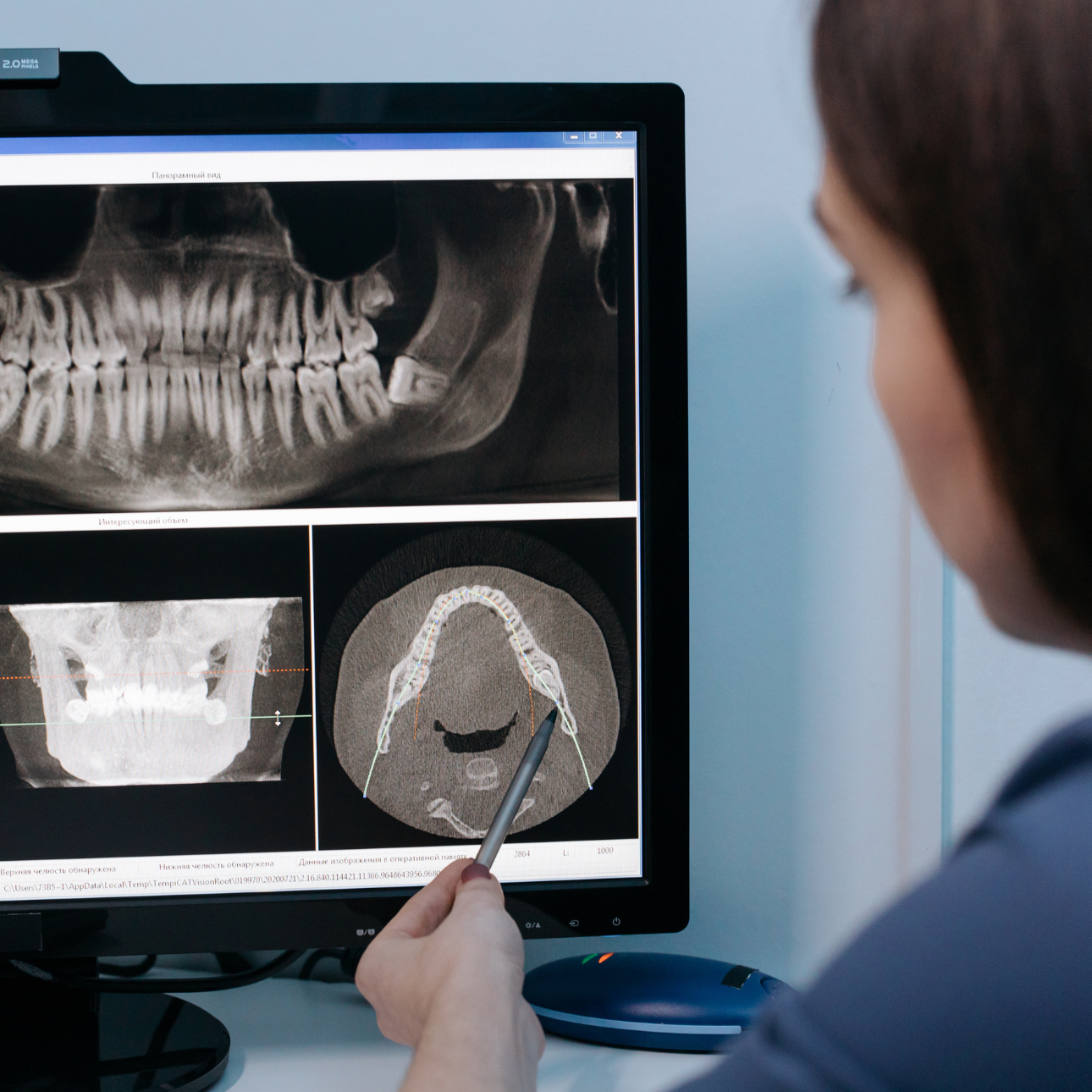
When a patient comes in describing chronic food trapping in a specific location, here's what we're assessing:
Contact tightness. We check the contact between adjacent teeth using dental floss and, in some cases, shimstock — a very thin film that shows us exactly how tight or open the contact is. An open contact is often immediately identifiable this way.
X-rays. Interproximal radiographs show us bone levels, the shape of the contacts between teeth, existing restorations, and any early decay that may be forming in the affected area. They also give us a baseline to compare against at future visits.
Bite analysis. We check how the upper and lower teeth come together in the affected area. An uneven bite can cause teeth to drift over time and change the contacts between them.
Restoration assessment. If there's a crown or filling near the affected area, we evaluate whether its margins, contour, and contact are still functioning correctly.
Gum pocket measurements. We measure the depth of the sulcus (the space between tooth and gum) to assess whether inflammation or early bone loss is already occurring at the food trap site.
This evaluation takes a few minutes and gives us a clear picture of whether the cause is structural, restorative, or bite-related — and what, specifically, needs to be addressed.
What Can Be Done
The good news: most causes of food trapping are straightforwardly addressable once the cause is identified.
Open contacts from shifting teeth can sometimes be addressed with minor bonding to reshape the contact point, or monitored with more frequent professional cleanings if the shift is minimal.
Ill-fitting restorations — crowns or fillings with open contacts — can be replaced. A new restoration made to the current bite closes the gap and eliminates the trap.
Gum recession creating enlarged embrasure spaces can be managed in several ways depending on severity: improved cleaning technique targeting those spaces, more frequent cleanings, or in some cases a soft tissue graft to restore coverage.
Bite imbalances contributing to tooth movement may warrant orthodontic evaluation, particularly if multiple areas are affected or if the overall bite has changed noticeably.
In many cases, the fix is simpler than patients expect. The longer the food trapping continues unaddressed, the more likely it is that a secondary problem — a cavity, gum inflammation — needs to be managed alongside the underlying cause.
Frequently Asked Questions
Can food getting stuck between teeth cause cavities? Yes — and this is one of the most direct pathways to interproximal decay. The bacteria that cause cavities feed on food debris, and areas where food consistently collects stay contaminated longer between cleanings. Catching this early, before a cavity forms, is significantly simpler than treating the cavity afterward.
If I floss every day, why does food still get stuck? Flossing removes food debris after it's lodged, but it doesn't change the structural reason it keeps getting caught. If food trapping is persistent and location-specific, flossing is managing the symptom rather than addressing the cause.
Is food getting stuck between teeth a sign of gum disease? Not necessarily — but it can be a contributing factor to it, or an early indicator that the gum architecture has changed. Gum recession creates larger interproximal spaces that trap food more readily. A clinical evaluation can tell you what's driving the issue.
My crown was done years ago and now food keeps getting stuck next to it. Is the crown the problem? Quite possibly. Restorations are made to fit the bite at the time they're placed. As the bite changes over years, the contact between a crown and its neighbor can open up. This is common, entirely fixable, and worth addressing before a cavity develops underneath the open margin.
How often should I have this checked? If you're noticing persistent food trapping in a specific location, that's worth bringing up at your next appointment rather than waiting for your next scheduled cleaning. It's a quick evaluation and the earlier we look, the more straightforward the options.

The Thing About "Minor Annoyances"
Food trapping is exactly the kind of thing people live with for years — because it doesn't hurt, it's easy to work around, and there always seems to be something more urgent to deal with.
But by the time it does hurt, there's usually already a cavity, or gum inflammation that's been quietly building in the background. The structural cause doesn't fix itself in the meantime.
If the same spot keeps bothering you, it's worth a quick look. Call us.
📍 State Avenue Dental Office — Kansas City, KS (KCK) 🗣 English • Korean • Spanish