

In over two decades of practice, certain conversations repeat themselves. One of the most common — and most telling — goes something like this:
"I kept putting it off. The kids needed their braces, my husband needed a crown, and I just... kept moving my name to the bottom of the list. I'm finally here."
It's said without complaint, usually with a small smile. And it's said by mothers, almost every time.
This post is for them. And for anyone who's been quietly waiting their turn.
What's Actually Happening While You Wait
A missing tooth feels like a gap — an absence. What most people don't realize is that it's also an active process.
The jawbone exists, in large part, because teeth give it a job to do. Every time you bite and chew, the pressure travels through the root into the bone, stimulating it to maintain its density and volume. When a tooth is lost, that stimulation stops. The bone no longer receives the signal to maintain itself, and it begins to resorb — to gradually shrink and flatten.
This isn't a slow, negligible process. Research suggests that up to 25% of bone width can be lost in the first year alone following tooth loss. By the third year, bone height begins to decline as well. The process continues indefinitely if nothing is done.
Here's why that matters for implants specifically: a dental implant requires sufficient bone volume to be placed safely and securely. When bone loss has progressed significantly, implant placement may require a bone graft — a separate procedure that adds cost, recovery time, and complexity to the process. In advanced cases, implants may not be immediately feasible at all.
The surrounding teeth don't wait either. Adjacent and opposing teeth begin to shift into the empty space, tilting and drifting in ways that can affect the bite, create new areas of uneven wear, and complicate any future restoration.
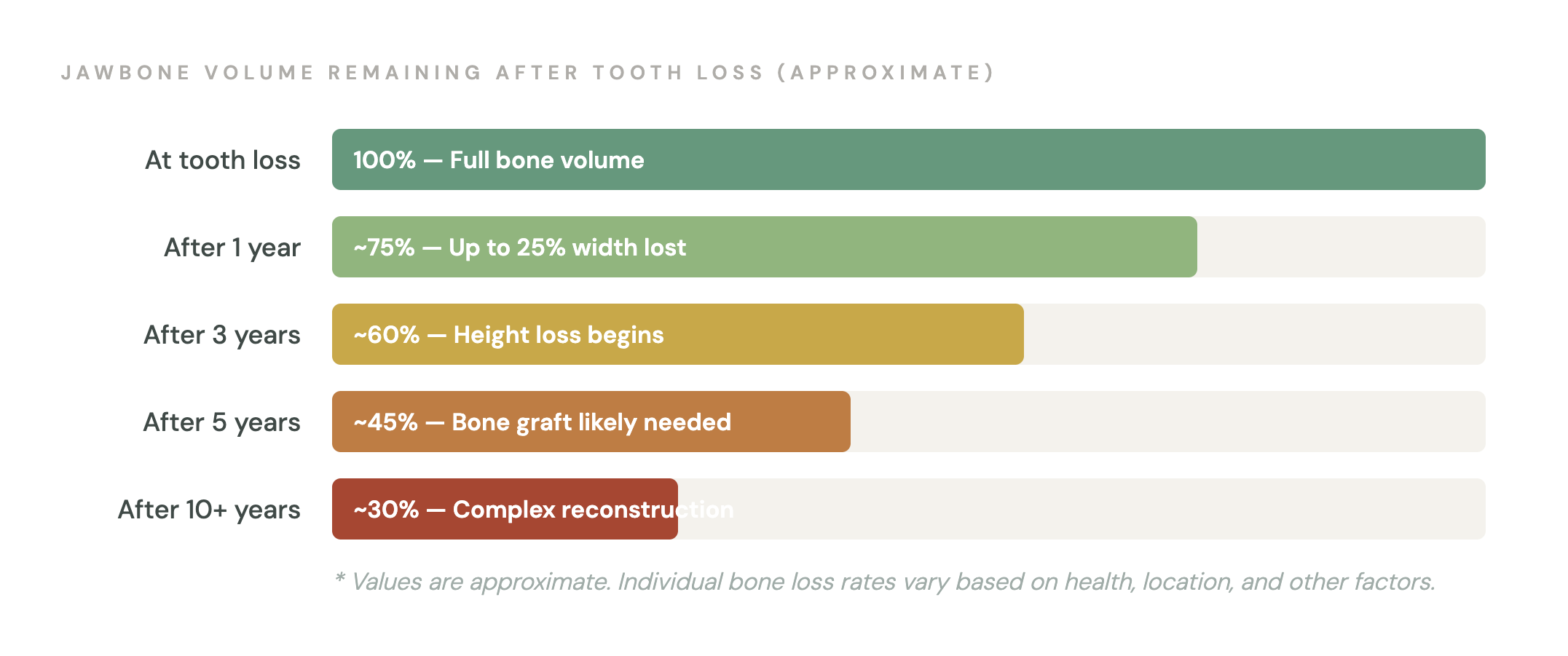
Time, in this context, is not neutral.
The Clinical Difference Between Early and Late
This is where the conversation moves from abstract to practical.
When implants are placed relatively soon after tooth loss — ideally within a few months, once the extraction site has healed — the bone is still at or near its original volume. Placement is more straightforward, the implant integrates more predictably, and the aesthetic result more closely resembles a natural tooth. The overall treatment arc is shorter, less involved, and generally less expensive.
When significant time has passed, the clinical picture changes. Bone loss requires assessment and sometimes correction before implant placement can proceed. The neighboring teeth may have shifted enough to require orthodontic evaluation. The entire treatment plan becomes more layered.
Neither situation is hopeless — implant dentistry has advanced significantly, and bone grafting is a routine procedure in experienced hands. But the difference between a straightforward implant case and a complex one is often measured in months, not years. And the variable that determines which side of that line a patient falls on is frequently timing.
Why Mothers, Specifically
There's a particular pattern we observe in practice that's worth naming directly.

Women — and mothers especially — tend to prioritize everyone else's dental care before their own. The kids' checkups, the husband's crown, the orthodontics, the emergency that came up. It's not negligence. It's the opposite: it's years of consistently putting family first, with the quiet assumption that personal health needs can wait a little longer.
The problem is that dental health, unlike many things, doesn't hold its position while you attend to everything else. The bone doesn't pause. The teeth don't stop shifting.
We see this play out regularly: a mother comes in for a consultation having lost a tooth two, three, or four years ago. The implant is still possible — often without any additional procedures. But sometimes it isn't, or the path to getting there has become meaningfully more involved than it would have been.
The framing we'd offer: getting an implant isn't a luxury you fit in when everything else is handled. It's a health decision with a time component, like most health decisions. And the version of it that's simplest and most effective is the version done sooner.
What Implants Actually Do — Beyond the Obvious
Most people understand that a dental implant replaces a missing tooth. Fewer understand the full picture of what that replacement accomplishes.
Bone preservation. An implant is the only tooth replacement that replicates the function of a natural root. The titanium post integrates with the jawbone and resumes the mechanical stimulation that prevents bone loss. A bridge or denture sits above the gum and does nothing to address the bone beneath it.
Facial structure. Bone loss beneath a missing tooth gradually changes the contour of the face — particularly in the lower third. Multiple missing teeth, or bone loss that extends over years, can produce a subtle but real change in facial appearance. Implants prevent this.
Chewing function. A properly integrated implant restores bite strength to near-natural levels. For patients who've been chewing around a missing tooth or managing with a partial denture, the difference in daily comfort is significant — easier, more varied eating, less compensatory strain on other teeth.
Adjacent tooth protection. By filling the space, an implant prevents the drift and tilting of neighboring teeth. This protects not just the implant site but the long-term stability of the surrounding dentition.
Longevity. With proper care, a well-placed implant can last decades — in many cases, a lifetime. The upfront investment is higher than alternatives, but the long-term cost-effectiveness is generally favorable compared to restorations that require replacement.
Addressing the Practical Concerns
"I'm worried about the cost." This is the most common reason people delay — and it's a legitimate concern. Implants are a significant investment. What's worth understanding is that delaying doesn't make the eventual cost lower; it often makes it higher, because additional procedures may become necessary. We work with financing options through CareCredit and Sunbit, and we'll give you a clear picture of what your specific case involves before any decisions are made.
"I'm nervous about the procedure." Implant placement is performed under local anesthesia and is generally well-tolerated. Most patients report that the procedure was far less uncomfortable than they anticipated. Post-procedure soreness typically resolves within a few days. If anxiety is a significant factor, that's a conversation worth having — we have options to make the experience more comfortable.
"I'm not sure if I'm a candidate." The only way to know is an evaluation. Many people who assume they've waited too long, or that their bone loss is too advanced, are still good candidates. Others need a straightforward preliminary procedure first. A cone-beam CT scan gives us a precise picture of the bone available, and we'll give you an honest assessment.
"My kids/husband need dental work first." Your turn doesn't have to wait until everyone else is done. Dental health isn't a finite resource that gets depleted if you use it. Getting your implant doesn't take anything away from anyone else's care.
Frequently Asked Questions
How soon after losing a tooth should I get an implant?
As soon as the extraction site has healed — typically 3 to 6 months after tooth loss. Immediate or early placement is sometimes possible depending on the case. The sooner an evaluation happens, the more options are available.
What happens to the bone if I wait?
Bone resorption begins almost immediately after tooth loss, with the most significant loss occurring in the first 12 months. The longer the wait, the more bone is lost — which can complicate or in some cases preclude implant placement without additional procedures.
Does getting an implant hurt?
The placement procedure is done under local anesthesia. Most patients describe post-procedure discomfort as mild and manageable with over-the-counter pain relief. Significant pain after implant placement is uncommon and worth reporting if it occurs.
How long does the whole process take?
From placement to final restoration, the typical timeline is 3 to 6 months. Cases requiring bone grafting take longer — often 9 to 12 months total. Early placement, when possible, shortens the overall timeline significantly.
Does insurance cover dental implants?
Coverage varies widely by plan. Some plans cover a portion of the implant procedure; others do not. We'll help you understand your specific coverage and work through the options that make sense financially.
Why We Do This

Two decades in Kansas City teaches you one thing pretty clearly: the patients who end up with the least dental work are usually just the ones who showed up before anything hurt, before anything broke, before the decision got made for them.
We've seen the other side too — people who came in when something finally forced them to. No judgment. But there's almost always a harder conversation to be had, and a more complicated path forward.
To the mothers specifically: you've spent years making sure everyone else is taken care of. Your dental health belongs on that list too — not at the bottom of it, and not after everyone else's needs are met. Getting this looked at now, while the options are simplest, is one of the most practical things you can do for yourself.
If you've been putting this off, give us a call. We'll tell you exactly where things stand and what the most straightforward path forward looks like.
📍 State Avenue Dental Office — Kansas City, KS (KCK) 🗣 English • Korean • Spanish