
Does My Kid Really Need a Mouthguard for Soccer?

It's a question that comes up every spring and fall, usually while a parent is standing in a sporting goods store aisle staring at a wall of brightly colored plastic: Does my kid actually need one of these? It's just soccer.
The honest answer is yes — and the reasoning is worth understanding, because it changes how you think about this from an optional accessory to a straightforward piece of protective equipment.
Soccer Is More Physical Than Most Parents Realize
The perception of soccer as a low-contact sport is understandable. No pads, no helmets, no intentional body-checking like you'd see in hockey or football. But the reality on the field is different from the impression.
Soccer involves:
Head-to-head and elbow-to-face contact during jumping and aerial play
Knee or foot contact with the face during tackles and falls
Ground contact from falls, slides, and collisions
Ball impact to the face at speeds that can reach 60–70 mph at competitive youth levels
Dental injuries in soccer are documented and not rare. Studies on youth sports dental trauma consistently rank soccer among the top sports for tooth injuries — often surprising parents who associated dental trauma primarily with hockey or football. Knocked-out teeth, crown fractures, root fractures, and luxation injuries (teeth pushed sideways or partially out of their sockets) all occur in soccer with meaningful frequency.
One collision at the wrong angle, one awkward fall — and you're in the car driving to the emergency dentist, working through the math of a dental implant years from now.
What a Mouthguard Actually Does
A mouthguard works by distributing and absorbing the force of an impact across a larger surface area, rather than concentrating it on a single tooth or group of teeth. It also creates a cushioning barrier between the upper and lower teeth, reducing the risk of the lower jaw slamming into the upper during a blow to the chin.
The protection isn't just for the teeth themselves. A well-fitted mouthguard also reduces the risk of:
Jaw fractures from direct impact
Lacerations to the lips, cheeks, and tongue — soft tissue injuries that are common when teeth without protection are driven into them
Concussions — emerging research suggests properly fitted mouthguards may help absorb some of the force transmitted to the skull during impact, though this remains an active area of study
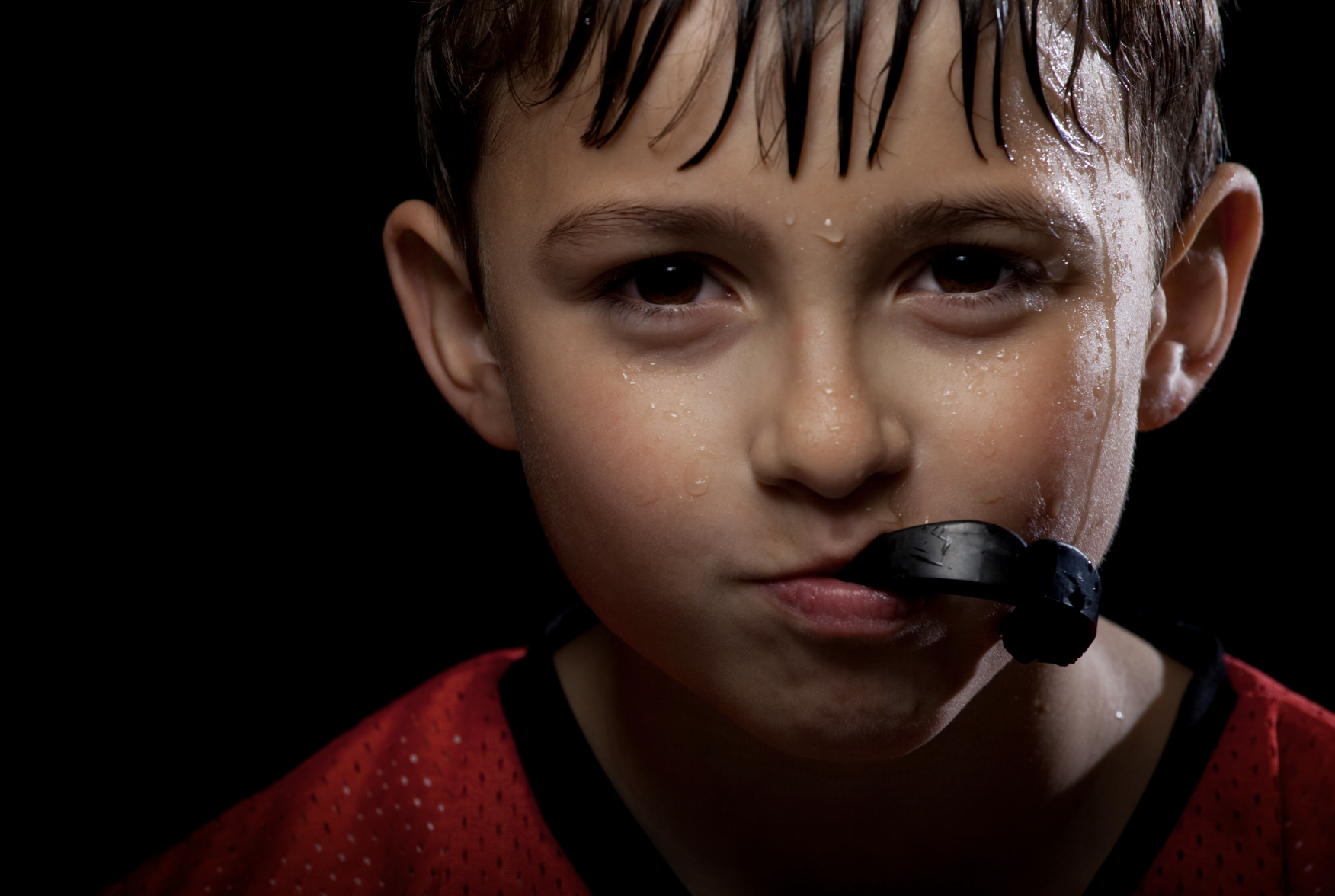
For a child, the stakes of dental trauma are particularly high. A knocked-out or severely fractured permanent tooth in a 10-year-old creates a dental challenge that will need to be managed for the next 70-plus years of that child's life.
Store-Bought vs. Custom: What's the Actual Difference?
This is where the conversation gets specific — and where it matters most.
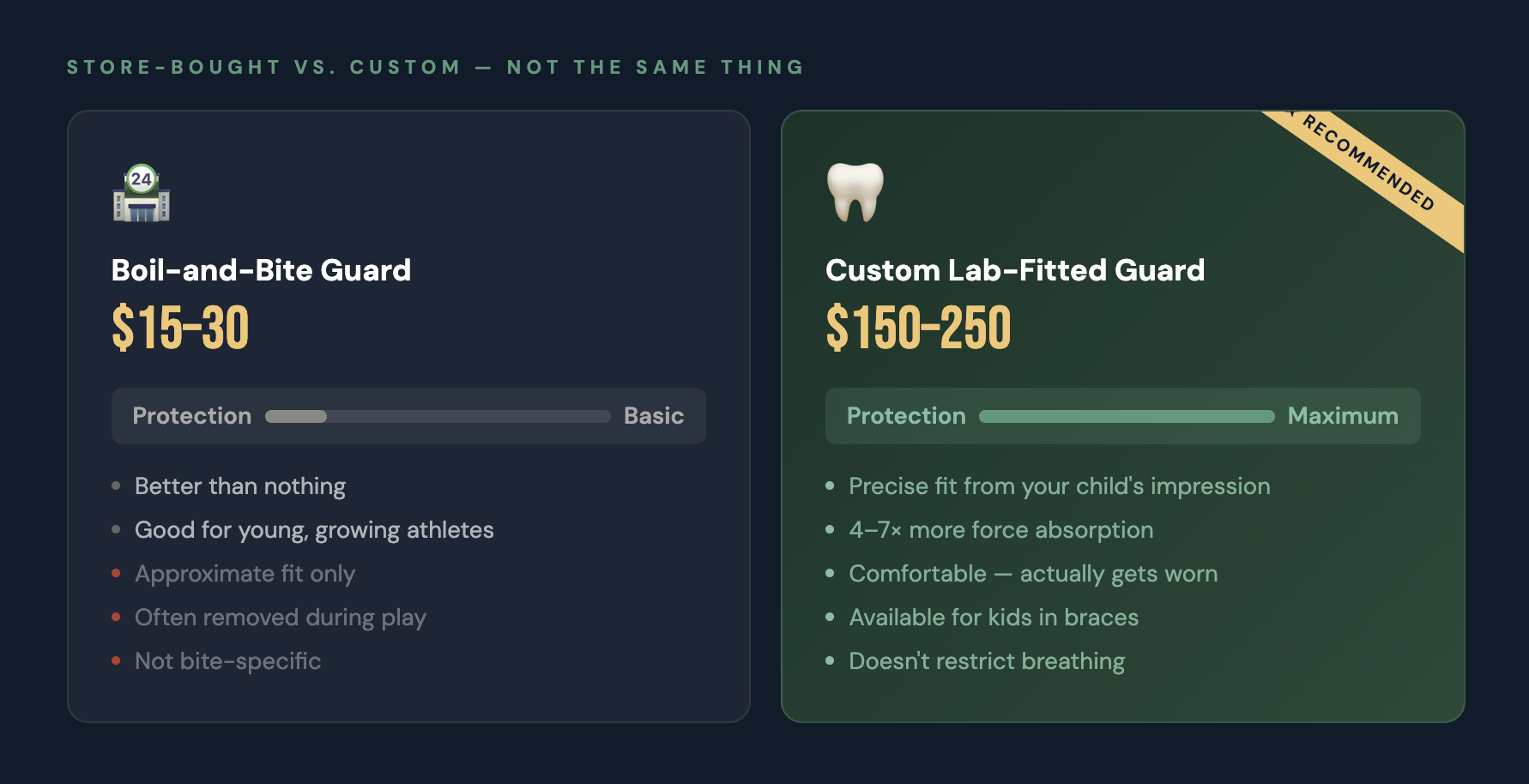
Boil-and-bite mouthguards (the standard sporting goods store option) work by softening in hot water and then being shaped to the teeth by biting down. They provide real protection compared to no guard at all, and they're inexpensive. For a child just starting a sport or one who is still growing and whose bite changes frequently, they're a reasonable starting point.
The limitations are meaningful, though:
Fit is approximate, not precise. A guard that doesn't fit well is one that gets removed during play because it's uncomfortable — which is the worst outcome.
Thickness is standardized rather than optimized. The protective cushioning isn't distributed based on where your child's specific high-risk contact points are.
They don't account for the bite. A guard that doesn't properly accommodate how the upper and lower teeth come together can interfere with breathing during high-intensity activity.
Custom mouthguards, fabricated from an impression of your child's teeth, address each of these limitations. The fit is precise to their specific dental anatomy. The material and thickness can be adjusted based on the sport and risk level. And because they're comfortable to wear, they actually get worn.
Research comparing the two consistently shows that custom guards provide significantly greater force absorption — typically measured as 4 to 7 times more protection in standardized impact testing.
Children in Orthodontic Treatment: A Higher-Risk Group
If your child is currently in braces or clear aligners, mouthguard use becomes even more important — and the type of guard matters more.
Orthodontic appliances change the risk profile in two significant ways:
Increased injury risk. Brackets and wires in the mouth create additional contact surfaces. An impact that might result in minor soft tissue bruising without braces can produce significant lacerations when there's metal hardware involved. The brackets themselves can be driven into the lips, cheeks, and gums.
Modified protective requirements. A standard mouthguard may not accommodate the altered bite geometry of teeth in active orthodontic movement. An orthodontic-specific guard — which is made to fit over brackets or is designed with the additional space brackets require — provides protection without interfering with treatment progress.
We can make a custom orthodontic mouthguard at a regular appointment, and we update it as the bite changes during treatment.
The Math That Changes the Conversation
Here's the way we put it to parents who are on the fence:
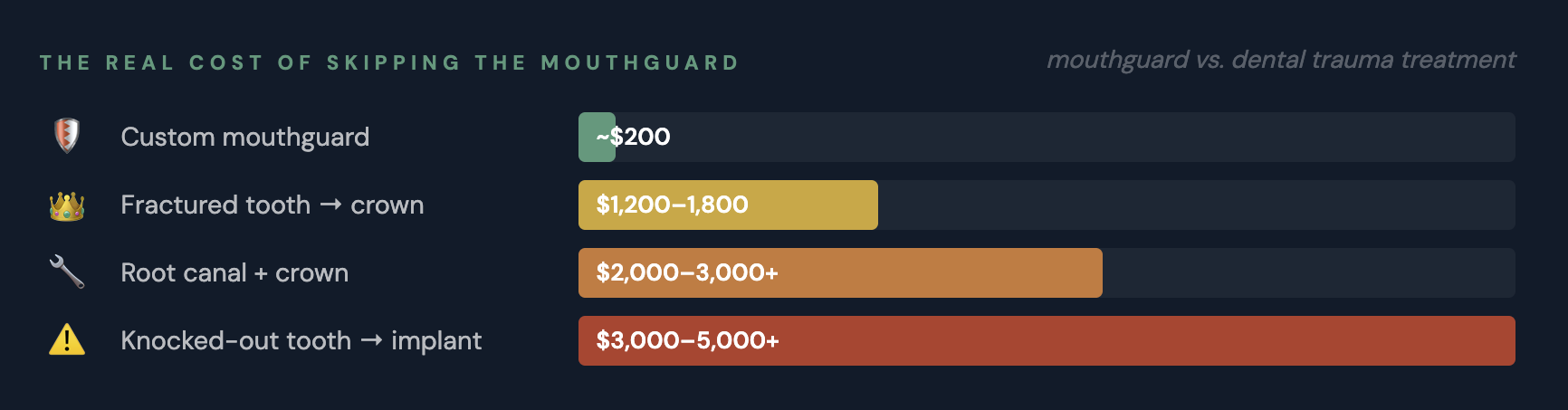
A custom mouthguard costs approximately $150–$250 and lasts one to two seasons with proper care.
A knocked-out permanent tooth, managed correctly from avulsion through reimplantation or implant placement, costs roughly $3,000–$5,000 over the course of treatment — and that's if everything goes smoothly.
A crown on a fractured tooth: $1,200–$1,800, potentially needing replacement every 15–20 years.
Root canal and crown on a tooth with pulp exposure from trauma: $2,000–$3,000+.
None of these figures account for the time, the appointments, the anxiety for the child, or the long-term management of a dental situation that follows them into adulthood.
One mouthguard is not going to prevent every possible outcome. But it changes the probability meaningfully — and the cost comparison makes it one of the more straightforward preventive investments in dental care.
Frequently Asked Questions
At what age should a child start wearing a mouthguard for soccer? As soon as permanent teeth start coming in — typically around age 6 or 7. Baby teeth matter too, but the urgency increases significantly once permanent teeth are present. There's no replacement for a permanent tooth that's lost before the child is old enough for an implant.
My child finds the mouthguard uncomfortable and won't wear it. What should I do? Fit is almost always the reason a mouthguard gets left in the bag. A store-bought guard that's been imprecisely shaped is uncomfortable; a custom guard that fits properly is not. If your child is refusing a store-bought guard, it's worth coming in for a custom one before assuming they won't wear any guard.
Does a mouthguard work for both upper and lower teeth? Upper mouthguards are standard because the upper front teeth are the most commonly injured teeth in sports. The guard also protects the lower teeth indirectly by creating a barrier that prevents them from slamming into the upper teeth on impact.
How do I care for a mouthguard? Rinse with cold water after each use, clean with a toothbrush and mild soap periodically, and store in the ventilated case it came with. Avoid hot water — it deforms the material. Replace it if it shows significant wear or if the bite changes noticeably.
Can we make a mouthguard at a regular appointment? Yes — it takes one impression and about a week for the lab to fabricate. Call ahead and we'll add it to your child's next visit.
The Thing About Practical Prevention
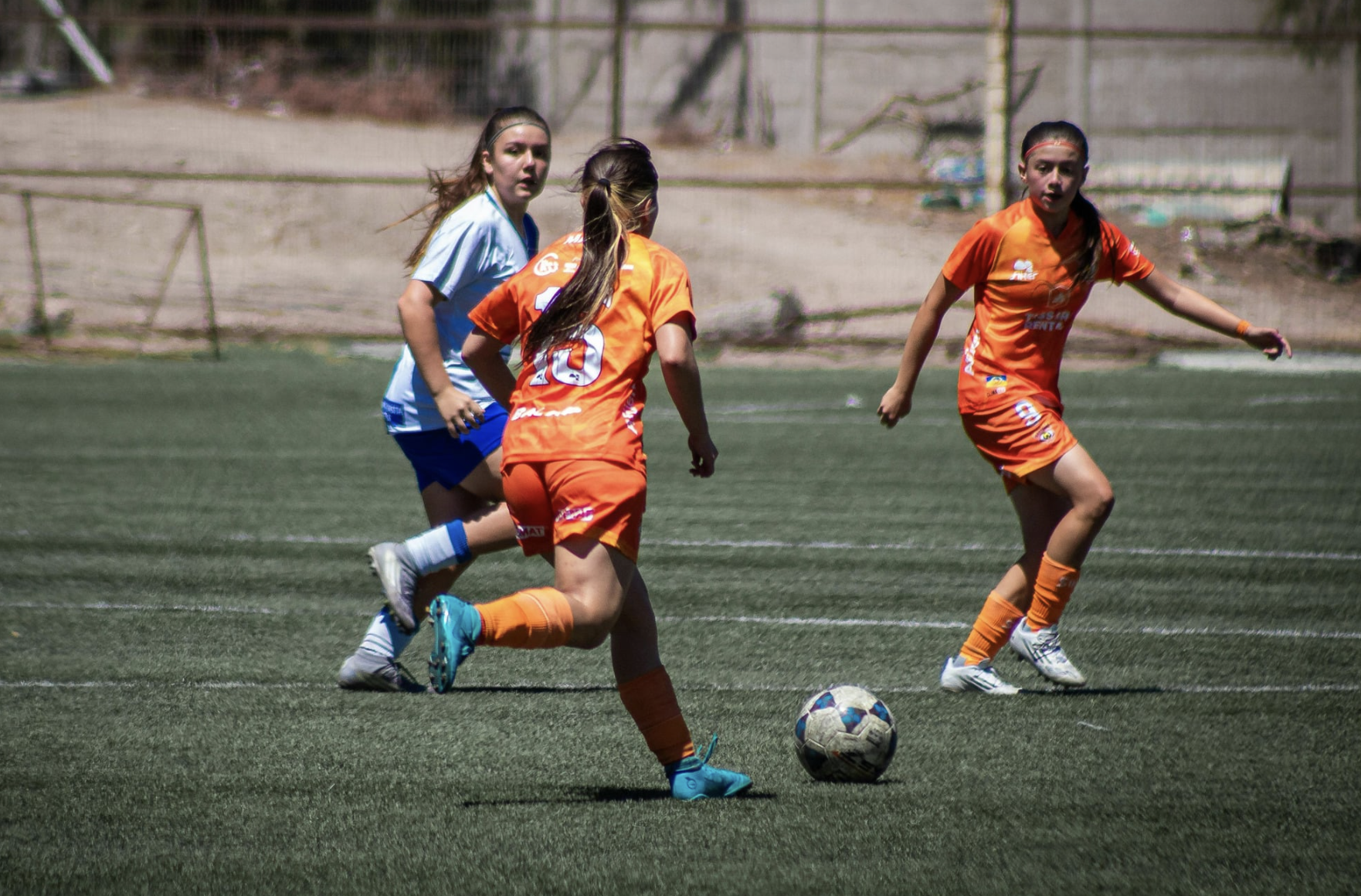
Mouthguards occupy an interesting space in parenting decisions — somewhere between "obviously necessary" (helmet on a bicycle) and "probably fine without it" (knee pads for a casual walk). Soccer sits closer to the first category than most parents initially assume.
This isn't about overprotection. It's about knowing the actual risk, understanding what prevents it, and making a straightforward decision based on that information. A custom mouthguard is a $200 decision that could prevent a $4,000 problem — and more importantly, protect a tooth that your child will need for the next several decades.
If your child plays soccer — or any sport with collision risk — give us a call. We'll take a quick look at their bite, talk through the options, and make something that actually fits.
📍 State Avenue Dental Office — Kansas City, KS (KCK) 🗣 English • Korean • Spanish