
Why You Should See a Dentist Before Your Vacation
Here's something that surprises people: emergency dental calls spike around vacation season. Not just from patients who ignored something obvious — often from people with good dental habits who had a small, quiet problem that waited until the absolute worst moment to announce itself.
A beach in Mexico. A family road trip through Colorado. The first night of a cruise. Somewhere far from home, unfamiliar with local providers, and with no good options for same-day care.
A pre-vacation dental checkup is one of the most practical, under-utilized things you can do before a trip. Here's why.
The Vacation Effect: Why Problems Surface When They Do
The timing isn't random. Several things converge around travel that reliably push borderline dental problems over the edge.
Fatigue and immune suppression. The weeks before a significant trip are often the most exhausting of the year — work deadlines cleared, logistics managed, packing done, kids prepared. Sleep suffers. Stress accumulates. The immune system, which plays a meaningful role in containing low-grade oral infections and periodontal inflammation, is running at reduced capacity. A small abscess or gingival infection that the body was quietly managing becomes symptomatic.
Dietary changes. Travel eating is real. More sugar, more alcohol, more frequent snacking, more acidic foods and drinks — airport food, celebratory meals, vacation indulgences. The oral microbiome shifts toward a more inflammatory state, and teeth that were hanging at the edge of sensitivity or decay cross the threshold into actual pain.
Dehydration. Flying, higher activity levels, and disrupted routines reduce hydration. Saliva production drops with dehydration, removing the mouth's primary acid buffer and bacterial defense. Dry mouth during travel is common and meaningfully increases the risk of both sensitivity and infection.
Disrupted routine. Brushing at irregular hours, forgetting floss, sleeping in unfamiliar positions — small disruptions in oral hygiene routine compound over a week of travel in ways they wouldn't over a week at home.
The Airplane Factor: What Actually Happens to Your Teeth at Altitude
This is the part most patients haven't heard about — and it's genuinely important for anyone who has any existing dental work or known issues.
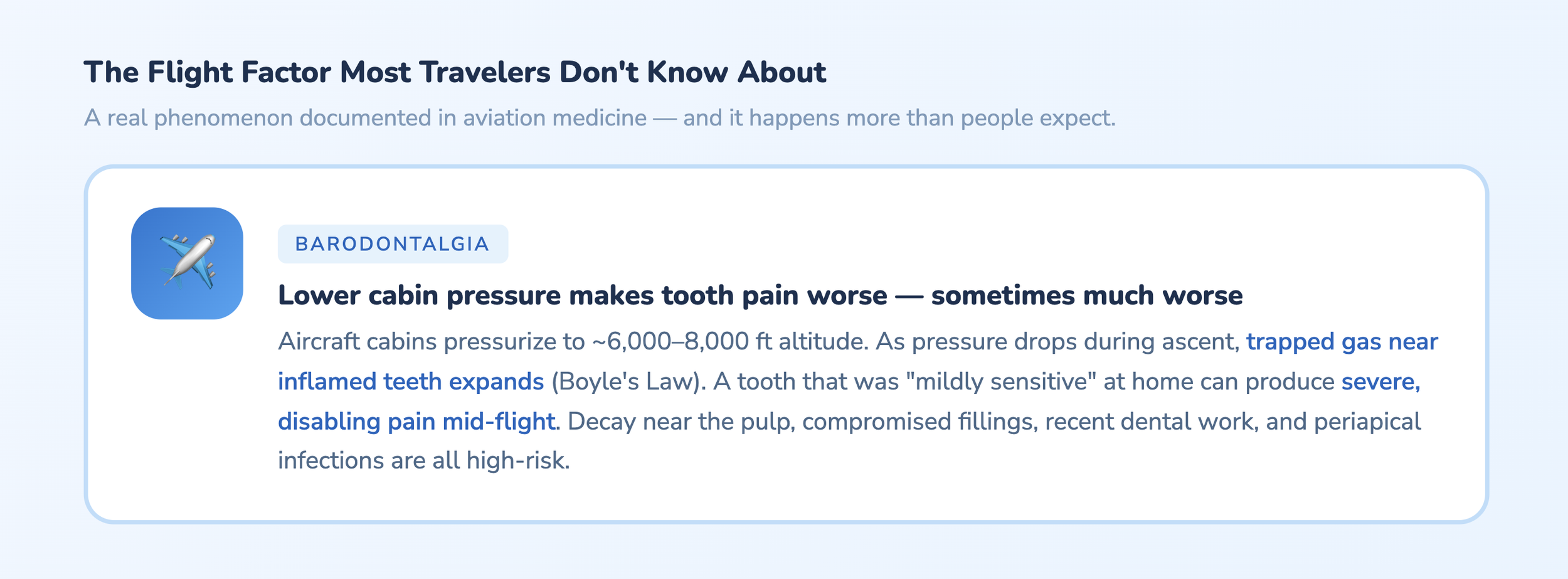
Commercial aircraft cabins are pressurized to approximately 6,000–8,000 feet of equivalent altitude, not sea level. This means cabin pressure is meaningfully lower than at ground level, and the air inside the cabin contains less oxygen. These pressure changes have a specific effect on dental health that's well-documented in aviation medicine under the term barodontalgia — tooth pain caused by atmospheric pressure change.
Here's the mechanism: enclosed spaces within or around teeth — including pulp chambers with inflammation, small pockets of decay, incompletely sealed restorations, and periapical abscesses — contain trapped gas. As cabin pressure decreases during ascent, that gas expands according to Boyle's Law. The expansion creates pressure within an enclosed space that has limited ability to accommodate it. The result is pain — sometimes mild, sometimes severe, sometimes incapacitating.
Who is most at risk:
Patients with any active or recent pulpal inflammation (including recent fillings, crown work, or root canals that are still healing)
Teeth with small amounts of decay that haven't yet produced significant symptoms
Partially treated or delayed treatment situations — teeth that "need work but aren't bothering me yet"
Existing restorations with compromised margins that may be trapping small amounts of gas
Recent extractions with incompletely healed sockets
The practical implication is significant: a tooth that's been mildly sensitive for weeks, dismissed as "not that bad," can produce severe pain during a four-hour flight. The time to catch that tooth is before the trip, not at 35,000 feet over the Gulf of Mexico.
What Can Go Wrong During Travel — The Clinical Picture
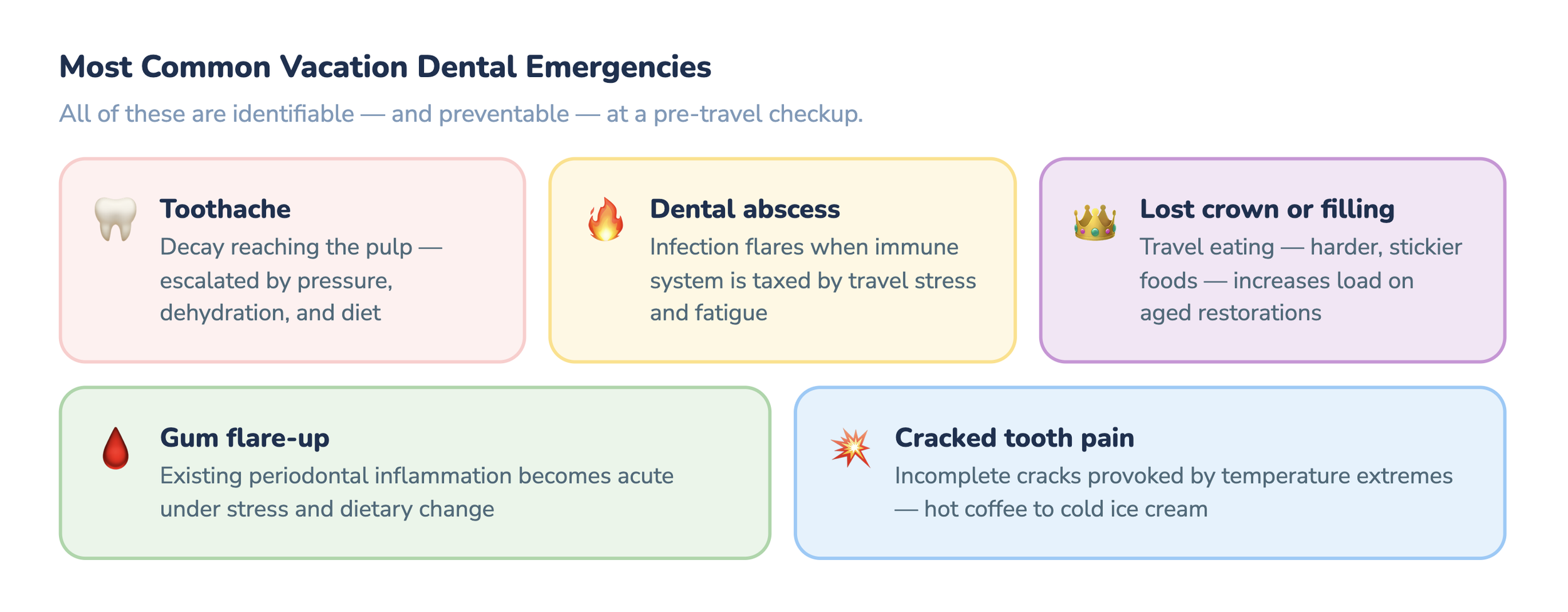
Toothache from existing decay or pulpal inflammation
This is the most common dental emergency during travel. Decay that has reached or is approaching the pulp causes pain that escalates under conditions of dehydration, dietary change, and pressure variation. Pain management options while traveling are limited — over-the-counter analgesics provide partial relief at best, and the underlying problem doesn't resolve without treatment.
Dental abscess
An abscess — a localized bacterial infection producing a pocket of pus — can develop rapidly when immune function is compromised by travel stress and fatigue. Dental abscesses cause significant pain, swelling, and in some cases fever. They require antibiotics and dental drainage, neither of which is easily obtained at an international resort or a small-town urgent care. Left untreated, a dental abscess is not just painful — it carries a small but real risk of serious complication.
Lost or broken restoration
Fillings and crowns can fail under normal circumstances. Travel eating — harder foods, more sticky foods, temperature extremes from ice cream to hot coffee — increases the load. A crown that dislodges during dinner on the first night of a trip is a two-week inconvenience that could have been a 30-minute appointment.
Gum flare-up (periodontal flare)
Patients with existing periodontal disease or gingival inflammation are susceptible to acute flares under stress. Swollen, painful gum tissue that was manageable at home can become significantly symptomatic during travel.
Cracked tooth symptoms
Cracked teeth — especially those with incomplete cracks that haven't yet been protected with a crown — can go from intermittent sensitivity to acute pain under the conditions of travel. Temperature extremes are particularly provocative.
What a Pre-Vacation Checkup Actually Covers
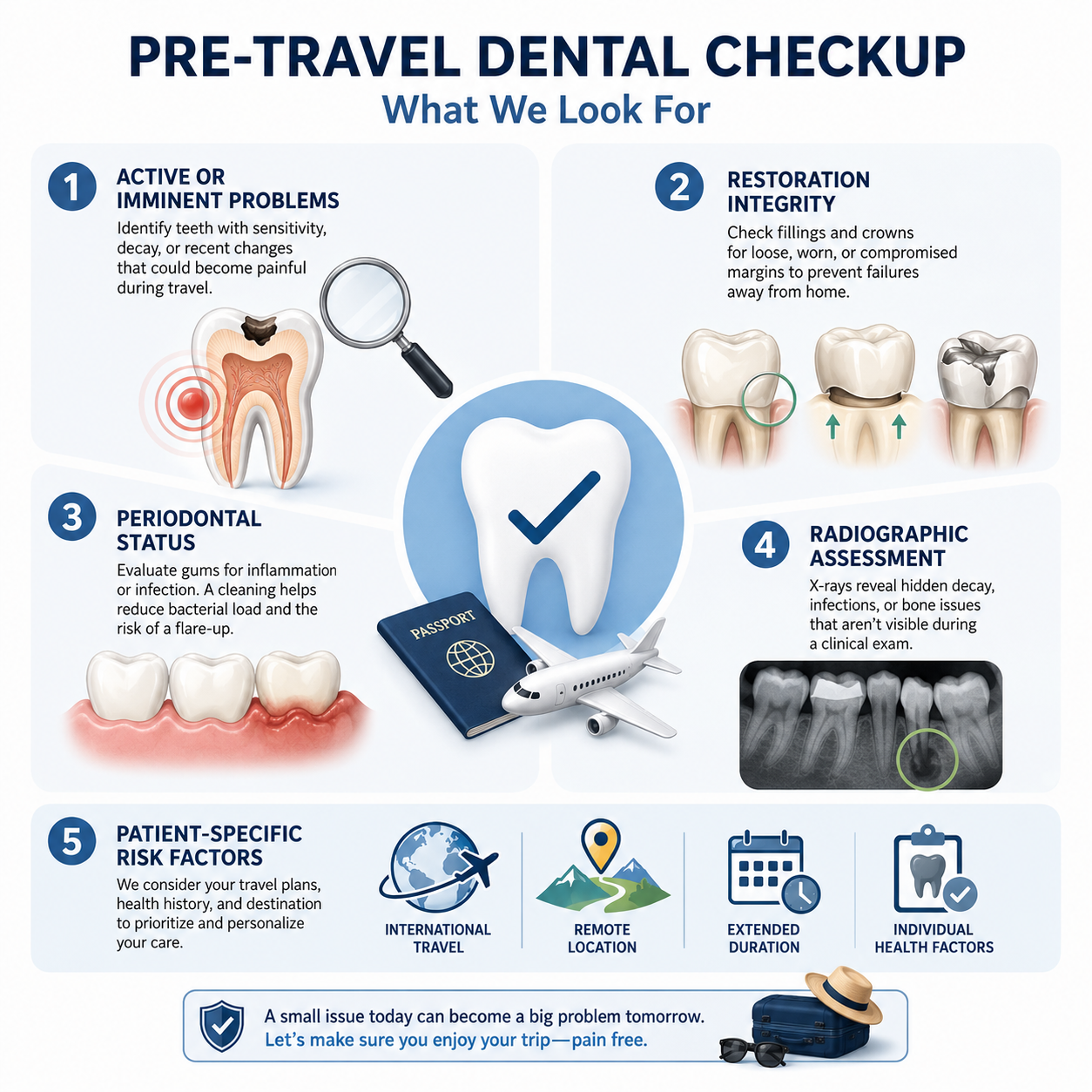
A focused pre-travel dental evaluation doesn't need to be a full comprehensive exam. What we're looking for specifically:
Active or imminent problems. Any tooth with current sensitivity, known decay, or a recent change in symptoms gets assessed clinically and radiographically. The goal is to identify anything with a meaningful probability of becoming symptomatic under travel conditions.
Restoration integrity. Existing fillings and crowns are examined for compromised margins, wear, or looseness. A crown that's slightly loose at a checkup is easily re-cemented. A crown that comes off in Tokyo is a significant problem.
Periodontal status. Any active gum inflammation is noted. Patients with known periodontal disease benefit from a cleaning before travel to reduce bacterial load and the risk of a flare.
Radiographic assessment. Bitewing X-rays catch interproximal decay and periapical pathology that isn't visible on clinical examination. A small periapical abscess that produces no symptoms at ground level may produce significant pain in a pressurized cabin.
Patient-specific risk factors. If you're flying internationally, going to a remote location, or traveling for an extended period, we factor that into our recommendations. A small issue that we'd normally monitor for a couple of months looks different if you're going to be out of the country for three weeks.
The Practical Reality of Dental Emergencies While Traveling
People underestimate how difficult dental care is to access during travel until they need it.
Domestically, finding same-day care in an unfamiliar city is possible but rarely smooth. Most practices prioritize established patients. Urgent care centers and emergency rooms can provide pain management but not dental treatment. Dental urgent care centers exist in larger cities but aren't universal.
Internationally, the challenges compound significantly. Language barriers, unfamiliar infection control standards, difficulty verifying provider credentials, and costs not covered by US insurance all add friction to an already stressful situation. Travel insurance sometimes covers dental emergencies, but with significant limitations and reimbursement delays.
The dental tourism paradox: the same patients who carefully research international dental care when planning elective treatment are completely unprepared for an emergency dental situation when it arises unexpectedly mid-trip.
The simplest solution is the one that doesn't require any of this: address what's findable before you leave.
Frequently Asked Questions
Why do my teeth hurt on airplanes? Reduced cabin pressure causes trapped gas in enclosed spaces within or near teeth to expand. This is called barodontalgia. Teeth with active inflammation, decay near the pulp, compromised restorations, or recent dental work are most susceptible.
How far in advance of travel should I see a dentist? Ideally two to four weeks before departure. This allows time for any treatment that's needed — a filling, a crown re-cement, a cleaning — to be completed and healed before you leave. A checkup the day before a trip is better than nothing but limits what can be addressed.
Can I get emergency dental care abroad? Yes, but it's significantly more complicated than at home. Major international cities have English-speaking dental providers; rural areas and smaller resorts often don't. Costs vary enormously. Travel insurance may cover some expenses but with limitations. The better answer is not needing it.
What if I have a dental emergency mid-trip? For pain management: ibuprofen is generally the most effective over-the-counter option for dental pain. Dental emergency kits with temporary filling material (available at pharmacies) can stabilize a lost filling or crown temporarily. For anything involving swelling, fever, or severe pain, seek care rather than self-managing — dental infections can progress.
Is a pre-travel checkup covered by insurance? Most dental insurance plans cover two cleanings and exams per year. A pre-travel checkup is simply using one of those visits strategically. If you've already used both, a focused examination without cleaning is typically a lower-cost out-of-pocket option.
The Thing About Timing
Every dentist has a version of the same story: a patient they wish they'd seen two weeks earlier. The emergency call from an airport. The text from a cruise ship. The parent whose kid needed a root canal on the third day of a family vacation.

None of those situations were inevitable. Almost all of them had a moment weeks before where a checkup would have caught something addressable.
If you have travel coming up — this summer, over the holidays, any trip that matters — give us a call before you go. It's one appointment, and it's the kind of preparation that pays off in ways you never have to think about.
📍 State Avenue Dental Office — Kansas City, KS (KCK) 🗣 English • Korean • Spanish