
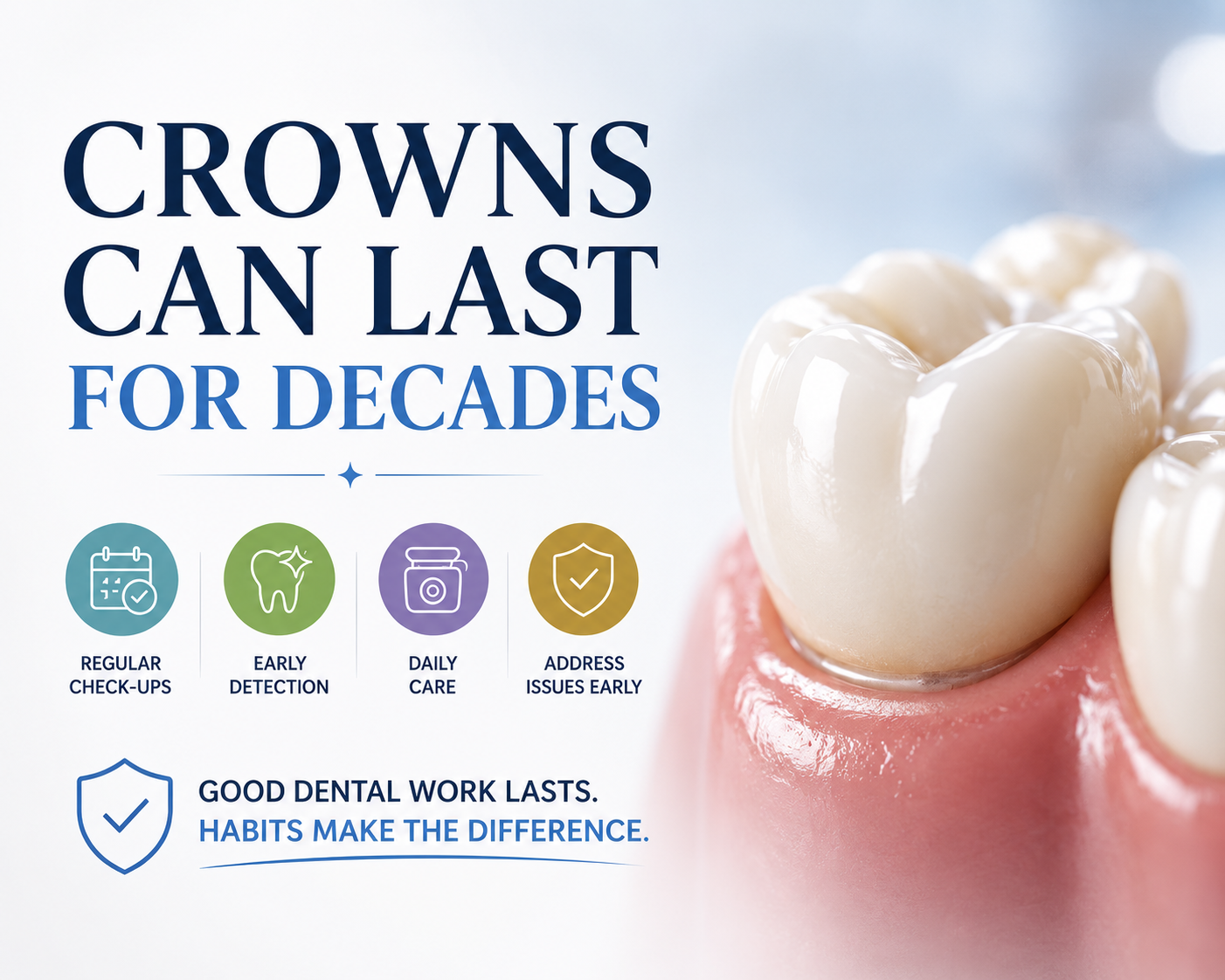
A crown is one of the more significant investments in dental care. Most patients treat it accordingly — they're careful with it immediately after placement, avoid the foods they were told to avoid, and generally take it seriously. And then, a few years in, it becomes just another tooth. The habits relax. The follow-up appointments get postponed.
Here's the thing: a well-made crown, placed correctly, has the potential to last 15 to 25 years or more. But that potential is realized by a fraction of patients — the ones who maintain consistent habits and catch small changes early. The rest replace their crowns in 7 to 10 years, or sooner, often not entirely understanding why.
The difference is almost never the quality of the crown. It's almost always what happens to it afterward.
Why Crowns Don't Last Forever — The Biology Underneath
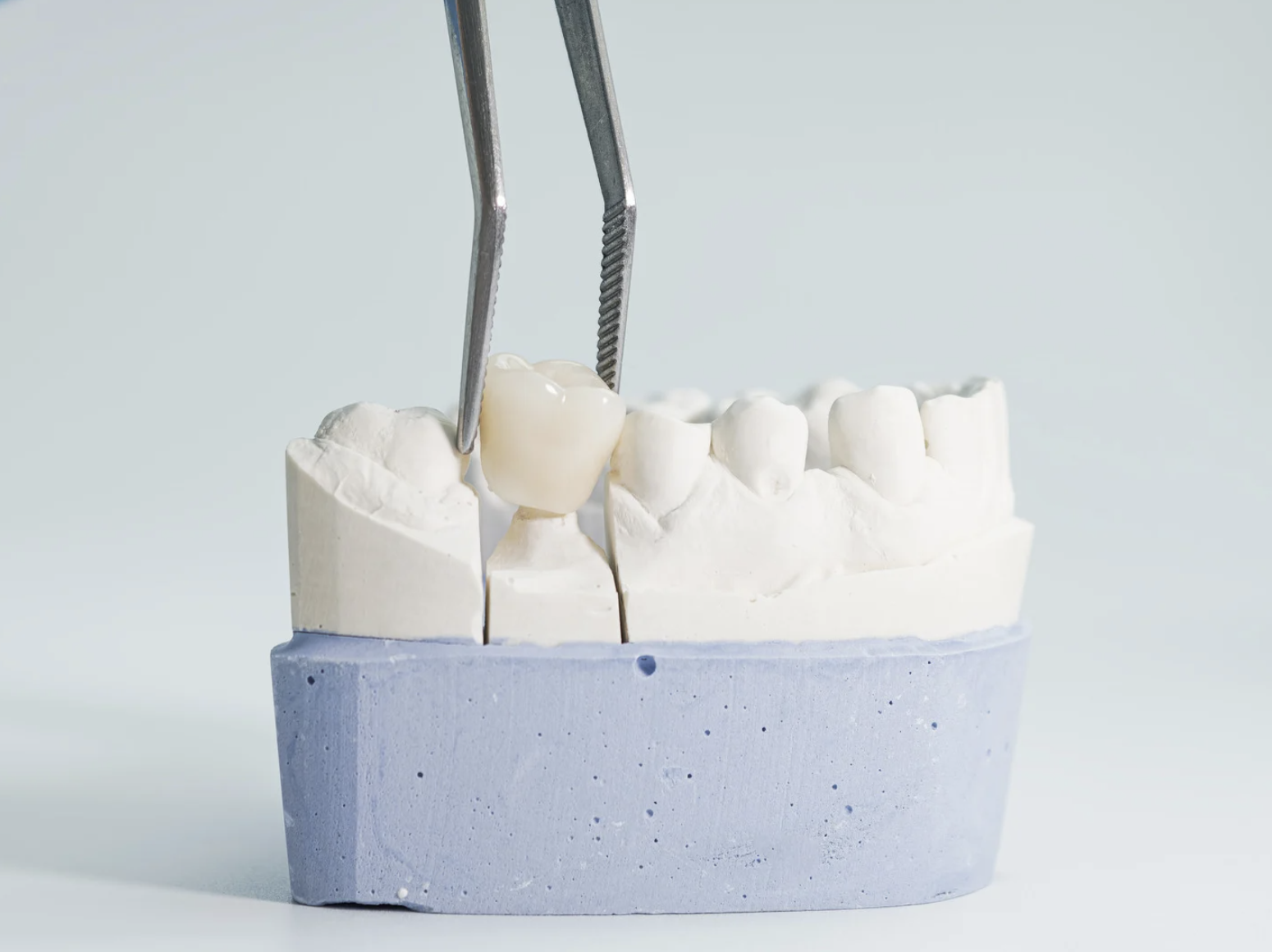
The most important thing to understand about a dental crown is that the crown itself is inert. The porcelain or ceramic or metal doesn't decay, doesn't change, doesn't age in the way biological tissue does.
What does change — continuously, throughout the life of the restoration — is everything around it.
The tooth underneath. The natural tooth structure beneath the crown is alive. It's subject to the same biological processes as any other tooth — bacterial penetration at the margin, pulpal changes in response to bite forces, and most critically, recurrent decay. Decay that develops underneath an existing crown is one of the most common reasons crowns fail before their time, and it's almost entirely preventable with proper marginal hygiene.
The gum tissue at the margin. The margin — the junction between the crown and the natural tooth at the gumline — is the most vulnerable point of any crown restoration. It's where bacteria accumulate, where the fit must be maintained over years of gingival change, and where recurrent decay begins if the area is inadequately cleaned. As gum tissue naturally recedes with age, the margin that was once at the gumline becomes more exposed and more susceptible.
The bone and periodontal support. The crown sits on a tooth that's supported by bone and periodontal ligament. Bone loss from periodontal disease doesn't affect the crown directly — but it affects the tooth the crown depends on. A crown on a tooth with significant bone loss is a crown on an unstable foundation.
The opposing and adjacent teeth. How the crown interacts with the teeth it touches — both the opposing tooth it bites against and the adjacent teeth it contacts — changes over time. Teeth shift. The opposing tooth wears. The bite evolves. A crown that was perfectly adjusted at placement may develop occlusal issues years later that accelerate wear or create stress fractures.
The Habits That Shorten Crown Lifespan
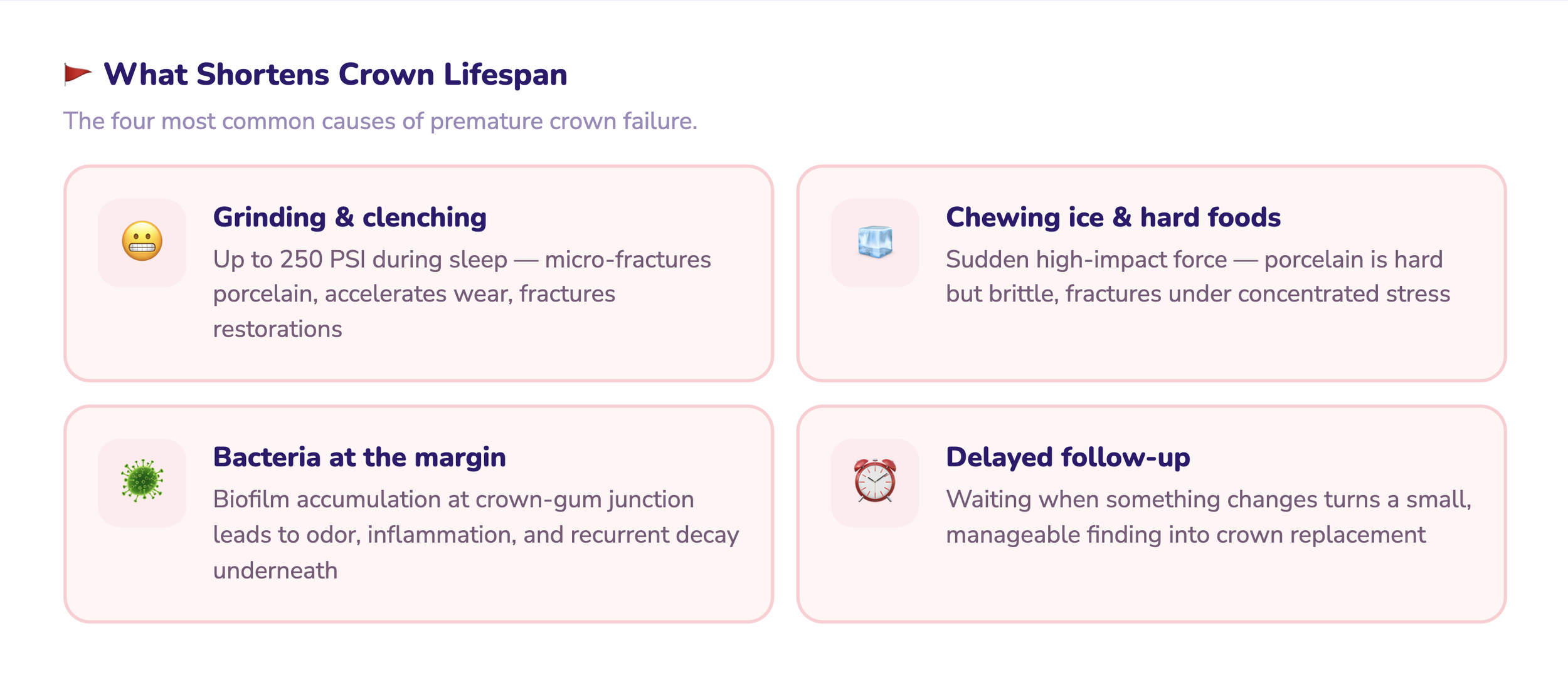
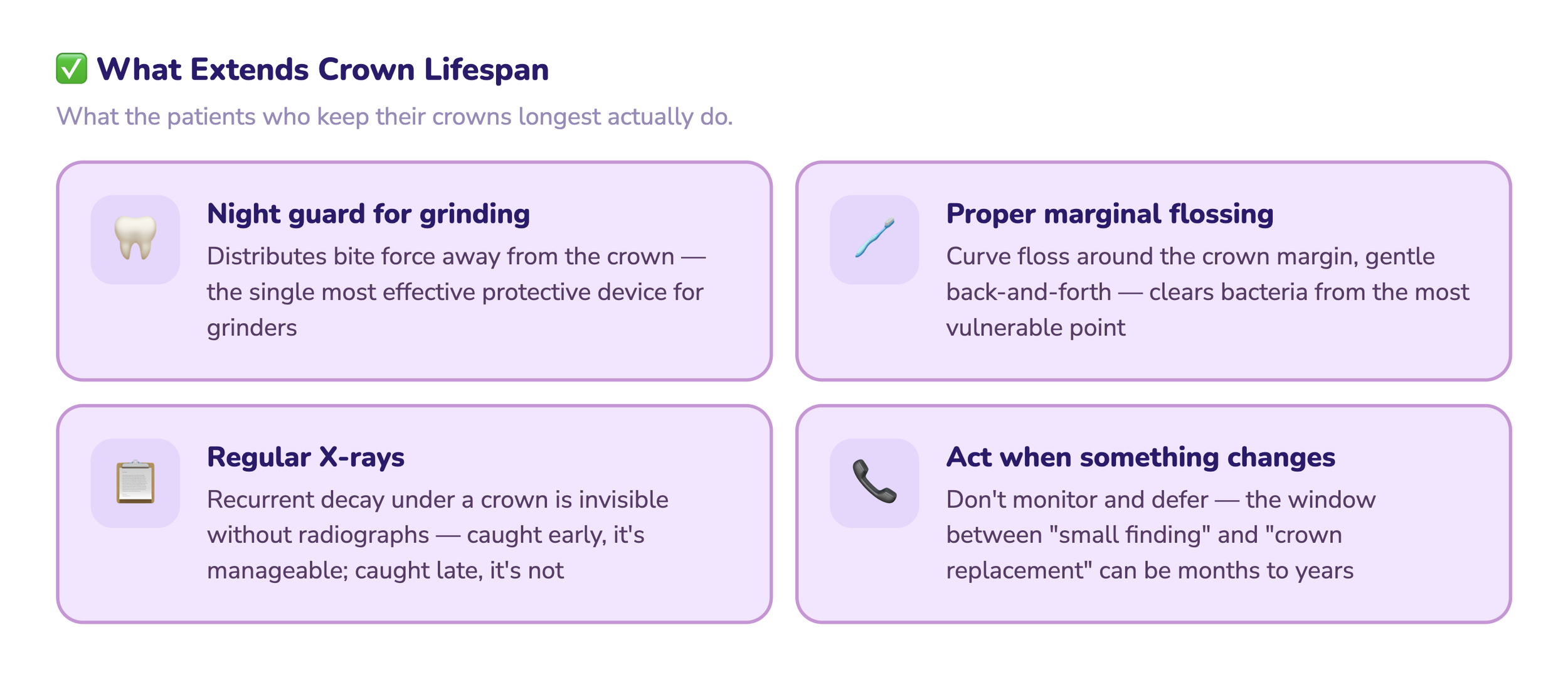
Grinding and clenching (bruxism) This is the single most common mechanical cause of premature crown failure. The forces generated during sleep grinding — up to 250 pounds per square inch, as we've discussed — are applied directly to the crown during the hours when it has no protective reserve of conscious muscle control. Over months and years, these forces produce micro-fractures in the porcelain, wear on the occlusal surface, and in some cases, complete fracture of the restoration.
Patients who grind and don't protect their crowns with a night guard are paying a predictable toll. The crown that cost $1,500 becomes a $1,500 restoration with a seven-year lifespan instead of a twenty-year one.
Chewing ice, hard candies, and hard nuts This is mechanical trauma applied directly to the crown surface. Porcelain, while very hard, is also brittle — it's vulnerable to the same fracture mechanism as glass under sudden impact. The forces involved in cracking a piece of ice or biting through a hard candy shell are disproportionate to what enamel can resist, and they apply sudden, concentrated stress that porcelain handles poorly.
This isn't about avoiding all hard foods. It's about eliminating the habits that create sudden, high-intensity impact on the restoration — ice-chewing being the clearest example.
Inadequate marginal cleaning The margin of a crown is the most difficult area of the mouth to clean thoroughly — the junction between the crown and the tooth sits at or below the gumline, and it requires specific technique to address. Patients who brush thoroughly but don't floss correctly around crown margins accumulate bacterial biofilm in exactly the spot that leads to both gingival inflammation and recurrent decay.
The technique for cleaning crown margins is simple: floss down to the margin, curve the floss around the crown, and use a gentle back-and-forth motion rather than a snapping motion that can damage the gum tissue at the margin.
Delaying follow-up when something changes This is the habit difference that separates the patients who keep crowns for 20+ years from the ones who replace them in 7. When something changes — a different feeling when biting, a faint odor, food that starts catching near the crown, sensitivity that wasn't there before — it gets addressed immediately rather than monitored and deferred.
Most of the reasons crowns fail prematurely are identifiable in their early stages. Recurrent decay under a margin is a small radiolucency on an X-ray before it's a visible problem. A crack in the porcelain is a clinical finding before it's a complete fracture. A loose crown is an adjustable situation before the tooth underneath has been compromised.
The window between "small finding" and "crown replacement" can be months to years. The patients who act in that window keep their restorations. The ones who don't, don't.
What Recurrent Decay Under a Crown Actually Looks Like
This is worth explaining in some detail, because it's so commonly misunderstood.
When decay develops under an existing crown, the patient often has no idea until it's significant. The crown masks the visible signs of decay. There's usually no sensitivity in the early stages because the decay is working through already-damaged or previously treated dentin rather than through intact tooth structure with active nerve response.
By the time symptoms develop — sensitivity, pressure discomfort, or a change in how the crown feels — the decay is often advanced enough that the crown needs to be removed, the decay excavated, and a decision made about whether the remaining tooth structure is sufficient to support a new crown or whether more extensive treatment is needed.
What catches recurrent decay early is bitewing X-rays at regular intervals — specifically, the ability to see a small radiolucent shadow at the margin before it progresses. This is one of the most concrete clinical reasons why annual or biennial X-rays for patients with existing restorations aren't a formality. They're how we find the finding that's still manageable.
The Warning Signs a Crown Is Sending You
Biting feels different. A change in how a crown feels under biting pressure — sensitivity, discomfort, or just a different tactile sensation — is the most reliable early signal. It can indicate occlusal change (the bite has shifted), a crack developing in the crown, or pulpal changes in the tooth underneath.
A faint odor. Bacterial accumulation at the crown margin, or early recurrent decay, can produce a localized odor that the patient notices. This is easy to dismiss — it's tempting to attribute it to general oral hygiene — but when it's persistent and localized to a specific crown, it warrants evaluation.
Food keeps catching in the same spot. A crown margin that's beginning to open, or gum recession that's created new space around the restoration, can create a reliable food trap near the crown. As we've discussed in previous posts, location-specific food trapping almost always has a structural explanation.
Sensitivity to temperature. New or changed thermal sensitivity near a crown indicates pulpal involvement — either the tooth is reacting to a change in the restoration or to secondary decay providing a pathway for thermal transmission. This symptom warrants evaluation rather than a switch to sensitive toothpaste.
Visible chip or crack. Even a small chip in the porcelain changes the mechanical behavior of the entire restoration. Chips concentrate stress at their edges and can propagate under bite forces. A chipped crown evaluated early is often repairable; one ignored often fractures further.
What the Checkup Actually Assesses
When we evaluate an existing crown at a routine appointment, here's what we're specifically looking at:
Marginal integrity. Using an explorer and visual examination, we assess whether the margin between crown and tooth is still sealed, whether there's any visible gap or ledge, and whether there are signs of beginning decay.
Radiographic assessment. Bitewing X-rays show us what's happening at and below the margins — recurrent decay, changes in bone level, and periapical status of the tooth underneath.
Occlusal contact. We check how the crown is hitting in the bite and whether contact has shifted since the last visit. Bite imbalances that develop over time accelerate crown wear and increase fracture risk.
Periodontal assessment at the margin. Pocket depth measurements around the crown tell us whether gingival inflammation is present, whether recession has changed the margin exposure, and whether bacterial accumulation has created a periodontal pocket at the restoration margin.
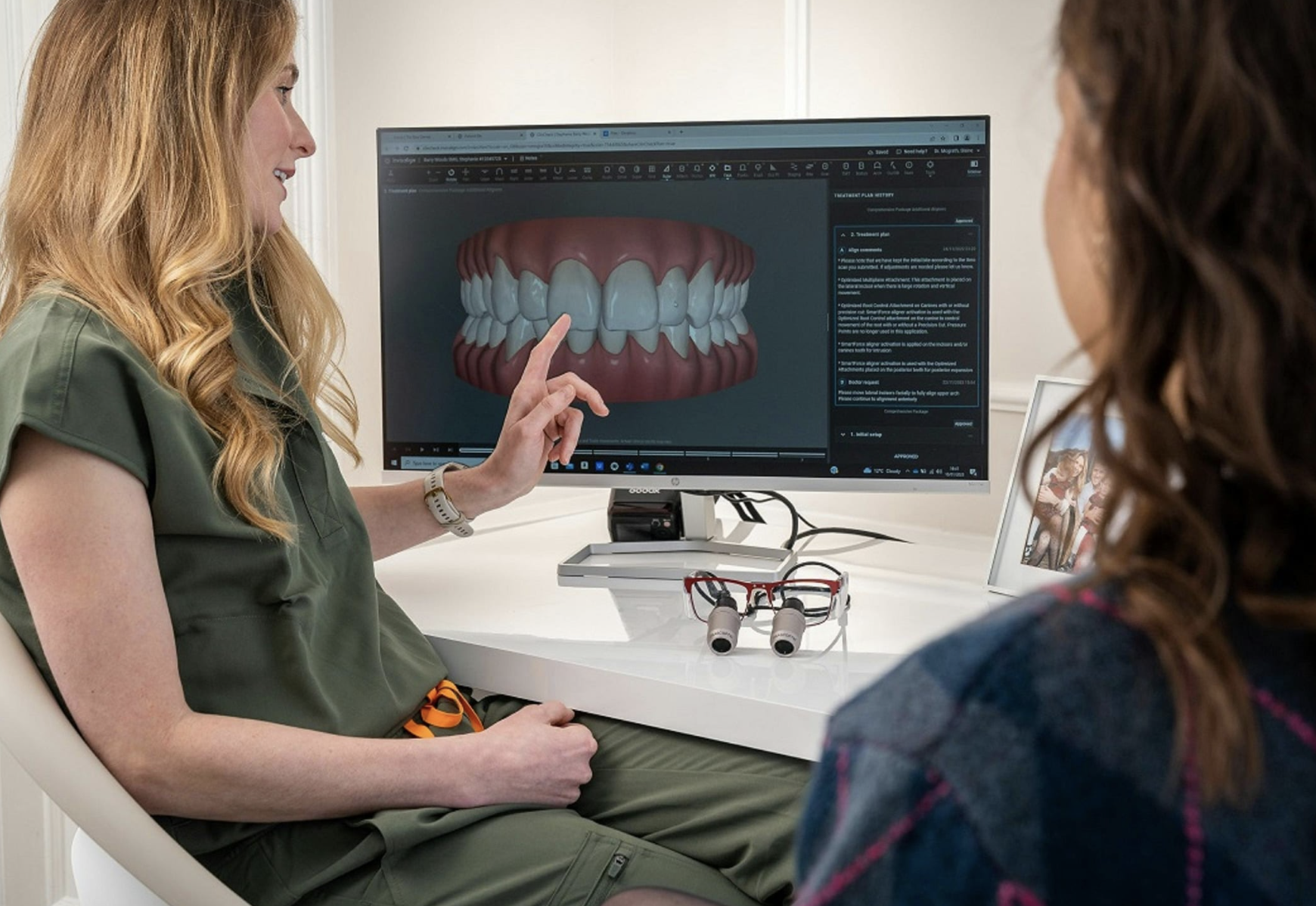
Crown integrity. We look for chips, cracks, and surface wear — particularly on the occlusal surface — that indicate mechanical stress is occurring.
This is a five-minute evaluation at a routine cleaning. The findings it generates determine whether a crown that could have lasted 20 years actually does.
Frequently Asked Questions
How long do dental crowns last?
With good maintenance and no significant mechanical issues, well-made crowns can last 15 to 25 years or more. Average lifespan across the general population is closer to 10 to 15 years — a gap explained largely by maintenance differences rather than crown quality.
Can you get a cavity under a crown?
Yes — recurrent decay at or beneath the crown margin is one of the most common causes of premature crown failure. It develops without symptoms in the early stages and is detectable primarily through regular X-rays.
Does teeth grinding damage crowns?
Significantly. Grinding forces up to 250 PSI applied to crowns during sleep produces micro-fractures, accelerated wear, and in some cases complete porcelain fracture. A night guard is the most effective protection for patients who grind.
What are the signs my crown needs attention?
Changed biting sensation, localized odor, new temperature sensitivity, food trapping near the crown, and any visible chip or crack. Any of these warrant an evaluation rather than watchful waiting.
Is it worth trying to make a crown last longer, or should I just replace it when it wears out?
Extending crown lifespan is almost always worthwhile. Replacement means preparing the tooth again — removing more natural structure — and starting the lifespan clock over. The tooth's capacity to support future restorations decreases with each replacement cycle.
The Thing About Good Work
A well-placed crown is a significant clinical investment — in the dentist's time, in materials, and in the patient's resources. The patients who get the full value of that investment aren't the ones who found the best crown material or the most advanced placement technique. They're the ones who came back consistently, reported changes when they noticed them, and let small findings be addressed while they were still small.
That's what makes the difference. Not the restoration itself — the habit of maintaining it.
If you have crowns that haven't been properly evaluated recently, or if something about a crowned tooth has felt different lately, give us a call. A quick look now is almost always simpler than what follows if you wait.
📍 State Avenue Dental Office — Kansas City, KS (KCK) 🗣 English • Korean • Spanish