
Why Summer Break Is the Best Time to Start Braces

Most parents think about orthodontic treatment in terms of whether and what — whether their child needs it, and what kind. The question of when tends to get less attention. But for the start of treatment specifically, timing turns out to matter more than most families expect.
And if you're weighing it, summer break is genuinely one of the better windows to begin. Here's the reasoning.
The First Week: What the Adjustment Period Actually Involves
Starting braces or aligners isn't painful in a dramatic sense, but it's an adjustment — and the first week or two is the most noticeable part of it.
When appliances are first placed and the teeth begin to move, here's what's typically happening:
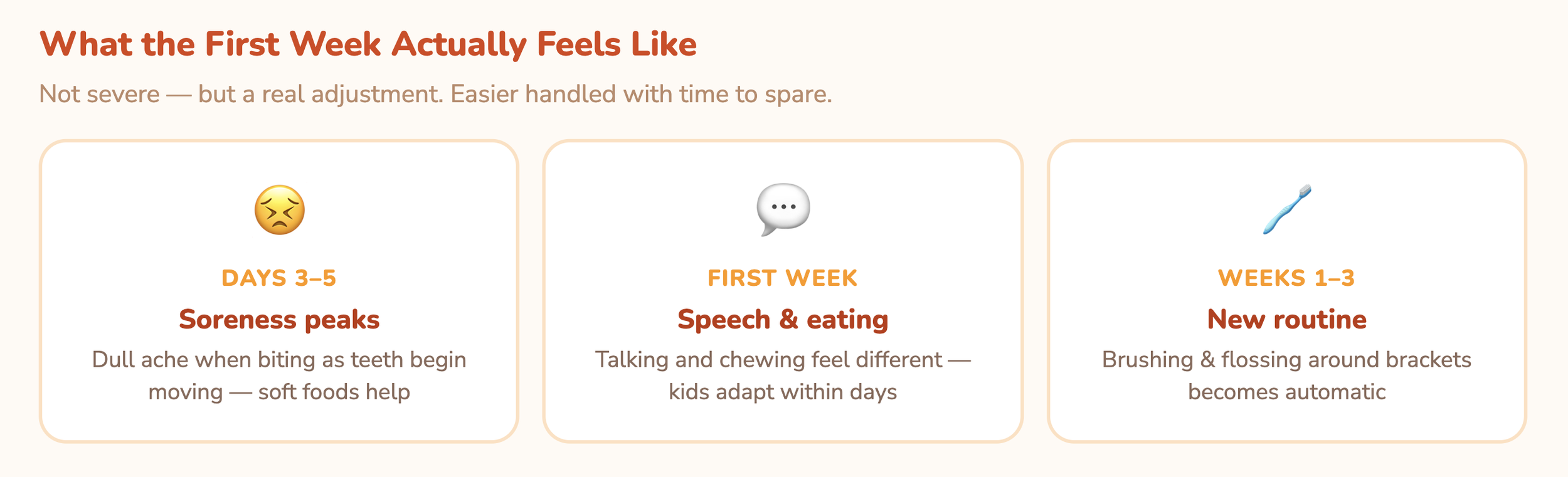
Soreness from tooth movement. Orthodontic appliances work by applying gentle, continuous pressure to teeth, which initiates the biological process of bone remodeling that allows teeth to shift. In the first few days, this produces a dull ache and tenderness, particularly when biting. It's most pronounced in the first 3 to 5 days and then subsides as the teeth and surrounding tissue adapt.
Soft tissue irritation. Brackets and wires are unfamiliar surfaces against the cheeks, lips, and tongue. Until the soft tissue toughens slightly and the child learns to navigate around the hardware, minor irritation and occasional small sores are common. Orthodontic wax helps significantly during this phase.
Speech and eating adjustments. Talking and eating feel different at first. Most kids adapt within days, but there's a learning curve — figuring out how to chew comfortably, what foods work, and how to speak normally with appliances in place.
None of this is severe. But it's a genuine adjustment period, and the conditions under which a child goes through it matter.
Why Summer Makes the Adjustment Easier
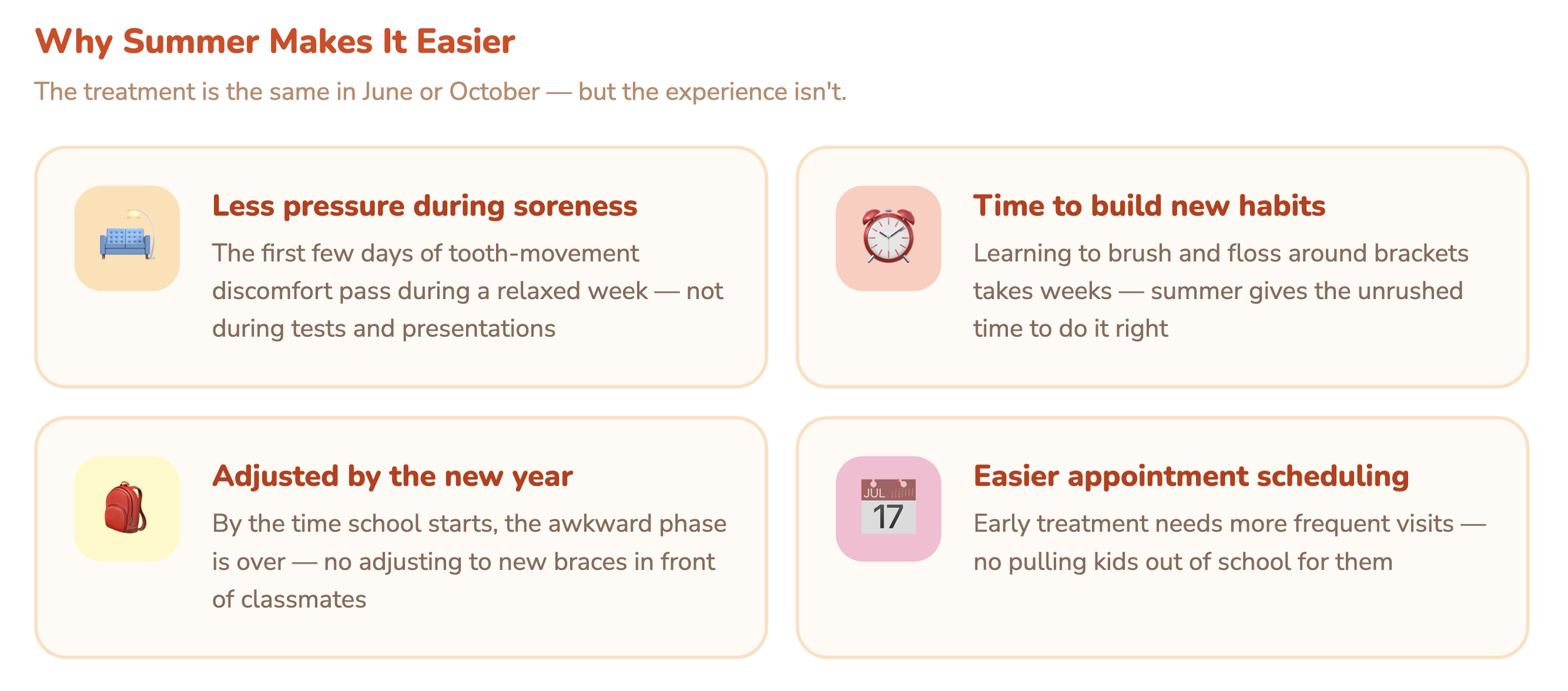
Less pressure during the soreness window.
The first few days of soreness coincide exactly with the period when a child most benefits from a relaxed schedule. Going through initial tooth-movement discomfort during a low-key summer week is meaningfully easier than going through it while managing a full school day, tests, presentations, and after-school activities. They can eat soft foods, take it easy, and let the soreness pass without it interfering with anything important.
Time to build new habits without pressure.
The early phase of treatment requires building new routines — a more thorough brushing technique to clean around brackets, flossing with orthodontic tools, and adjusting eating habits to protect the appliances. These habits take a few weeks to become automatic. Summer provides the unstructured time to establish them properly, rather than trying to cram a new oral hygiene routine into already-packed school mornings.
For younger kids especially, the difference between learning these habits with a parent's relaxed summer supervision versus rushed school-year mornings is significant. Habits that get established well at the start tend to hold for the duration of treatment.
Adaptation is complete by the new school year.
This is the practical payoff. A child who starts treatment in early summer is, by the time school resumes in August, largely past the awkward adjustment phase. The soreness is gone, the speech has normalized, the eating habits are established, and they walk into the new school year already comfortable with their appliances — rather than navigating the social and practical adjustment of new braces in front of classmates during the first weeks of school.
Easier scheduling for early appointments.
The beginning of orthodontic treatment often involves more frequent appointments — initial placement, early adjustments, and addressing any issues that come up. Summer scheduling is simply easier, without the conflict of pulling a child out of school for these visits.
A Note on Hygiene During Orthodontic Treatment
This is worth emphasizing, because it's the part of treatment where habits matter most and where the summer start provides the most benefit.
Braces dramatically increase the difficulty of keeping teeth clean. Brackets and wires create dozens of new surfaces and crevices where food and plaque accumulate, and the areas around brackets are exactly where decalcification — the white spot lesions that can permanently mark teeth — develops when cleaning is inadequate.
The patients who finish orthodontic treatment with healthy teeth and no white spot lesions are the ones who established a thorough cleaning routine early and maintained it. The ones who struggle are usually the ones who never quite built the habit at the start.
Starting in summer, when there's time to learn the technique properly — special orthodontic brushes, floss threaders or a water flosser, and the extra few minutes per cleaning that braces require — sets up the entire course of treatment for a better outcome.
Orthodontic Treatment Is About More Than Appearance
It's worth stating directly, because the cosmetic framing dominates the conversation: straightening teeth is not primarily a cosmetic procedure, even though the cosmetic result is the most visible part.
Properly aligned teeth are easier to clean, which reduces lifetime risk of decay and gum disease. A balanced bite distributes chewing forces evenly, reducing abnormal wear, fracture risk, and strain on the jaw joint. Correcting crowding eliminates the food traps and hard-to-clean areas that crowded teeth create. In many cases, orthodontic treatment is genuinely a long-term dental health investment that happens to also improve appearance.
That framing matters for the timing decision, too. This isn't a cosmetic indulgence to be squeezed in whenever convenient — it's a health intervention worth starting under the conditions most likely to produce a good result. And those conditions, for most kids, line up well with summer.
Frequently Asked Questions
Is summer really a better time to start braces?
For the start of treatment specifically, yes — the initial adjustment period (soreness, soft tissue irritation, habit-building) is easier to navigate without the demands of the school schedule, and the child is comfortably adapted by the time school resumes.
How long does it take to adjust to braces?
The initial soreness typically peaks in the first 3 to 5 days and resolves within one to two weeks. Adapting to eating, speaking, and the new hygiene routine takes a few weeks to become fully comfortable.
My child is nervous about braces. Does the timing help?
It can. Starting in a low-pressure summer environment — without the added social dimension of adjusting in front of classmates — gives an anxious child time to get comfortable on their own terms before re-entering the school setting.
What foods should be avoided with braces?
Hard, sticky, and chewy foods that can damage brackets or wires — things like hard candies, caramel, gum, ice, and very crunchy items. The summer start allows time to learn these adjustments without the pressure of school lunches.
At what age should orthodontic evaluation happen?
The American Association of Orthodontists recommends an initial evaluation by age 7. This doesn't mean treatment starts then — but it allows the timing and approach to be planned well, including choosing the optimal window to begin.
The Thing About Timing
A lot of dental decisions come down to timing — not just whether to do something, but when. Orthodontic treatment is one of the clearer examples. The treatment itself will be the same whether it starts in June or October. What changes is how smoothly the adjustment goes, how well the early habits get established, and how the child experiences the whole transition.
Summer isn't the only time that works. But for most families, it lines up the adjustment period with the lightest schedule of the year — which is exactly when you want it.
If you've been considering orthodontic treatment for your child, an evaluation now lets us plan the timing well — and if summer makes sense, there's still time to start it right. Give us a call.
📍 State Avenue Dental Office — Kansas City, KS (KCK) 🗣 English • Korean • Spanish