
Why Chewing Still Feels Off After a Dental Implant
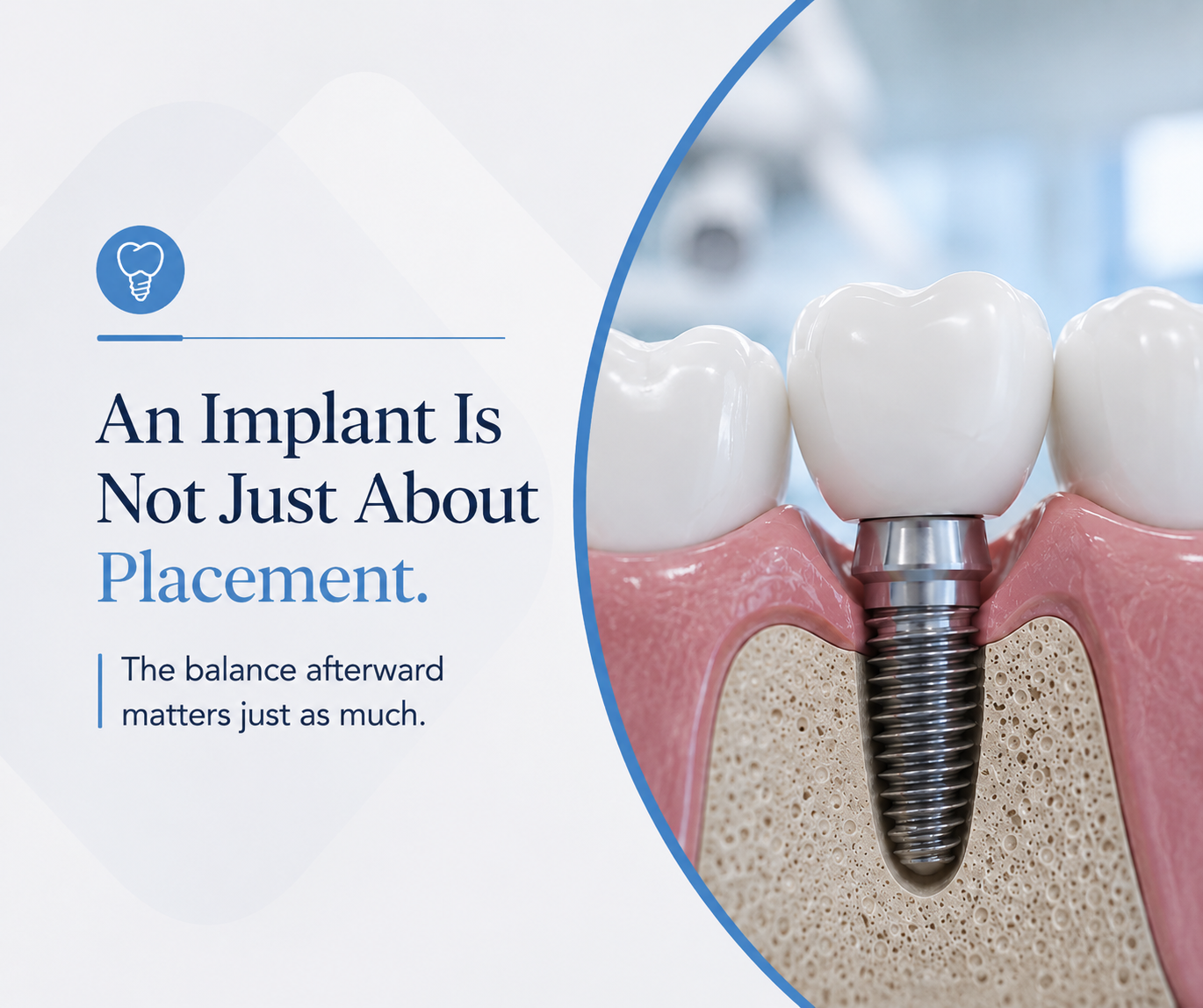
Here's a scenario we see more often than most patients expect: someone goes through the full implant process — the placement, the healing, the final crown — and everything looks perfect. The implant is solid, the crown is beautiful, the X-rays are clean. And yet, when they chew, something feels off. Not painful, usually. Just not quite right.
Many patients assume this means something went wrong. Usually, it didn't. The implant was placed successfully — but the larger system it's now part of needs time and attention to fully integrate it. Understanding why makes the whole experience less worrying, and points toward what actually resolves it.
The Implant Is a Component, Not the Whole System
The most useful reframe is this: a dental implant doesn't restore a tooth in isolation. It inserts a new component into a complex, finely-tuned system that's been operating without it.
Your mouth is not a collection of independent teeth. It's an integrated system in which the upper and lower teeth, the temporomandibular joints (the jaw joints), and the muscles of mastication all work together in precise coordination. Every time you chew, dozens of micro-adjustments happen automatically based on feedback from all of these structures.
When a tooth is lost and later replaced, that system has spent months — sometimes years — operating without it. The bite redistributed. The muscles developed new patterns. The opposing and adjacent teeth may have shifted. Then a new implant arrives, and the system has to re-integrate it. A well-placed implant that "feels off" is usually a system that hasn't finished adjusting — not a failed implant.
The Specific Reasons Chewing Can Feel Wrong
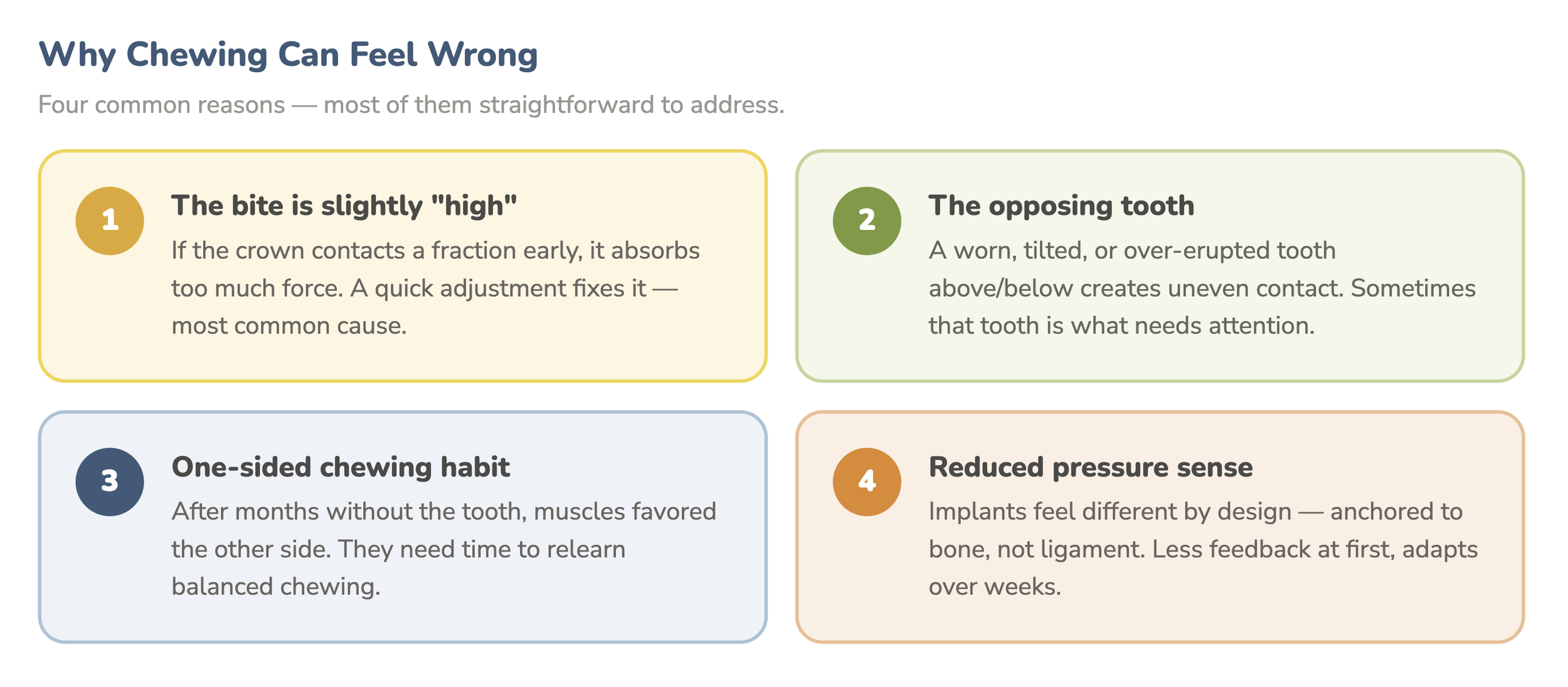
Occlusal balance — how the bite forces distribute.
This is the most common and most correctable cause. Occlusion refers to how the upper and lower teeth meet, and for chewing to feel natural, the force needs to distribute evenly across the bite. If the implant crown is even fractionally too high, it makes contact a moment before the surrounding teeth and absorbs a disproportionate share of the biting force — producing a distinct "high" feeling. The fix is a straightforward refinement to the crown's biting surface. It sometimes takes a couple of visits to get precisely right, because the way a bite settles over the first few weeks can reveal adjustments that weren't apparent immediately.
The opposing tooth.
An implant doesn't chew against nothing — it chews against the tooth above or below it. If that tooth is worn, tilted, or over-erupted (having drifted into the space while the implant tooth was missing), the contact between the two won't be ideal, and force concentrates where it's uneven. In some cases, addressing the opposing tooth is what actually resolves the discomfort.
Long-standing one-sided chewing habits.
When a tooth is missing for a significant period, most people unconsciously shift their chewing to the other side — and the jaw muscles adapt to favoring it. When the implant restores the ability to chew on the previously avoided side, the muscles need time to relearn balanced chewing. The implant might be perfect, but the habit persists until the pattern re-establishes through conscious, gradual use.
Osseoperception — why an implant feels different by design.
This is the part that's genuinely different about implants. A natural tooth is connected to the jawbone by the periodontal ligament — a thin layer of tissue packed with nerve receptors that give natural teeth remarkable sensory feedback. It's why you can feel a single grain of sand in your food or sense exactly how hard you're biting. A dental implant has no periodontal ligament; it's fused directly to the bone. It provides a different, less precise form of sensation called osseoperception, transmitted through the surrounding bone rather than ligament. The practical effect: an implant can feel slightly "numb" or less responsive than the natural teeth around it, especially at first. This isn't a malfunction — it's the inherent difference between a tooth anchored by ligament and one anchored by bone, and most patients stop noticing it within weeks to months.
What's Normal, and What Warrants a Call
This distinction matters, so let's be specific.
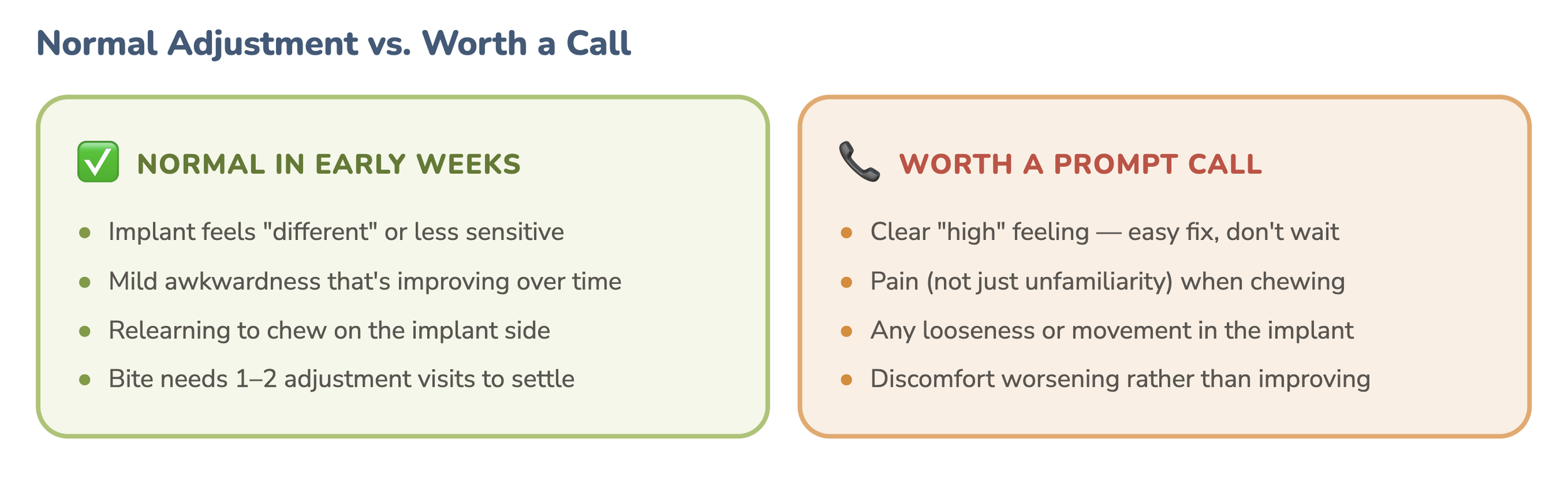
Generally normal in the early weeks:
A sense that the implant feels "different" or less sensitive than natural teeth
Mild awkwardness when chewing on the implant side, improving over time
Needing to consciously re-learn chewing on a previously avoided side
A bite that needs one or two adjustment visits to feel fully settled
Worth a prompt call:
A clear "high" feeling where the implant hits first and harder than other teeth — an easy adjustment, no reason to live with it
Pain (as opposed to unfamiliarity) when chewing or biting
A sense of looseness or movement in the implant
Discomfort that's worsening rather than improving over weeks
The first category resolves with time and minor adjustment. The second is worth evaluating promptly — often it's still a simple fix, but it shouldn't be waited out.
Why the Adjustment Phase Is a Normal Part of Treatment
The framing we'd offer patients is this: implant treatment has a beginning, a middle, and an end — and the placement of the implant is the middle, not the end.
The final phase is calibration: the series of small refinements that take a successfully placed implant and integrate it into your bite so it functions like a natural tooth. This means checking and fine-tuning the occlusion, sometimes addressing the opposing tooth, and giving your muscles time to adapt. Skipping or rushing this phase is how an otherwise perfect implant ends up feeling permanently "off." The patients who follow through on the adjustment appointments — and communicate clearly about what feels wrong — are the ones who end up forgetting which tooth is even the implant. That's the goal: not just an implant that's structurally sound, but one that disappears into normal function so completely you stop thinking about it.
Frequently Asked Questions
Is it normal for a dental implant to feel different from a natural tooth?
Yes. Implants lack the periodontal ligament that gives natural teeth their fine pressure sensitivity, so they provide a less precise form of feedback called osseoperception. An implant can feel slightly less responsive, especially early on. Most patients adapt within weeks to months.
Why does my implant feel too high when I bite?
The crown's biting surface may be fractionally too high, causing it to make contact before the surrounding teeth. This is a common, easily corrected issue — a small adjustment redistributes the bite force properly. You shouldn't have to live with a "high" feeling.
How long does it take to get used to chewing with an implant?
Most patients adapt over a few weeks to a few months. The timeline depends on how long the tooth was missing, whether one-sided chewing habits developed, and how much bite adjustment is needed.
Can the bite on an implant be adjusted after it's placed?
Yes, and it often should be. Fine-tuning the occlusion after placement is a normal part of implant treatment, since the bite can settle and change over the first few weeks of use.
My implant is uncomfortable but not painful. Should I just wait it out?
Mild unfamiliarity that's gradually improving is usually fine to give time. But a distinct "high" feeling, discomfort that's worsening, or anything painful is worth a call — many causes are simple adjustments, and there's no reason to tolerate it indefinitely.
The Thing About "Finished"
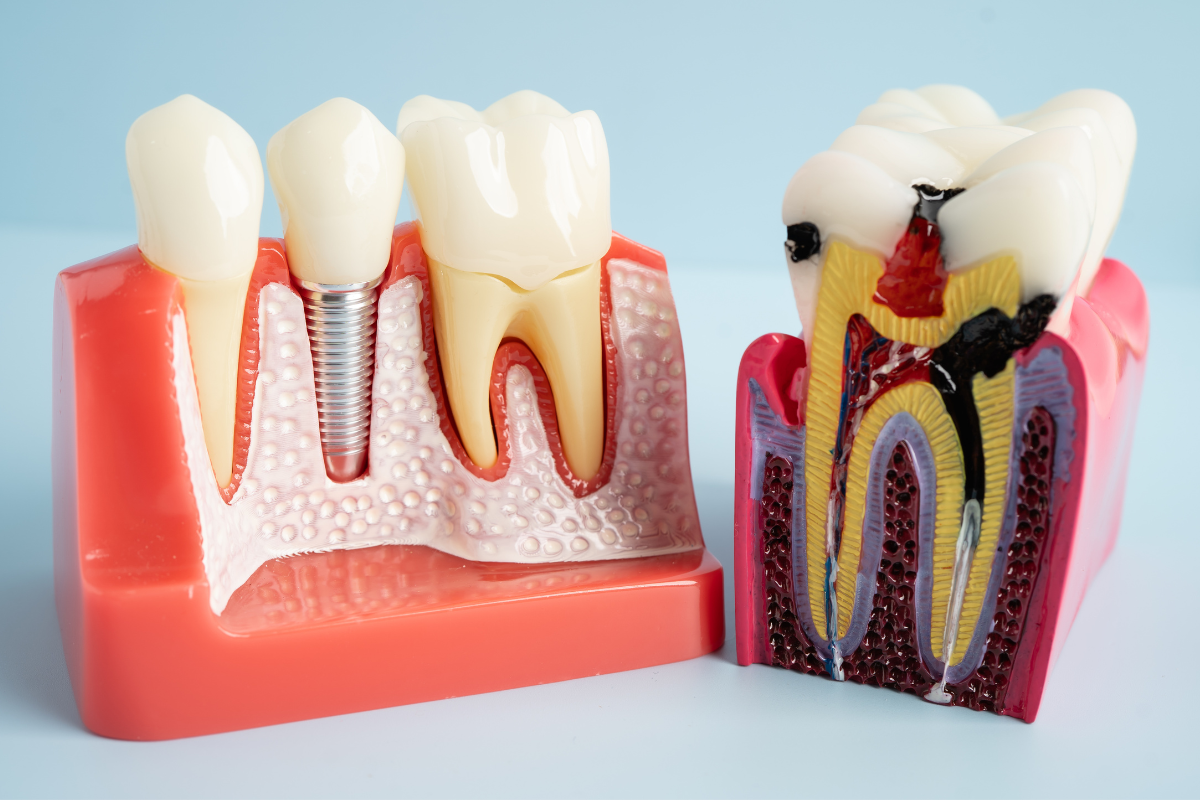
A lot of dental treatments feel binary — the filling is in, the tooth is fixed, done. Implants are a little different, and setting the expectation correctly makes the whole experience better.
The implant going in is a milestone, not a finish line. What determines whether it feels like a natural tooth is the calibration that follows — the bite adjustments, the opposing tooth, the time your muscles need to adapt. None of that is a complication. It's the normal, expected final phase of getting an implant to do what it's supposed to do.
If you've had an implant and chewing still doesn't feel right — even if it's just "off" rather than painful — give us a call. It's usually a simple adjustment, and exactly the kind of thing this final phase is meant to address.
📍 State Avenue Dental Office — Kansas City, KS (KCK) 🗣 English • Korean • Spanish