
Implant or Bridge? How to Actually Choose
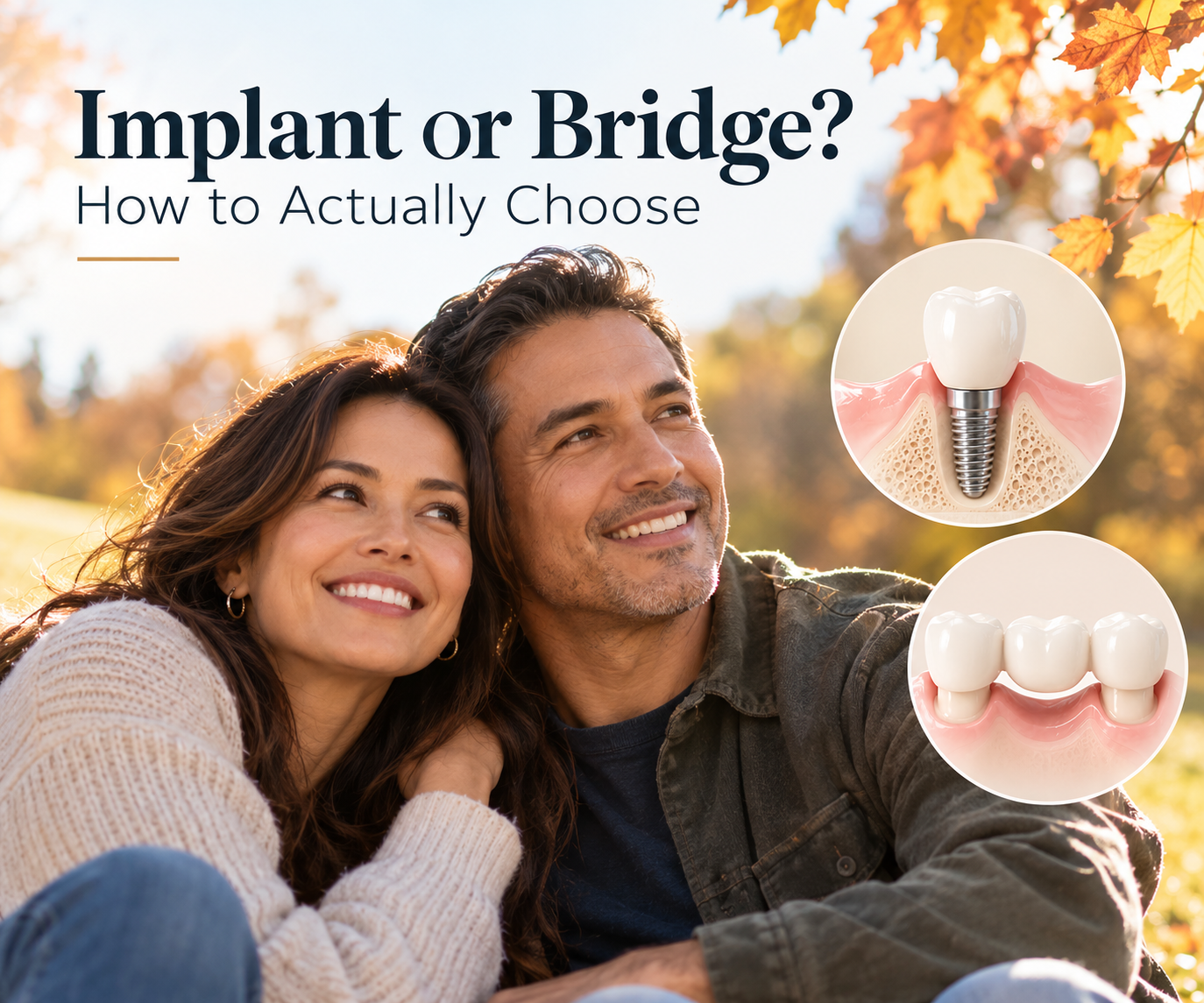
Once you've decided to replace a missing tooth, the next question is almost always the same: implant or bridge? And the next question after that is usually about cost.
Cost matters — but it's not the first thing to look at, and leading with it can point you toward the wrong choice. The better starting point is a handful of clinical factors specific to your mouth, because those are what actually determine which option will serve you best and last the longest. Here are the four that matter most, roughly in the order we weigh them.
First: The Condition of the Neighboring Teeth
This is usually the single most decisive factor, and it's the one patients think about least.
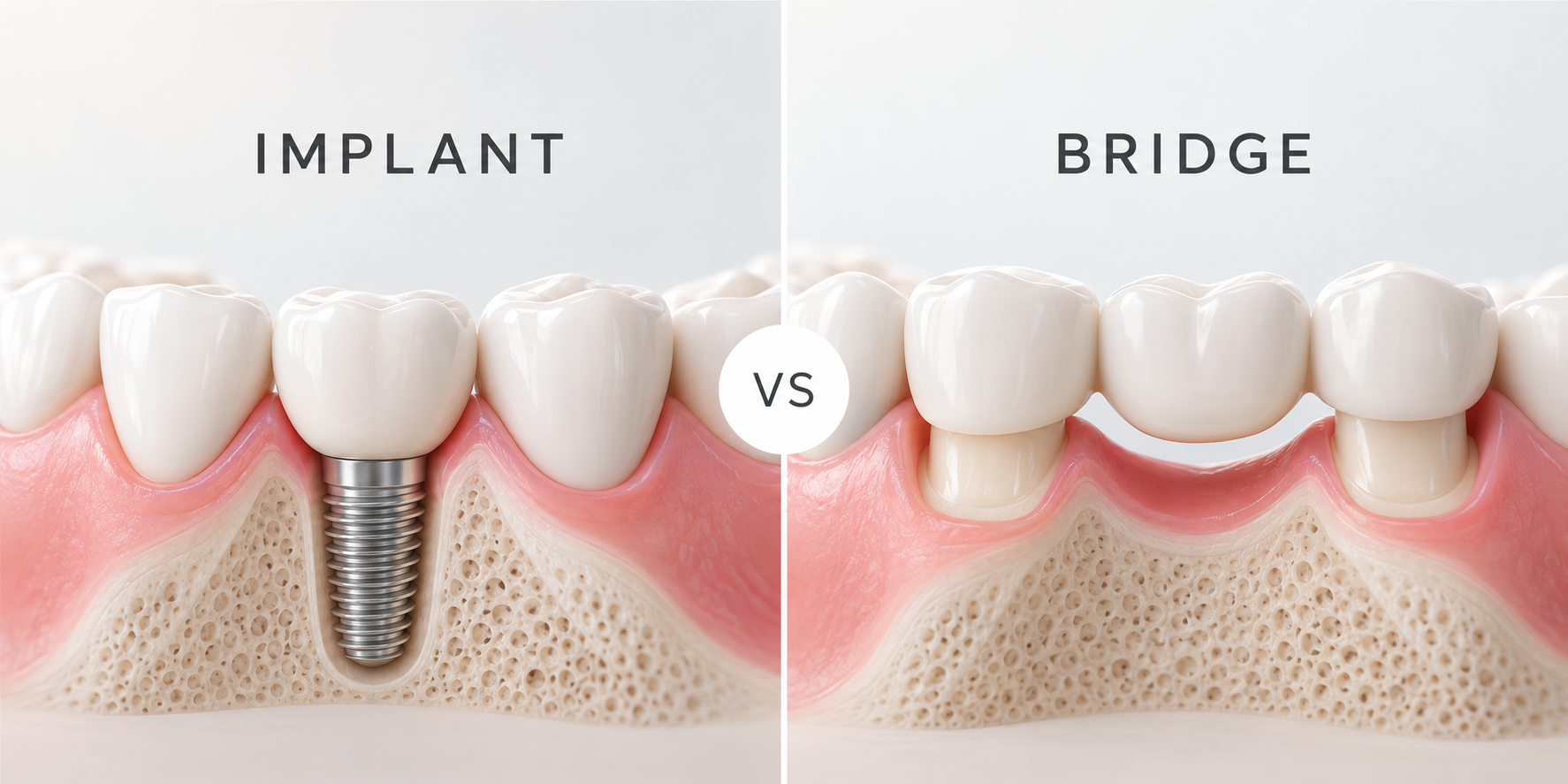
A bridge doesn't stand on its own. It works by reshaping — grinding down — the teeth on either side of the gap and using them as anchors, connecting three units (two supports and the replacement in the middle) into one solid piece. That means the neighboring teeth are essential to how a bridge works.
And that cuts both ways:
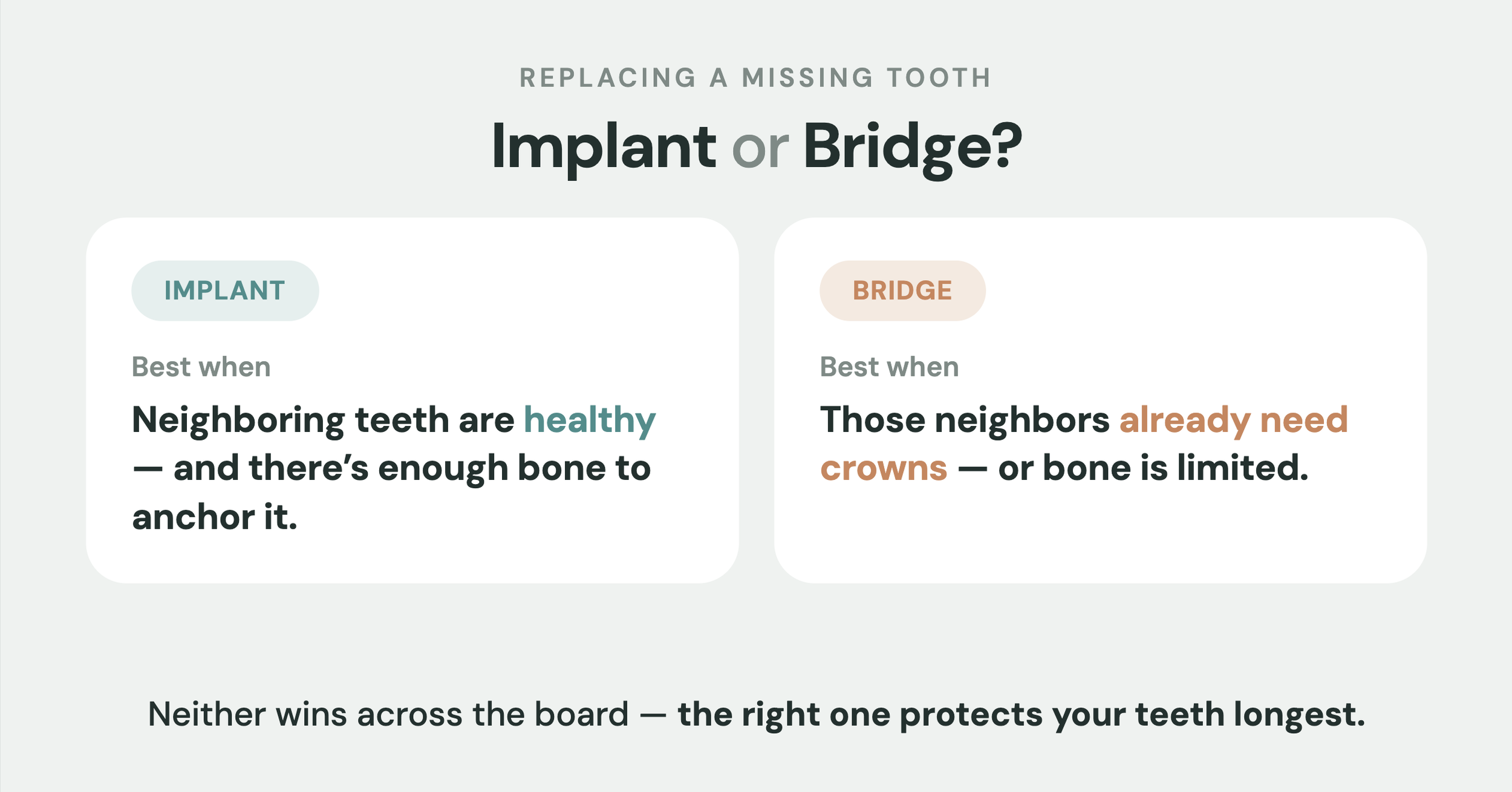
If the neighboring teeth are perfectly healthy, a bridge asks you to grind down two sound, intact teeth purely to support the replacement. Removing healthy tooth structure that didn't need any work is a real downside — and in that situation, an implant, which stands on its own without touching the neighbors, is often the more conservative choice.
If the neighboring teeth already have large fillings or need crowns anyway, the calculation flips. Those teeth were going to need significant restoration regardless, so incorporating them into a bridge — crowning them as part of the solution — makes efficient use of work that was coming either way. In that case, a bridge can be the genuinely sensible choice.
So the first question isn't "implant or bridge?" It's "what shape are the teeth on either side of the gap in?"
Second: The Condition of the Gums and Bone
This factor can be decisive in the other direction, because it's about whether an implant is even straightforward to place.
An implant is anchored directly into the jawbone, which means the foundation has to be there. There needs to be sufficient bone volume to hold the implant and healthy gum tissue around it. When there's enough of both, an implant has a solid base to integrate with.
When there isn't — often because bone has already diminished in a spot where a tooth has been missing for a while — a bone graft may be needed first to rebuild enough foundation before the implant can go in. That's not a dealbreaker, but it adds a step, time, and complexity. A bridge, which relies on the neighboring teeth rather than the bone at the gap, can sometimes be more straightforward when bone is limited.
Third: The Timeline
If timing matters to you, this is a real practical difference between the two.
A bridge is usually completed within a few weeks. The neighboring teeth are prepared, impressions are taken, and the finished bridge is placed — start to finish, it's a relatively short process.
An implant takes several months. The reason is biological, not a matter of scheduling: after the implant is placed, it needs time to fuse firmly with the surrounding bone — a process called osseointegration — before the final tooth can go on top. That bonding time can't be rushed without compromising the result.
Neither timeline is "better." But if you have a specific reason to want the gap resolved quickly, it's a factor worth naming up front, because it genuinely separates the two options.
Fourth: How You'll Maintain It
The two are also cared for differently day to day, and this is worth understanding before you choose — not after.
A bridge requires a specific cleaning habit. Because the three connected units are joined as one piece, you can't simply pass floss down between them the way you would with separate teeth. Cleaning underneath the connected section — where it sits against the gum — requires special tools (like a floss threader or an interdental brush) and the consistent habit of using them. It's very doable, but it's a routine you have to adopt.
An implant is relatively simple to clean — you largely care for it like a natural tooth. But it has its own vulnerability: the tissue around an implant is susceptible to inflammation (peri-implantitis), which can threaten the implant if it goes unaddressed. So while daily care is simpler, regular professional checkups are genuinely essential to catch any issue early.
Different habits, neither harder in the abstract — just different, and worth matching to how you actually maintain your teeth.
There's No Universal "Better" — Only the Right Fit
Here's the honest bottom line, and it's the opposite of what a ranking or a price list would tell you: neither an implant nor a bridge is unconditionally better than the other.
Each is the right answer in different situations. An implant shines when the neighboring teeth are healthy and the bone is good. A bridge shines when the neighbors already need crowns, or when bone at the gap is limited, or when the timeline matters. The best choice is entirely dependent on the specific picture in your mouth — which is exactly why the clinical factors come before the cost comparison.
The real question is never "which is better in general?" It's "which option best protects the teeth you still have, for the longest time?" That answer is different for different people — and finding it is what a proper consultation is for.
If you're weighing an implant against a bridge, the most useful next step is an evaluation that looks at your neighboring teeth, your bone, your timeline, and your daily habits — and then talks cost in the context of all of it. Give us a call, and we'll help you find the option that's genuinely right for you.

Frequently Asked Questions
Should I get an implant or a bridge?
It depends on four main factors: the health of the neighboring teeth, the amount and health of your bone and gums, your timeline, and how you'll maintain it. An implant is often best when neighboring teeth are healthy and bone is sufficient; a bridge can be the better fit when neighbors already need crowns or bone at the gap is limited.
Why does the condition of the neighboring teeth matter so much?
A bridge works by grinding down the teeth on either side of the gap to anchor it. If those teeth are perfectly healthy, that means removing sound structure — a reason to consider an implant. If they already have large fillings or need crowns, incorporating them into a bridge makes sense.
Do I need enough bone for a dental implant?
Yes. An implant is placed directly into the jawbone, so it requires sufficient bone volume and healthy gum tissue. If bone has diminished — common after a tooth has been missing a while — a bone graft may be needed first to rebuild the foundation.
How long does each take?
A bridge is usually completed within a few weeks. An implant takes several months, because it needs time to fuse firmly with the bone (osseointegration) before the final tooth is attached. That bonding time can't be safely rushed.
Is a bridge or an implant harder to keep clean?
They're different. A bridge requires special tools (like a floss threader or interdental brush) to clean underneath the connected section, since regular floss can't pass through. An implant is simpler for daily care but is vulnerable to inflammation around it, making regular checkups essential.
📍 State Avenue Dental Office — Kansas City, KS (KCK) 🗣 English • Korean • Spanish