
The Domino Effect That Starts When You Lose One Tooth
Losing a tooth — especially a back molar that doesn't show when you smile — is easy to file under "not urgent." You can still chew, nothing hurts, and life is busy. Plenty of people leave a gap for months or years, figuring they'll deal with it eventually.
Here's what's worth understanding before "eventually" arrives: a missing tooth is rarely a stable situation. It's the first domino. The teeth in your mouth hold their positions by leaning on and meeting each other, and when one is removed, that balance starts to shift — quietly, gradually, and in more directions than most people expect. Let's walk through the chain reaction.
Teeth Don't Stand Alone — They Hold Each Other in Place
The key thing to understand is that your teeth aren't independent posts, each rooted firmly on its own. They function as a unit, each one bracing against its neighbors on either side and against the tooth it meets when you bite. That mutual support is part of what keeps every tooth in its proper position.
Remove one tooth from that arrangement, and you've taken away support that the surrounding teeth were quietly relying on. Nothing collapses overnight — but the structure is no longer balanced, and the teeth around the gap begin, slowly, to move. This is why a single missing tooth is the start of a process rather than a contained event.
The First Dominoes: Tilting and Drifting
Two movements begin almost immediately, though you won't feel them for a long time.
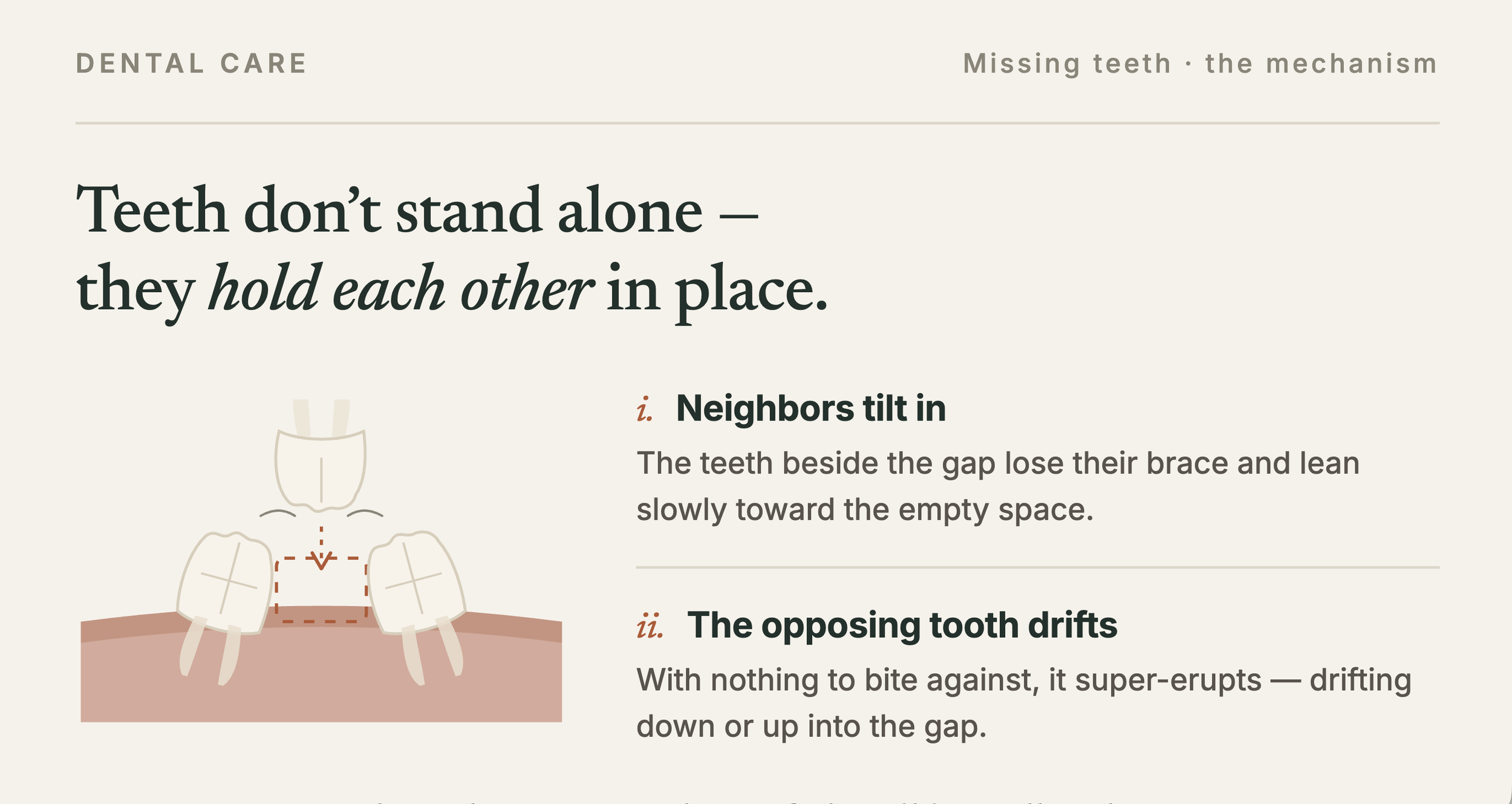
The neighboring teeth tilt in.
The teeth on either side of the gap lose the neighbor that was bracing them, so they begin to tilt and lean toward the empty space. What was a straight, upright tooth slowly angles into the gap.
The opposing tooth drifts.
The tooth that used to bite against the missing one — above or below it — now meets nothing when you close your jaw. Without an opposing tooth to stop it, it gradually "super-erupts," drifting down (or up) out of its normal position into the empty space.
Both of these happen over months and years, at a pace far too slow to notice day to day. That's the deceptive part: by the time the movement is visible, it has usually been underway for quite a while.
How One Gap Multiplies Into Several Problems
The tilting and drifting aren't just cosmetic — they set off knock-on effects that reach well beyond the original gap.
New spaces and food traps.
As teeth tilt out of alignment, new gaps open up between them. Food starts packing into these spaces, and because a tilted tooth is harder to clean around, a toothbrush and floss can't reach as well as they should. The result is a meaningful rise in the risk of both gum disease and decay — in teeth that were previously healthy.
One-sided chewing and concentrated force.
When chewing on the side of the gap becomes awkward or inefficient, most people unconsciously shift to chewing on the other side. That means all the force of chewing concentrates on one side of the mouth, overloading those teeth and placing extra strain on the jaw joint. A single missing tooth can, in this way, end up stressing the entire chewing system.
The bite relationship changes.
As teeth tilt and drift, the way your upper and lower teeth meet gradually changes. An altered bite can accelerate wear, create uneven pressure points, and contribute to jaw discomfort over time.
Each of these traces back to that one original gap — which is how a "single tooth" problem quietly becomes a "several teeth" problem.
The Change You Can't See: Bone Loss
The most important consequence is also the most invisible, and it's the one most people have never heard about.
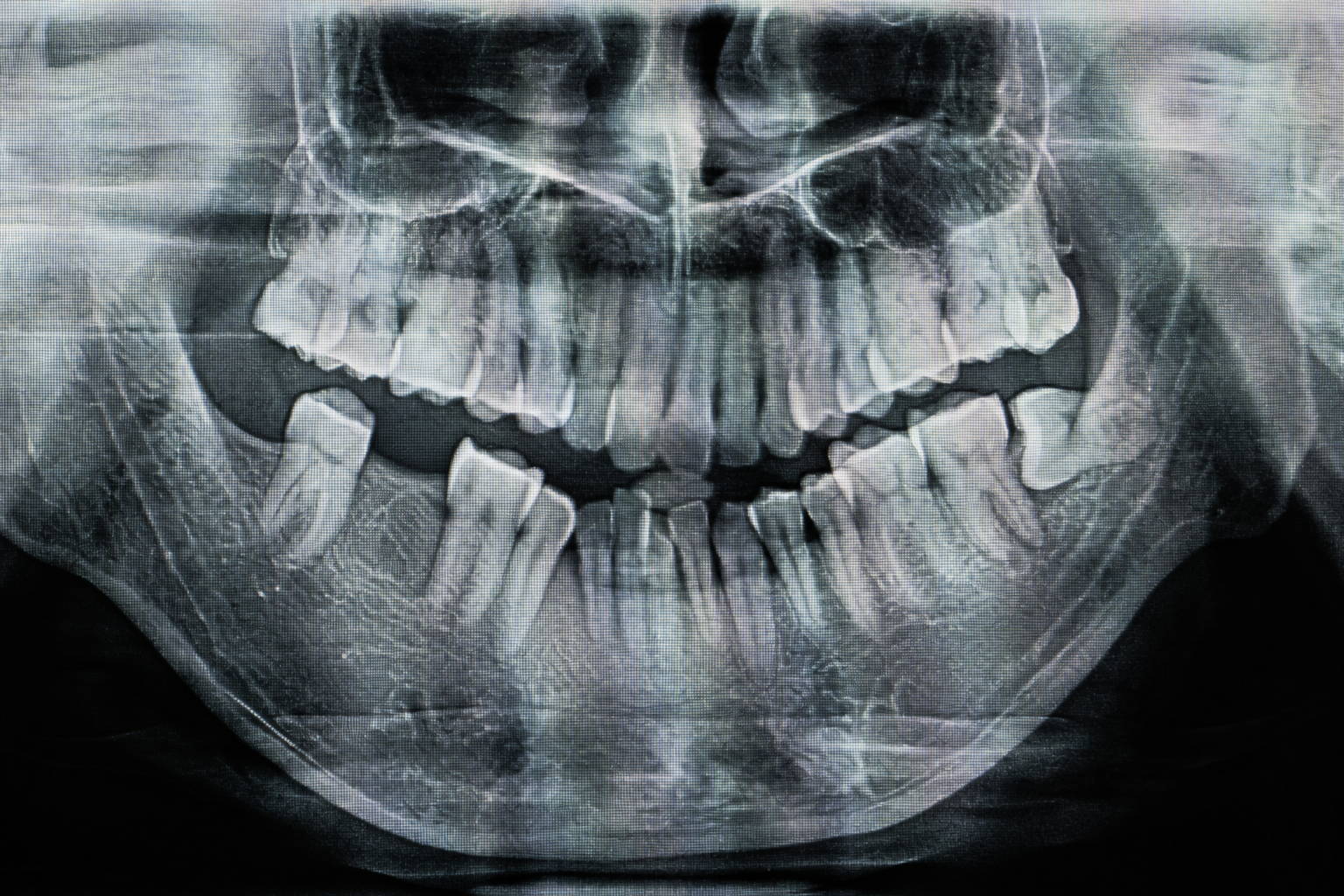
The jawbone that surrounds and supports a tooth's root depends on that tooth to stay healthy. Every time you chew, the tooth transmits stimulation into the surrounding bone, and that stimulation is what signals the body to maintain the bone. It's a use-it-or-lose-it system.
When a tooth is gone, the bone in that spot stops receiving that signal. No longer stimulated, it begins to resorb — to shrink and diminish — gradually, over months and years. This happens silently and invisibly, beneath the gum, with nothing you can feel to tell you it's underway.
This is the specific reason that timing matters so much for future treatment. When someone decides, a few years after losing a tooth, that they'd like an implant, they sometimes discover the bone that would have anchored it has diminished — and a bone graft is now needed to rebuild enough foundation before the implant can be placed. The graft is often the direct consequence of the gap having been left too long.
The Real Loss Is Your Options
Here's the reframe that matters most. When you lose a tooth, the most significant loss over time isn't that one tooth — it's the narrowing of your choices for dealing with it.
Early on, with the neighboring teeth still upright, the opposing tooth still in place, and the bone still full, you typically have the full range of replacement options available and straightforward. As the dominoes fall — as teeth tilt, the bite shifts, and bone diminishes — some of those options become more complicated, more involved, or require additional preliminary procedures like grafting or realigning tilted teeth first. Nothing about waiting makes the eventual solution easier; it tends to do the opposite.
That's why the single most useful thing you can do after losing a tooth is simply to have the conversation early — not necessarily to rush into treatment, but to understand your options while you still have all of them.
Frequently Asked Questions
What happens if you don't replace a missing tooth?
Over time, the neighboring teeth tilt toward the gap and the opposing tooth drifts into it. This creates new food traps and cleaning challenges (raising decay and gum disease risk), concentrates chewing force on one side, and allows the jawbone under the gap to shrink from lack of stimulation.
Do teeth really shift if I lose just one?
Yes. Teeth hold their positions by bracing against their neighbors and the teeth they bite against. Remove one, and the surrounding teeth gradually tilt and drift into the empty space over months and years — usually too slowly to notice until it's significant.
Why does the jawbone shrink after losing a tooth?
Bone stays healthy through stimulation from chewing, transmitted through the tooth's root. When the tooth is gone, that stimulation stops, and the bone in that area gradually resorbs. This is why a bone graft is sometimes needed before an implant if a gap has been left for a long time.
Is it okay to leave a gap from a back molar no one sees?
Even an invisible gap sets off the same chain reaction — tilting, drifting, bone loss, and one-sided chewing. The consequences are functional and structural, not just cosmetic, so a hidden molar gap is still worth addressing.
Why should I act quickly on a missing tooth?
Because your replacement options are widest early, before teeth have shifted and bone has diminished. Waiting tends to add complexity — like needing a graft or straightening tilted teeth first — rather than making treatment simpler.
The Thing About One Domino
It's natural to judge a missing tooth by how it feels right now: if chewing still works and nothing hurts, it's hard to treat it as a problem. But a missing tooth is one of those situations where the present moment is genuinely misleading. The important changes are the slow, quiet ones — the tilting you can't feel, the drifting you can't see, the bone thinning beneath the gum with no symptom to announce it.
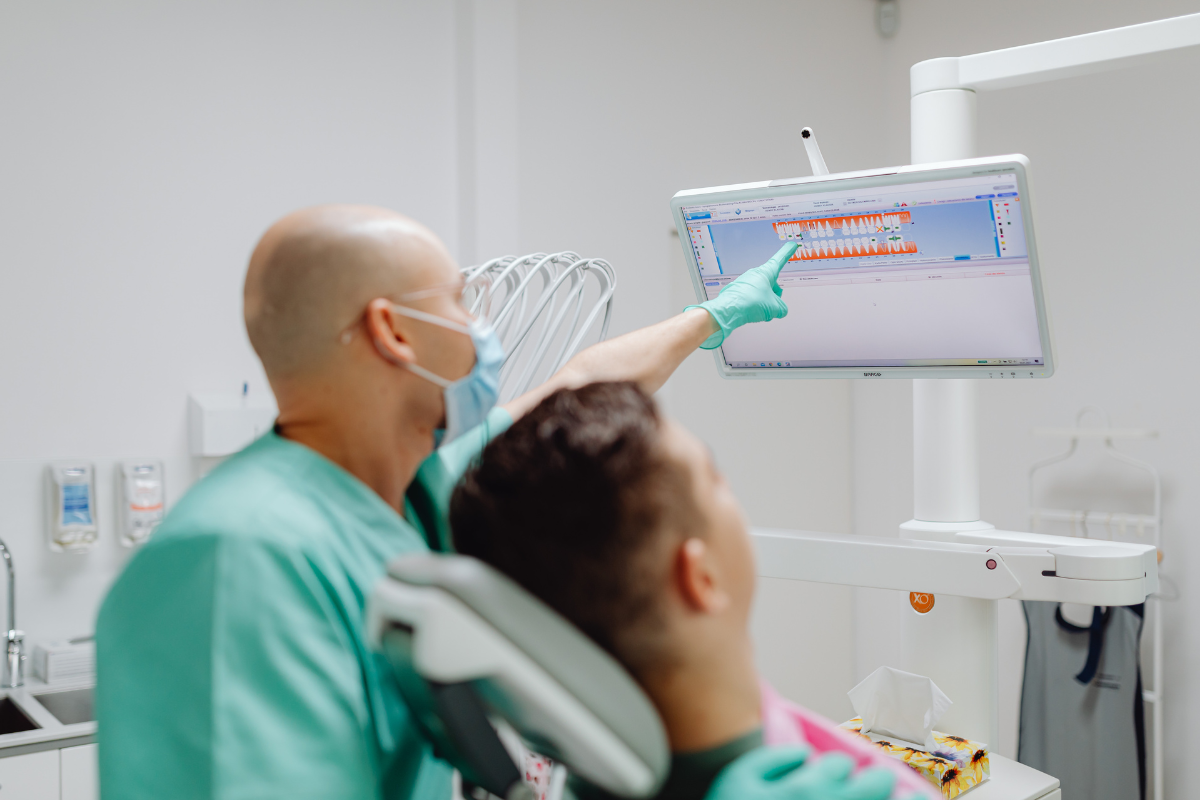
None of this is a reason to panic. It's a reason to look early, while everything is still in its place and every option is still on the table. The gap that gets addressed while it's simple almost always stays simple. The one that waits is the one that tends to bring the harder conversation later.
If you've lost a tooth — recently or a while ago — it's worth a conversation about what's happening in that space and how best to fill it. Give us a call, and let's keep your options open while you still have all of them.
📍 State Avenue Dental Office — Kansas City, KS (KCK) 🗣 English • Korean • Spanish