
What Happens When You Only Chew on One Side
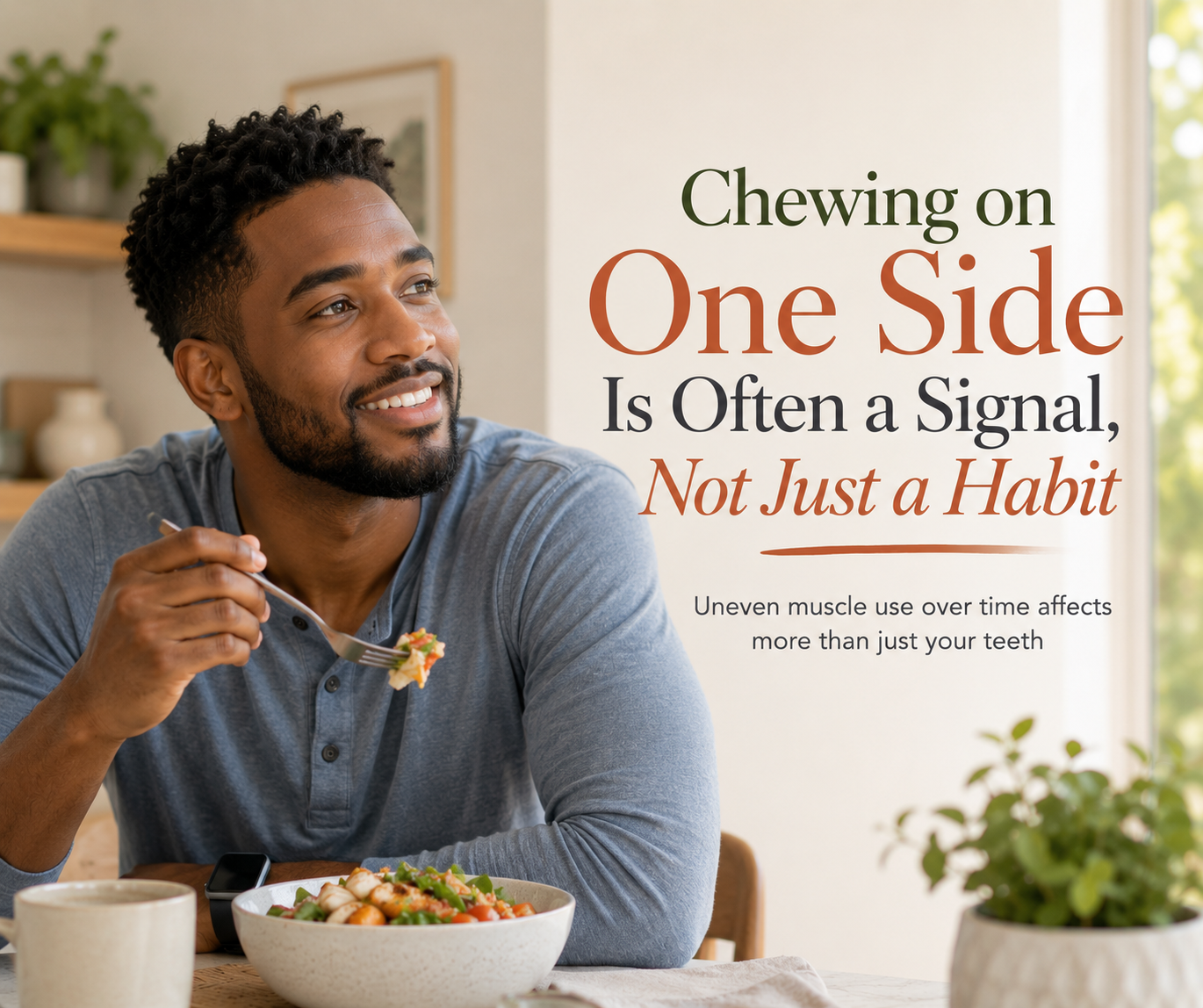
Here's a habit almost nobody notices they have: chewing on one side of the mouth. If you're not sure whether you do it, pay attention at your next meal — a surprising number of people discover that nearly every bite drifts to the same side, automatically, and has for years.
It seems like the most harmless thing in the world. And in the short term, it mostly is. But sustained over months and years, one-sided chewing quietly reshapes things — the muscles, the teeth doing all the work, and sometimes the balance of the face itself. More importantly, it's often not really a habit at all, but a symptom of something worth knowing about.
The Muscle Side: Your Jaw Adapts to How You Use It
The muscles of chewing — primarily the masseter and temporalis — respond to use the same way any muscle does: the side that works harder develops more.
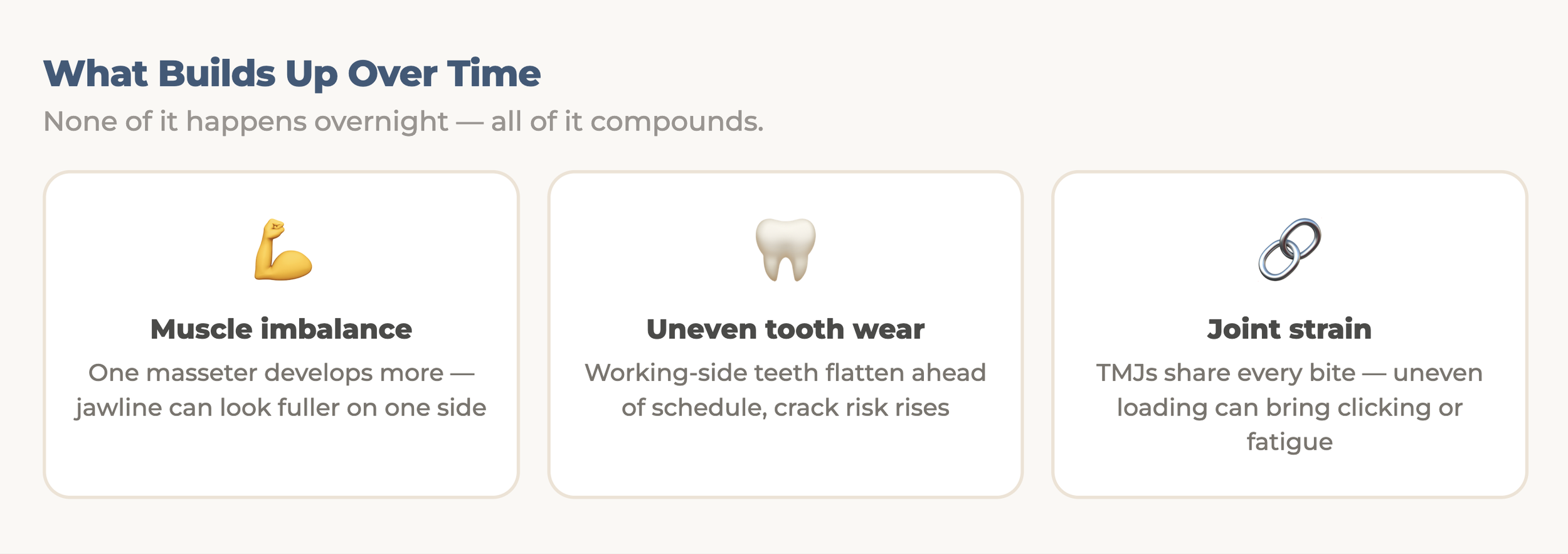
When chewing consistently favors one side, that side's muscles get a disproportionate workout, meal after meal, year after year. The working side becomes stronger and often visibly fuller, while the less-used side stays comparatively underdeveloped. Because the masseter sits right at the angle of the jaw and contributes meaningfully to the lower face's contour, a long-standing imbalance can subtly affect facial symmetry — one side of the jawline appearing fuller or more defined than the other.
The jaw joints feel it too. The temporomandibular joints on both sides are designed to share the load of chewing. Chronic one-sided use loads them unevenly, which over time can contribute to discomfort, clicking, or fatigue on one side — sometimes the overworked side, sometimes the neglected one, since both joints move together with every bite regardless of which side the food is on.
None of this happens overnight, and mild asymmetry is normal for everyone. But the pattern is real: the longer the imbalance runs, the more the structures adapt around it.
The Tooth Side: Concentrated Force Takes a Toll
Chewing force is substantial — and it's meant to be distributed across the whole arch. When one side does all the work, the teeth on that side absorb roughly double their intended share of load, every meal, indefinitely.
The consequences accumulate quietly. Working-side teeth wear faster, their chewing surfaces flattening ahead of schedule. Repeated concentrated force can initiate the same micro-cracks we've discussed in previous posts — small fractures that develop silently and surface later as sensitivity or pain when biting. Existing restorations bear it hardest: a crown or implant on the favored side absorbs far more force than it was calibrated for, accelerating wear, stressing margins, and in the case of implants — which lack the shock-absorbing periodontal ligament of natural teeth — transmitting that extra load directly into the restoration and bone.
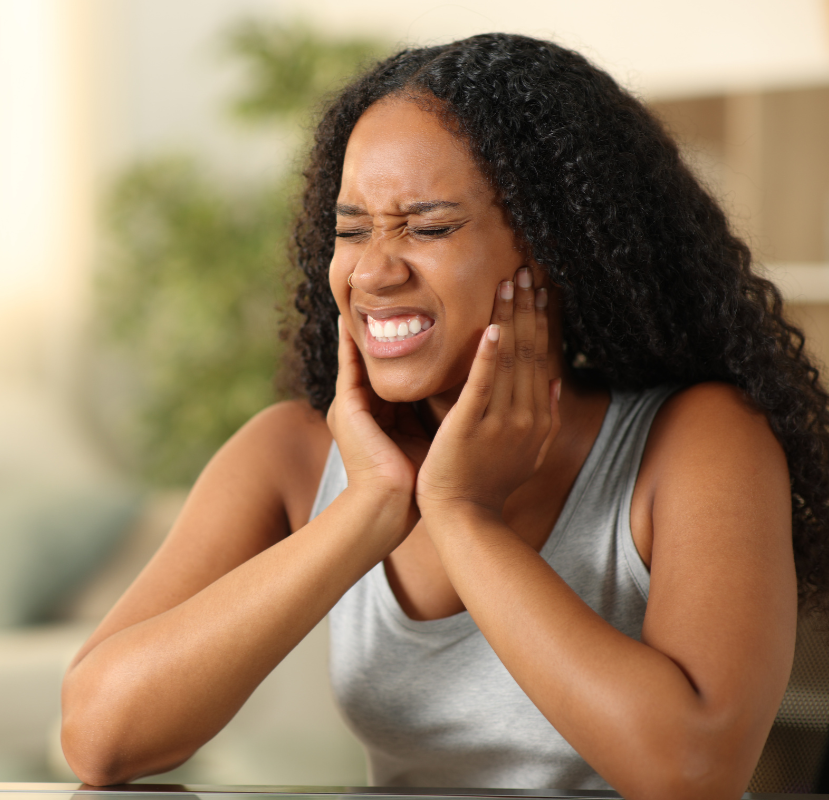
Meanwhile, the neglected side has its own problem: less chewing means less of the natural self-cleaning action that chewing and saliva flow provide, which can allow plaque to accumulate more readily on the side that's doing less work.
The Real Question: Why Did the Habit Start?
This is the part that matters most clinically. One-sided chewing rarely starts at random. In most cases, it's the mouth's quiet workaround for a problem it didn't want to deal with directly.
The most common reason: avoiding something. A tooth that twinges under pressure. A spot where food packs uncomfortably. An old filling that feels wrong. A missing tooth that makes one side less efficient. The shift is usually unconscious — the mouth simply reroutes around the discomfort, so smoothly that most people never register the decision. Months later, the "habit" remains, but the reason has been forgotten or was never noticed.
The other common driver is a change in bite balance. When occlusion shifts — from tooth movement, wear, a new restoration, or an extraction — one side may simply meet better than the other, and chewing naturally follows the side that works.
Either way, the habit is information. A persistent, unexplained preference for one side is one of the more reliable soft signals that something in the bite deserves a look — often before that something has produced any pain at all.
What an Evaluation Looks At
When a patient mentions one-sided chewing, the checkup focuses on finding the why.
We look for the tooth being avoided — testing for sensitivity, checking for cracks or failing restorations, and identifying food traps on the neglected side. We assess the bite itself, checking how the teeth meet on both sides and whether contact is balanced. We examine existing crowns and implants on the working side for signs of overload — accelerated wear, stressed margins, or looseness. And we check the jaw muscles and joints for asymmetry, tenderness, or dysfunction that's developed around the pattern.
The goal isn't to scold anyone into chewing symmetrically. It's to find and fix whatever made one side preferable — because once the underlying reason is addressed, balanced chewing usually returns on its own.
Frequently Asked Questions
Is chewing on one side bad for you?
Occasionally, no. As a sustained pattern, yes — it overloads the teeth and jaw muscles on one side, accelerates wear and crack risk on the working teeth, and loads the jaw joints unevenly. It's also frequently a sign of an underlying bite or tooth problem.
Can chewing on one side change your face?
Over long periods, it can contribute to subtle asymmetry. The chewing muscles on the favored side develop more, which can make one side of the jawline appear fuller or more defined. This develops gradually and is usually mild, but it's a real effect of chronic muscle imbalance.
Why do I only chew on one side?
Usually because your mouth is avoiding something — a sensitive tooth, a food trap, an uncomfortable restoration, or a missing tooth — or because your bite meets better on one side. The preference is typically unconscious, which is why the underlying cause often goes unnoticed.
Does one-sided chewing damage crowns or implants?
It significantly increases the load on them. Restorations on the favored side absorb far more force than intended, accelerating wear and stressing margins. Implants are particularly affected because they lack the natural shock absorption of the periodontal ligament.
How do I stop chewing on one side?
Start by finding out why you do it — an evaluation can identify the tooth or bite issue being avoided. Once the cause is treated, balanced chewing usually returns naturally. Consciously practicing on the neglected side helps retrain the pattern afterward.
The Thing About Workarounds

The mouth is remarkably good at working around problems — so good that the workaround often outlives any memory of what it was avoiding. One-sided chewing is a perfect example: a quiet detour that starts for a reason, stays out of convenience, and slowly creates costs of its own.
If you've noticed that you always chew on the same side — or someone's pointed it out — it's worth one visit to find out what started it. Sometimes it's nothing. Often it's a small, fixable something that's much easier to address now than after it's had years to compound.
Give us a call — we'll figure out what your bite is working around.
📍 State Avenue Dental Office — Kansas City, KS (KCK) 🗣 English • Korean • Spanish