
Here's something that catches a lot of people off guard: getting a crown doesn't make a tooth immune to cavities. It's an understandable assumption — the crown is a hard, sealed cap that covers the tooth, so it feels like that tooth should be permanently protected. Many people mentally file a crowned tooth as "handled, permanently."
But a crown doesn't replace the whole tooth, and the part it doesn't cover is exactly where trouble can start — quietly, and often without pain. Understanding where and why decay develops on a crowned tooth is what lets you catch it early, while it's still an easy fix.
The Crown Doesn't Decay — but the Tooth Underneath Can
The first thing to understand is a simple distinction: the crown itself is inert. It's made of porcelain, ceramic, or metal — materials that don't decay, ever. In that narrow sense, a crowned surface can't get a cavity.
But a crown is a cap over a real, living tooth. Underneath and around it, your natural tooth structure remains — and that structure is just as vulnerable to decay as any other tooth. The crown protects the surfaces it physically covers, but it doesn't transform the tooth beneath into something decay-proof.
So the question was never whether the crown decays. It's whether the natural tooth it's protecting can still develop a cavity somewhere the crown doesn't reach. And it can — in one specific, predictable place.
Where Decay Actually Starts: The Margin
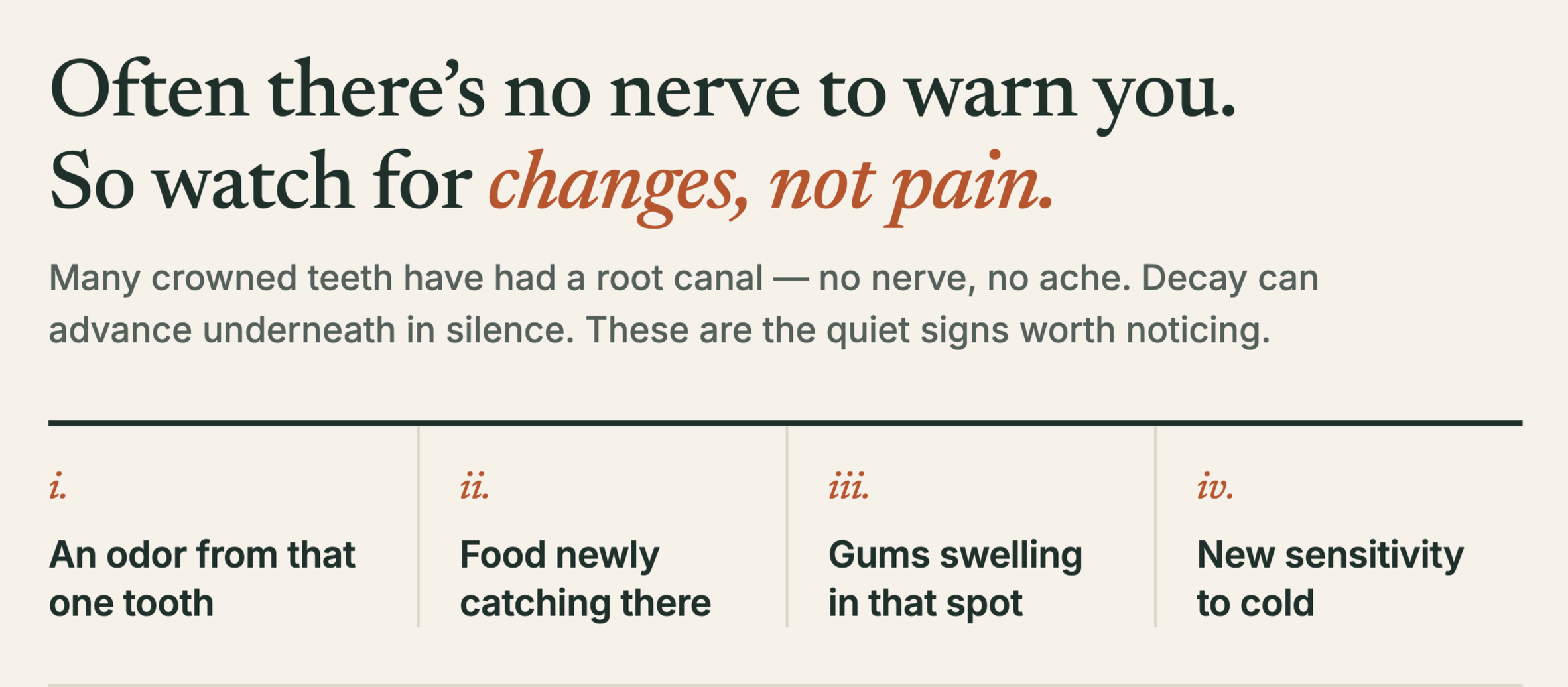
Decay on a crowned tooth almost always begins at the margin — the border line where the edge of the crown meets your natural tooth, usually right around the gumline.
This is the one spot where the sealed crown surface ends and exposed natural tooth begins. Even on a perfectly made crown, that junction is a potential foothold: plaque and bacteria collect there, and if the area isn't cleaned thoroughly, decay can begin right at that border and work its way underneath. This is why decay on a crowned tooth is often called recurrent decay — it starts at the seam, not on the cap.
Two things make this margin considerably more vulnerable over time.
Gum recession exposes it.
When a crown is placed, the margin often sits right at or just below the gumline, tucked away. But gums naturally recede a little over the years, and as they do, that margin becomes exposed. What was once a protected seam is now out in the open, collecting plaque and harder to keep clean.
The exposed area has little or no enamel.
This is the part that makes it genuinely risky. The margin sits close to the tooth's root, and roots aren't protected by hard enamel the way the crown of a tooth is. The root surface is covered by a much thinner, softer material. So when decay starts at an exposed margin, it's attacking one of the least protected surfaces on the whole tooth — which means it progresses faster there than it would on a normal enamel surface.
Why You Often Can't Feel It
There's a second factor that makes decay under a crown especially sneaky: a large share of crowned teeth have also had a root canal.
Crowns are frequently placed on teeth that needed a root canal — the procedure leaves a tooth more brittle, so it's capped for protection. But a root-canaled tooth has had its nerve removed. And no nerve means no pain signal. The built-in warning system that normally tells you "there's a cavity here, get it looked at" has been switched off on exactly the teeth where decay is most likely to hide.
The result is that decay can start at the margin, work its way underneath the crown, and progress significantly — all without producing the toothache that would normally send someone to the dentist. By the time anything hurts, if it hurts at all, the decay is often well advanced. This is why crowned teeth genuinely need closer monitoring, not less.
What to Watch for Instead of Pain
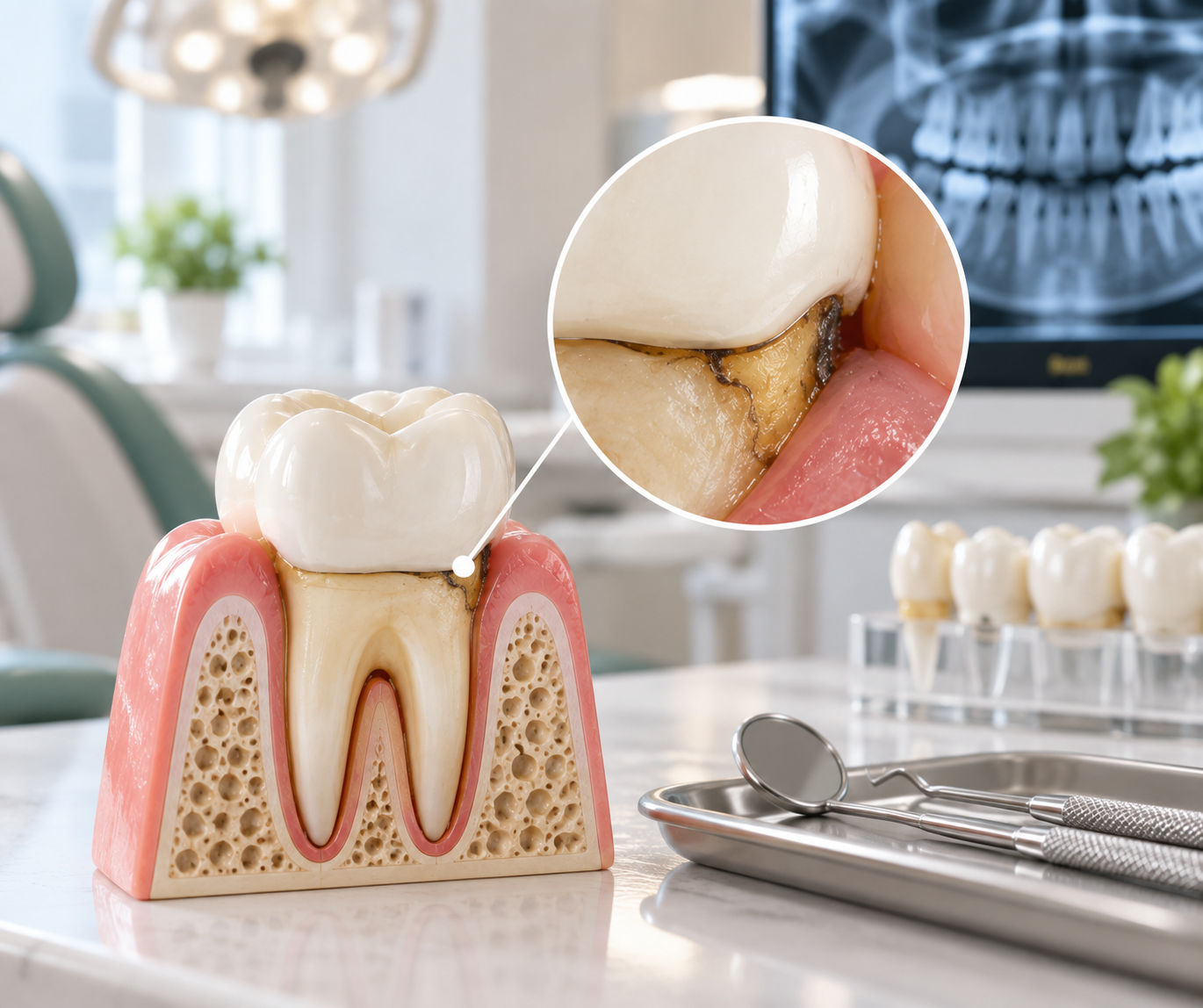
If pain isn't a reliable signal, what is? These are the changes worth paying attention to around a crowned tooth — the quiet signs that decay may be developing at the margin:
An odor from that specific area. A persistent bad smell localized to one crowned tooth can indicate bacteria and decay accumulating at the margin.
New food trapping. If food suddenly starts catching around a crown where it never did before, it can mean the margin has opened up or decay has created a gap.
Gums that swell there frequently. Recurring inflammation or swelling of the gum around one particular crown is a signal worth checking — the bacteria driving decay also irritate the surrounding tissue.
New sensitivity to cold. Even on a crowned tooth, new cold sensitivity can indicate that decay has reached sensitive tooth structure at or below the margin (this applies especially to crowned teeth that have not had a root canal and still have a live nerve).
None of these is dramatic, and that's exactly the point. They're easy to dismiss — but around a crowned tooth, they're the signals doing the job pain can't.
Why Catching It Early Changes Everything
The reason all this monitoring matters comes down to how much easier early treatment is than late treatment.
Caught early, decay at a crown margin is a very manageable problem. The dentist removes the crown, cleans out the decay from the underlying tooth, and places a new crown on the cleaned-up foundation. It's essentially a redo of the original crown — more involved than a simple filling, but a routine, tooth-saving procedure.
Left too long, the same decay follows the path underneath the crown down toward the root. Once it reaches deep enough, the tooth may no longer have enough sound structure to support a new crown — and the situation can move from "clean it out and re-crown" to root canal complications, or to the tooth no longer being savable at all. The difference between those two outcomes is almost entirely about how early the problem is caught. That's the whole case for watching the margins.
Frequently Asked Questions
Can a tooth with a crown still get a cavity?
Yes. The crown itself doesn't decay, but the natural tooth underneath it can — especially at the margin, where the crown meets the tooth near the gumline. This is called recurrent decay, and it's a common reason crowns eventually need to be replaced.
Why does decay form under a crown?
It starts at the margin, where the crown's edge meets natural tooth. Plaque collects at that seam, and as gums recede over time, the margin becomes exposed. Because that area is near the root and has little protective enamel, decay there can progress faster than on a normal tooth surface.
Can you feel a cavity under a crown?
Often not. Many crowned teeth have also had a root canal, meaning the nerve is gone and there's no pain signal. Decay can progress significantly with no discomfort at all, which is why watching for other signs — odor, food trapping, gum swelling — matters more than waiting for pain.
What are the signs of decay under a crown?
Watch for a persistent odor from that tooth, food newly getting caught around the crown, frequent gum swelling in that spot, or new sensitivity to cold. These changes can signal decay at the margin even when there's no pain.
Does getting a crown mean the tooth is protected forever?
No. A crown protects the surfaces it covers, but the natural tooth underneath still needs care — arguably more attention at the margin than an average tooth. Good cleaning around the gumline and regular checkups are what keep a crowned tooth healthy long-term.
The Thing About "Handled"
It's natural to think of a crowned tooth as a finished project — a problem that got fixed and can now be crossed off the list. That mental filing is exactly what makes decay under a crown so easy to miss: the one tooth you've stopped worrying about is quietly the one that needs a particular kind of attention.
The reframe worth carrying is small but useful. A crown isn't the end of a tooth's story; it's a tooth wearing protective gear over most of itself, with one seam left where care still matters. Clean that margin well, watch for the quiet signs, and keep up with checkups, and a crowned tooth can last for many years. Ignore it because "that one's already done," and the margin is where it can slowly come undone.
If you've got a crown and you've noticed any of the signs here — or you just can't remember the last time anyone looked closely at it — give us a call. Checking a margin is quick, and it's the kind of thing that's far easier to stay ahead of than to catch up on.
📍 State Avenue Dental Office — Kansas City, KS (KCK) 🗣 English • Korean • Spanish