
Why Am I Getting Cavities If I Brush Every Day?
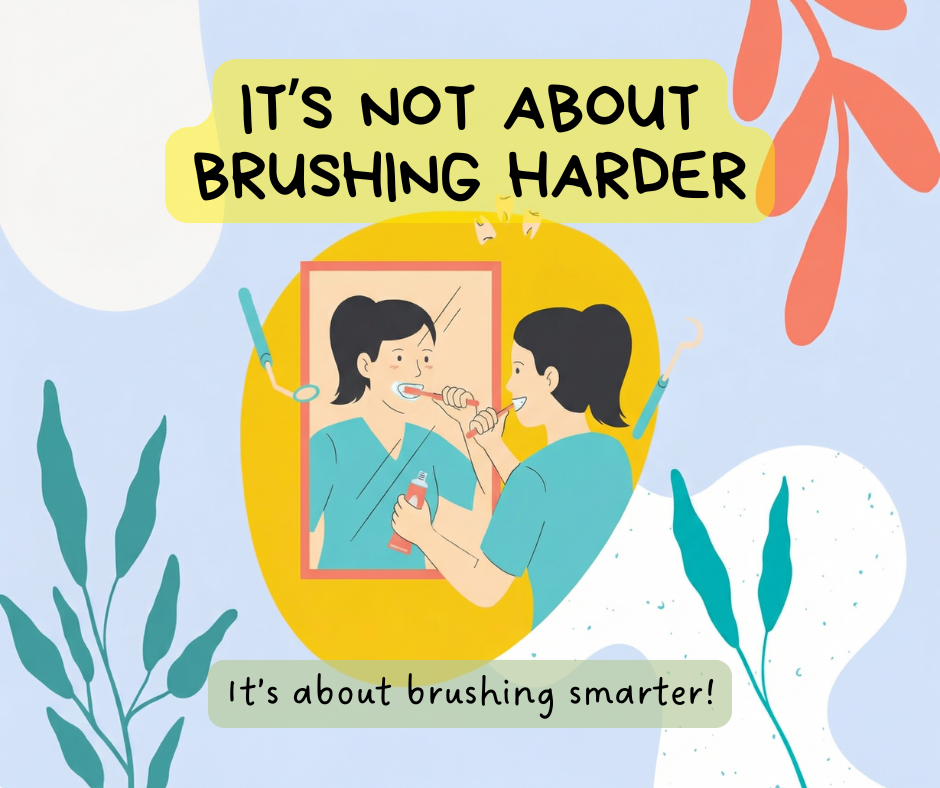
Few things in dentistry are as quietly demoralizing as this: you brush twice a day, you're not eating candy for breakfast, and you still walk out of a checkup with a new cavity. It feels like the rules don't apply to you — or worse, like you're doing something wrong that nobody's bothered to explain.
Here's the honest answer: for a lot of people, cavities aren't a discipline problem. They're a direction problem. Brushing consistently matters — but when you brush, how you brush, and what's happening in your mouth between brushes can matter just as much, sometimes more.
Let's work through the actual variables.
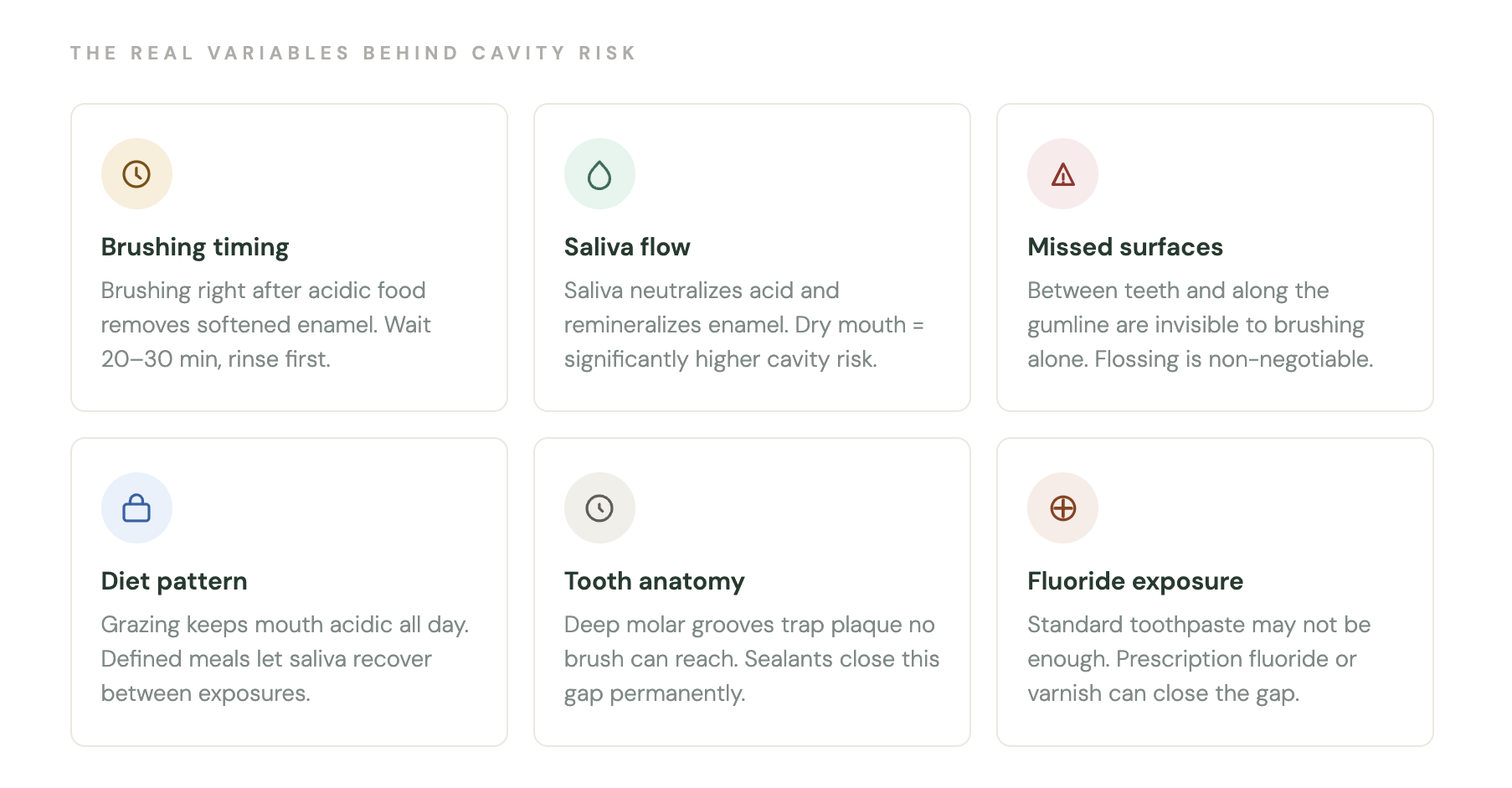
The Timing Problem: Why Brushing Right After Eating Can Backfire
This one surprises people. The instinct to brush immediately after a meal feels hygienic — and in many cases, it is. But there's an important exception.
When you eat or drink anything acidic — sodas, citrus fruits, vinegar-based foods, sports drinks, wine — the pH in your mouth drops. Acid temporarily softens the mineral structure of your enamel, a process called demineralization. In this softened state, your enamel is more vulnerable to physical abrasion. Brushing while it's in that condition doesn't clean more effectively — it removes more enamel.
The fix is simple: rinse with water immediately after eating, then wait 20 to 30 minutes before brushing. During that window, your saliva works to neutralize the acid and begin remineralizing the enamel surface. By the time you brush, the surface has recovered enough to handle it.
If you've been brushing right after every meal your whole life — especially if those meals often include acidic foods — this single habit change can make a meaningful difference over time.
The Saliva Factor: Your Mouth's Built-In Defense System
Saliva is one of the most underappreciated variables in cavity prevention, and it's the one that explains why some people seem to get cavities no matter how well they brush.
Here's what saliva actually does:
Neutralizes acid after eating, restoring the mouth's pH toward a safe range
Remineralizes enamel by delivering calcium and phosphate ions to the tooth surface
Washes away food debris and reduces the time bacteria have access to fermentable sugars
Contains antimicrobial proteins that inhibit certain cavity-causing bacteria
When saliva flow is normal and consistent, it acts as a continuous buffer. When it's reduced — which happens more often than most people realize — the mouth spends more time in an acidic, bacteria-friendly environment.
Dry mouth (xerostomia) is common, and it has a long list of causes that have nothing to do with hydration habits. Many of the most frequently prescribed medications list dry mouth as a side effect: antihistamines, antidepressants, blood pressure medications, diuretics, and dozens of others. If you've started a new medication and noticed a change in your cavity rate, that connection is worth raising with both your dentist and your physician.
Mouth breathing during sleep is another major contributor. While you sleep, saliva production drops significantly. For people who breathe primarily through their mouth at night — whether due to nasal congestion, sleep apnea, or habit — the teeth can spend hours in a dry, unprotected environment every single night. This is one reason some patients present with cavities concentrated along the gumline or on surfaces that would normally be well-protected by saliva flow.
The Technique Problem: What Your Brushing Might Actually Be Missing
Brushing twice a day is the baseline — but if the technique isn't covering the right areas, the frequency doesn't compensate.
The most cavity-prone surfaces in adults are:
Between the teeth (interproximal). A toothbrush, no matter how well used, cannot clean between teeth. That's what floss and interdental brushes are for. Decay between teeth — interproximal decay — is one of the most common findings on X-rays, and it develops entirely in the blind spot of even the most dedicated brusher.
Along and below the gumline. Plaque accumulates at the gumline, where the tooth meets the gum, and it's easy to brush above this area without fully addressing it. The correct technique angles the brush at roughly 45 degrees toward the gumline, using small circular or sweeping motions rather than scrubbing back and forth.
The back molars. These are the hardest to reach and the easiest to under-brush. A smaller-headed brush or an electric toothbrush makes meaningful contact with these surfaces more reliably.
Electric vs. manual: Research consistently shows that oscillating electric toothbrushes reduce plaque and gingivitis more effectively than manual brushing. That's not because manual brushing is inherently inadequate — it's because electric toothbrushes are less dependent on technique. If you're a strong manual brusher with good coverage, your results may be equivalent. If you're not sure, an electric brush removes the variability.
The Diet Factor: It's Not Just Sugar

Cavity-causing bacteria (Streptococcus mutans and others) feed on fermentable carbohydrates and produce acid as a byproduct. Sugar is the obvious culprit, but it's not the only one.
White bread, crackers, chips, pasta, and other refined starches break down into simple sugars quickly and create the same acidic environment. Frequency of exposure matters as much as quantity — grazing on snacks throughout the day keeps the mouth in a prolonged low-pH state, which favors cavity formation far more than a single larger meal.
The practical implication: consolidating eating into fewer, more defined meals and drinking water rather than snacking throughout the day gives your saliva time to recover between acid challenges. It's not about eliminating carbohydrates — it's about the pattern of exposure.
The Fluoride Factor: Are You Getting Enough?
Fluoride strengthens enamel by incorporating into its mineral structure, making it more resistant to acid attack. For most people, a fluoride toothpaste used twice daily provides a reasonable baseline. But for patients who are cavity-prone, that baseline sometimes isn't enough.
Options that go beyond standard toothpaste include:
Prescription-strength fluoride toothpaste (5,000 ppm vs. the 1,000–1,500 ppm in standard products) — available through your dentist
Fluoride varnish applied at professional cleanings, which provides a concentrated dose directly to the tooth surface
Fluoride mouth rinse used as a daily supplement
If you're getting cavities despite good habits, the question of whether your fluoride exposure is adequate is worth raising at your next visit.
What "Cavity-Prone" Actually Means
Some patients carry a higher baseline risk regardless of habits — and understanding why is useful.
Tooth anatomy. Some people have deeper fissures and grooves on their molars. These are natural and common, and they're excellent at trapping plaque that a brush can't reach. Dental sealants — thin resin coatings applied to the chewing surfaces — are an effective and straightforward way to eliminate this vulnerability.
The bacteria in your mouth. Cavity-causing bacteria can be transmitted between people — most commonly from parent to child during early childhood. Some people simply carry higher concentrations of these bacteria, which affects their baseline risk.
Genetics. Enamel quality and saliva composition have a hereditary component. If cavities run in your family despite good oral hygiene, that pattern is meaningful.
Frequently Asked Questions
Should I brush right after eating? Not immediately, especially after acidic foods or drinks. Rinse with water first, wait 20–30 minutes, then brush. This gives your saliva time to neutralize acid and allows the enamel to reharden before physical contact.
Does dry mouth really cause cavities? Yes — significantly. Saliva is your mouth's primary defense against acid and bacteria. Reduced saliva flow, from any cause, increases cavity risk substantially. If you experience chronic dry mouth, it's worth discussing with your dentist.
I floss every day and still get cavities. What else can I do? Timing, saliva quality, fluoride exposure, dietary patterns, and tooth anatomy all affect cavity risk independently of brushing and flossing. A cavity risk assessment at your next visit can identify which factors apply to your specific situation.
Are some people just genetically prone to cavities? Yes, to a degree. Enamel quality, saliva composition, and the bacteria you carry all have hereditary components. But even high-risk patients can significantly reduce their cavity rate with the right targeted interventions.
What Twenty Years in Kansas City Actually Teaches You
Two decades in Kansas City teaches you one thing pretty clearly: the patients who end up with the least dental work are usually just the ones who showed up before anything hurt, before anything broke, before the decision got made for them.
We've seen the other side too — people who came in when something finally forced them to. No judgment. But there's almost always a harder conversation to be had, and a more complicated path forward.
That's the actual reason we talk about preventive care. Not because it's the responsible thing to say, but because we've watched it play out both ways long enough to know which one we'd rather help you with.
If it's been a while, give us a call. We'll tell you exactly what we see and figure out the most realistic path from there.
📍 State Avenue Dental Office — Kansas City, KS (KCK) 🗣 English • Korean • Spanish