

The day your braces come off is a genuinely great one. After months — often years — of appointments and adjustments, you finally get to run your tongue across smooth, straight teeth and see the result in the mirror. It feels finished.
Here’s the part that catches so many people off guard: it isn’t quite finished, and the final step is the easiest one to underestimate. Keeping your new smile isn’t automatic. It depends almost entirely on a small, simple habit — wearing your retainer — and understanding why is what makes the difference between a result that lasts and one that quietly slips away.
Straightening Teeth Is Only Half the Job
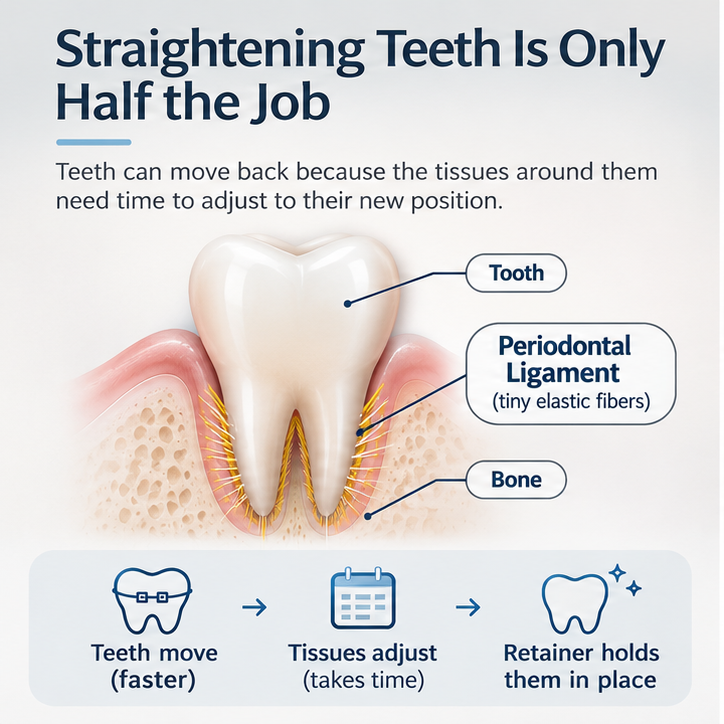
It’s tempting to think of orthodontics as a one-time move: the teeth were crooked, now they’re straight, done. But teeth aren’t set in concrete. Each one sits in its socket held by the gums and, most importantly, by a network of tiny elastic fibers called the periodontal ligament.
When braces or aligners move a tooth, they move it faster than this surrounding tissue can fully adapt. The tooth arrives in its new position, but the ligament and bone around it are still, in a sense, “remembering” the old one. Until that tissue remodels and settles into the new arrangement — which takes time — the fibers act a bit like a stretched rubber band, gently pulling the tooth back toward where it started.
This backward drift has a name in dentistry: orthodontic relapse. And it isn’t a sign that anything went wrong with your treatment. It’s simply the default behavior of a tooth whose support structure hasn’t finished catching up. The retainer’s entire job is to hold each tooth in place during that catch-up period, so the new position becomes the permanent one.
The First Year Is the Critical Window
Not all moments after braces carry equal risk. The first year — especially the first several months — is by far the most important, because that’s when the surrounding tissue is least settled and the pull back toward the old position is strongest.
This is also when relapse happens surprisingly fast. In that early window, leaving a retainer out for just a couple of weeks can be enough for teeth to move measurably. Many people discover this the hard way: they set the retainer aside during a busy stretch, go to put it back in a few weeks later, and find it suddenly feels tight, awkward, or like it won’t quite seat.
If Your Retainer Suddenly Doesn’t Fit — Don’t Force It
This is worth saying clearly, because the instinct is exactly the wrong one. If your retainer no longer goes in easily, do not push or force it into place.
A retainer that won’t seat properly is not a retainer that shrank or warped. It’s telling you something: your teeth have already moved, and the retainer — made to fit their previous position — no longer matches. Forcing it can put harmful, uncontrolled pressure on the teeth and the appliance itself.
The right move is simple: stop, and come in as-is. We can assess how much the teeth have shifted and determine the best way forward — often far easier to address early, before the drift goes further. A retainer that no longer fits is a signal to be seen, not a problem to muscle through at home.
The Hidden Risk of the Fixed Retainer
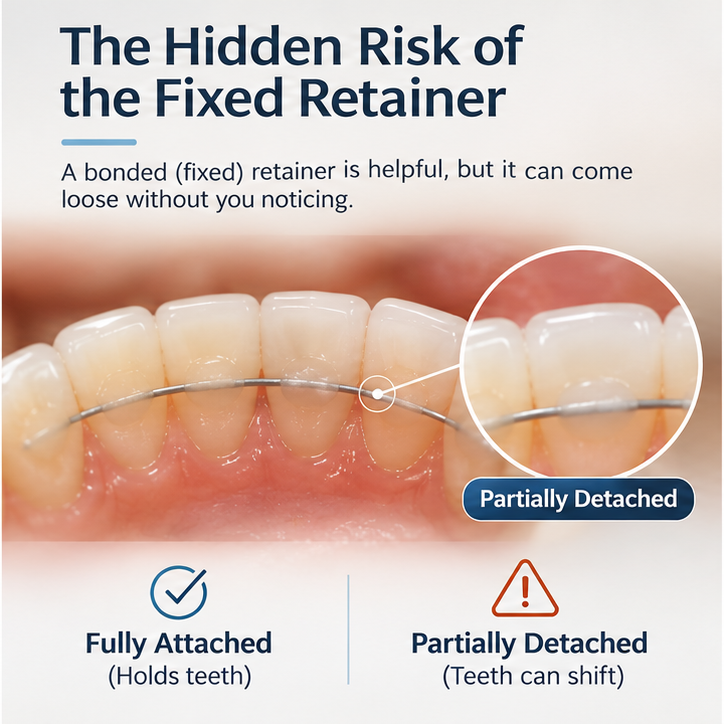
Many patients — particularly those with a thin wire bonded behind the lower front teeth (a fixed, or permanent, retainer) — assume they’re exempt from all of this. After all, it’s attached; there’s nothing to remember to wear. That assumption is exactly where the risk hides.
A bonded retainer holds the teeth because the wire is attached at multiple points. But if even one end of that wire quietly detaches — from a hard bite, normal wear, or time — the teeth in that area are no longer held, and they can begin to drift from that spot. The trouble is its location: because the wire sits on the inside surface of the teeth, a partial failure is nearly invisible. Many people go weeks or months without realizing anything has come loose, while the teeth are slowly moving the whole time.
This is why a fixed retainer isn’t a “set it and forget it” solution. It needs periodic checks to confirm it’s still fully bonded — a quick look that takes seconds and prevents exactly the kind of silent relapse that’s hardest to catch on your own.
The Good News: Retainer Duty Gets Lighter Over Time
If all of this sounds like a lifelong burden, here’s the reassuring reality: the commitment shrinks dramatically as time goes on, precisely because the tissue does eventually settle.
The typical progression looks like this:
At first, a removable retainer is worn close to full-time, while the surrounding tissue is least stable.
After that, as things settle, it drops to nights only — worn while you sleep.
Eventually, maintenance eases further, to just a few nights a week.
The exact timeline is individual, and your dentist will guide the step-downs based on how your teeth are holding. But the direction is always the same: lighter and lighter over time. What never fully disappears is the value of some long-term retention, because teeth have a mild tendency to shift throughout life — with or without a history of braces.
The Simplest Way to Protect What You Built
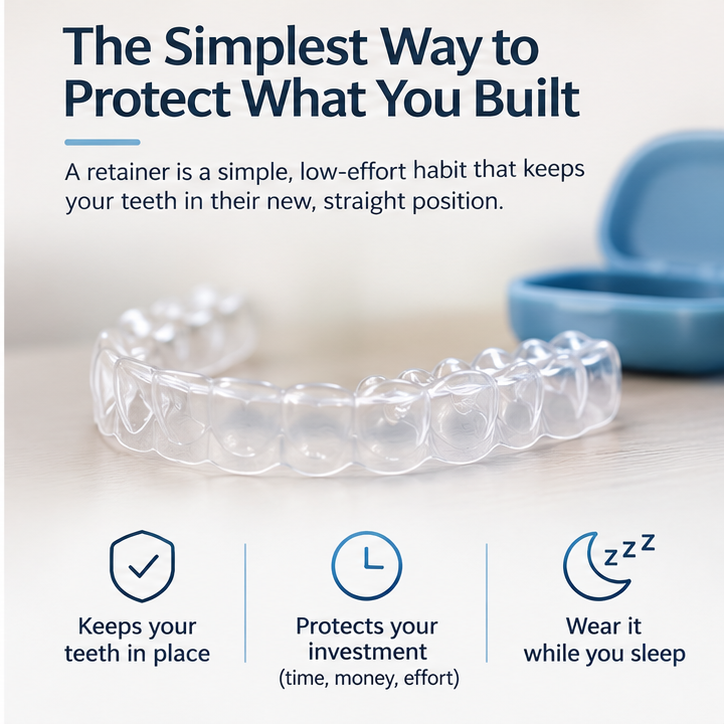
Step back and the logic is hard to argue with. Orthodontic treatment is a significant investment — of time, of money, and of patience through every adjustment. Relapse can undo a meaningful part of that result, and it can do it quietly, within weeks, especially early on.
Against all of that stands a retainer: an appliance you wear while you sleep. It is, without exaggeration, the single simplest and most reliable thing you can do to protect a result that took so much to achieve. Few things in dentistry offer that kind of return for that little effort.
If your retainer has started to feel tight, if you’ve fallen out of the habit, if you’re not sure your bonded wire is still fully attached — or if you simply haven’t had it checked in a while — come in and let us take a look. Protecting your smile is far easier than rebuilding it.
Frequently Asked Questions
What happens if I stop wearing my retainer?
Your teeth gradually drift back toward their original positions — a process called orthodontic relapse. It happens because the gums and periodontal ligament around each tooth need time to settle after treatment, and until they do, the fibers pull the teeth backward. The effect is strongest in the first year, when even a couple of weeks without a retainer can cause noticeable movement.
How fast do teeth shift without a retainer?
Faster than most people expect, especially soon after braces. In the critical first year, leaving a retainer out for just a few weeks can move teeth enough that the retainer no longer fits properly. Relapse slows over time as the tissue stabilizes, but early on it can happen remarkably quickly.
Why doesn’t my retainer fit anymore?
Because your teeth have already moved. A retainer that won’t seat easily isn’t warped — it’s made for your teeth’s previous position, which has changed. Don’t force it in, as that can harm the teeth and the appliance. Instead, come in as-is so we can assess the shift and advise the best next step.
Can a permanent (fixed) retainer fail without me noticing?
Yes, and this is a common hidden risk. If one end of the bonded wire detaches, the teeth there start to drift — but because the wire is on the inside of the teeth, the failure is easy to miss for weeks or months. Fixed retainers need periodic checks to confirm they’re still fully bonded.
How long do I have to wear a retainer after braces?
It tapers over time: close to full-time at first, then nights only, and eventually just a few nights a week. The exact schedule is individualized, but some long-term nighttime retention is usually recommended, because teeth tend to shift mildly throughout life regardless of past orthodontic work.
📍 State Avenue Dental Office — Kansas City, KS (KCK) 🗣 English • Korean • Spanish