

If you wear a denture, this probably sounds familiar: it fit beautifully the day you got it. Now, a few years on, it slips when you talk, shifts when you chew, and needs more adhesive than it used to — and somewhere along the way, certain foods quietly dropped off your plate.
Here’s the part most people don’t realize: when a denture that once fit well turns loose, it’s usually not because the denture went bad. Something is changing underneath it. Understanding what that is — and what can be done about it — is the difference between a lifetime of chasing the fit and actually solving it.
A Loose Denture Is Usually a Foundation Problem
It’s natural to blame the denture itself. And occasionally that’s fair — an older denture can warp or wear. But in the large majority of cases, the denture hasn’t changed much at all. The thing that changed is the ridge of gum and bone it sits on.
A conventional denture is, in essence, a custom-fitted lid. It rests on the ridge of your jaw and stays put through suction, a snug fit, and the surrounding muscles. That entire design depends on one assumption: that the ridge beneath it stays the same shape. When the ridge changes, the lid no longer matches the jar — and no amount of craftsmanship in the denture can fix a foundation that has moved.
So to understand a loose denture, we have to look below it, at the bone.
Why the Bone Keeps Shrinking: The Part Few People Are Told
Here is the key fact that explains almost everything about a loosening denture — and it’s one many patients are never told.
Jawbone is living tissue, and like muscle, it operates on a “use it or lose it” principle. A natural tooth root constantly transmits the forces of chewing down into the surrounding bone, and that steady stimulation is the signal that tells the body to keep the bone dense and maintained. It’s the tooth root’s daily workout that keeps the bone in shape.
When the teeth are gone, that signal stops. The bone in that area is no longer being stimulated, so the body gradually reclaims it — a process called resorption. This isn’t a sign anything is wrong; it’s simply what bone does when the roots that used to load it are no longer there. And it doesn’t stop. The ridge shrinks a little more each year, slowly and silently, beneath the denture.
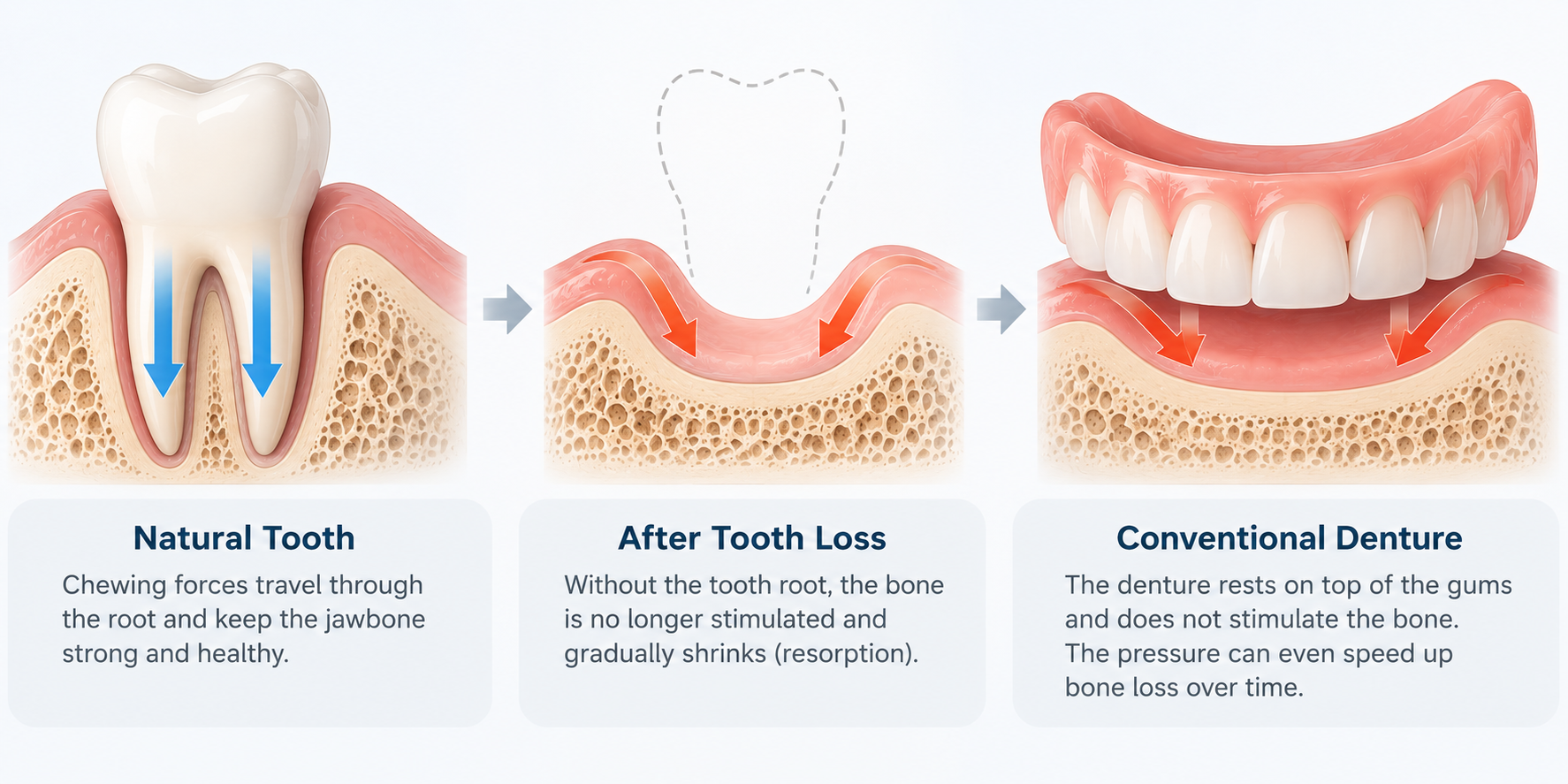
A conventional denture actually has nothing to offer against this. Because it only rests on top of the gums, it provides no stimulation to the bone underneath — and the pressure it does place on the ridge can even modestly speed resorption along. This is why the problem is progressive: the foundation the denture needs is quietly lowering, year after year.
The Slow Slide Most Wearers Recognize
Put the pieces together, and the familiar pattern makes sense. As the ridge flattens, the denture that was molded to the old, taller shape fits a shape that no longer exists. It loosens.
At first, it’s manageable — a little adhesive, a few foods avoided. But because resorption continues, so does the loosening. The adhesive goes on thicker and more often. More foods come off the menu — the apple, the steak, the crusty bread — not by choice but by necessity. For many wearers, the end point is a denture that moves when they speak, clicks when they eat, and makes them self-conscious about both. It’s a steady slide, and it traces directly back to the shrinking foundation underneath.
The Fix That Addresses the Cause: An Implant-Retained Denture
Here’s the encouraging part. There’s a well-established solution that doesn’t just chase the fit with more adhesive — it anchors the denture to something that doesn’t shrink away.
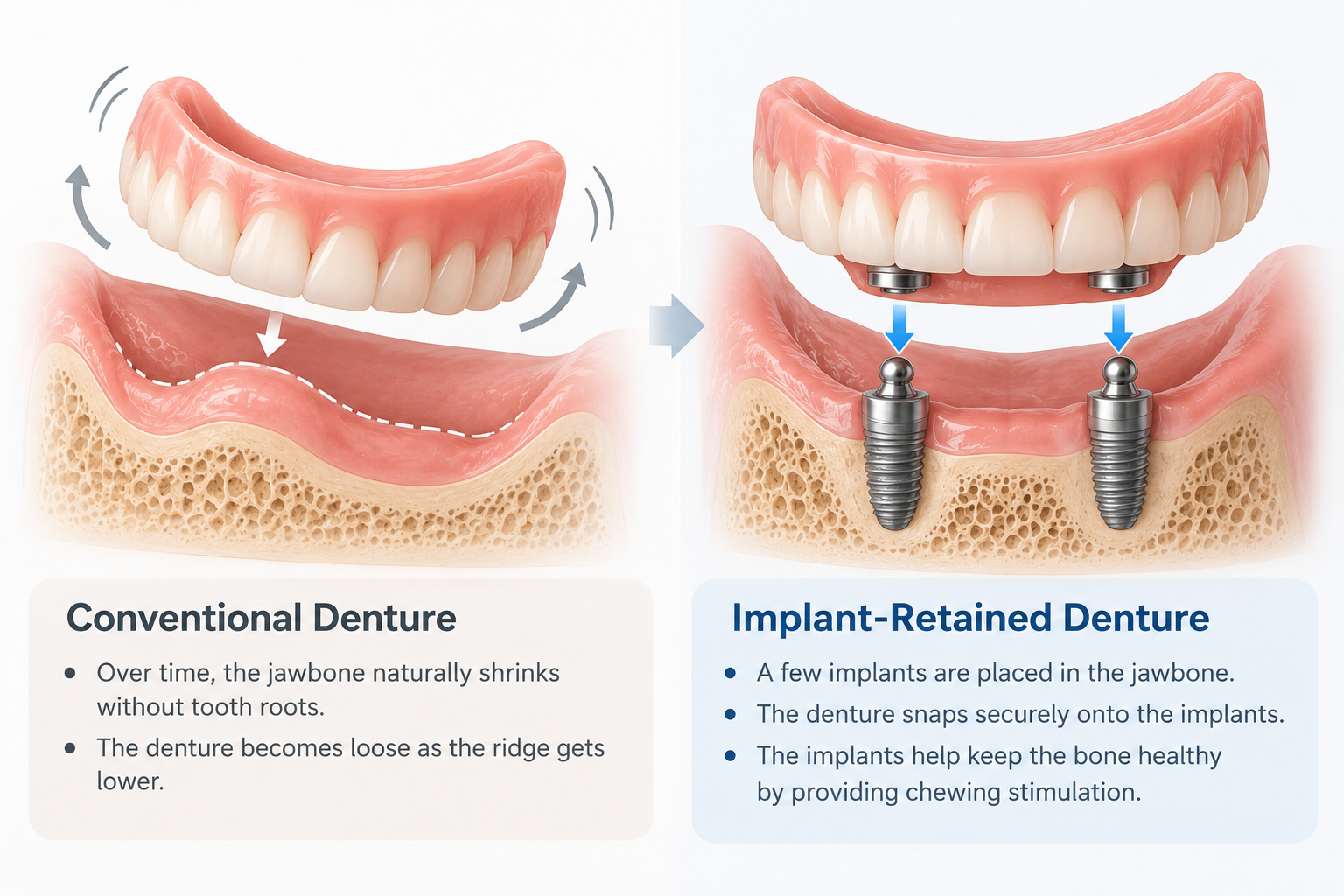
It’s called an implant-retained denture (sometimes a “snap-in” or “overdenture”), and the idea is elegantly simple. Rather than replacing every tooth with its own implant, the dentist places just two to four implants into the jawbone. Small attachments on those implants let your denture snap firmly into place and lock there — secure while you wear it, and still removable when you want to take it out.
The result is a denture that’s held by the bone, not balanced on top of it. And because the implants transmit chewing forces down into the jaw the way natural roots once did, they also give the bone the stimulation it’s been missing — helping slow the very resorption that caused the problem in the first place. It treats the cause, not just the symptom.
What Actually Changes Day to Day
The practical improvements are what patients notice most:
Chewing power returns. Because the denture no longer shifts or lifts when you bite, you can chew with real force again. Firmer foods that had quietly disappeared from your meals often come back.
Speech steadies. A denture that stays put doesn’t slip or click mid-sentence, which removes a common and frustrating source of self-consciousness.
Food tastes better — especially on top. This one surprises people. A conventional upper denture covers the roof of your mouth (the palate) to hold its suction, and the palate is rich in the sensors that help you taste and feel food. Because an implant-retained upper denture is anchored instead of suctioned, that palate coverage can be greatly reduced or removed — and many people rediscover flavors and temperatures they’d forgotten a denture was muting.
Cleaning stays simple. It’s still a removable denture. You take it out and clean it just as you do now — you simply get a secure, anchored fit while it’s in.
The One Thing That Decides Your Options: Timing

If there’s a single point to take from all of this, it’s this: bone you still have is far easier to work with than bone you’ve already lost.
Because resorption never pauses, the amount of jawbone available to anchor implants is greatest today and smaller every year that follows. When there’s ample bone, placing the implants is typically straightforward, and your options are at their widest. When the ridge has shrunk significantly, the path can still exist — but it may require additional steps, such as bone grafting, to rebuild enough foundation first.
That’s why this isn’t a decision to leave for “someday.” Even if you’re not ready to act, it’s genuinely worth knowing where your bone stands now, while the full range of options is still open to you. The best time to protect your choices is while you still have them.
If your denture has been slipping, loosening, or sending more foods to the “can’t eat that anymore” list, let’s take a look at what’s happening underneath and talk through whether anchoring it with implants makes sense for you. The sooner we look, the more options you’ll have.
Frequently Asked Questions
Why does my denture keep getting loose?
Usually because the jawbone beneath it is shrinking. Without tooth roots to stimulate it, the bone slowly resorbs year after year, so the ridge your denture was molded to gradually flattens. Even a well-made denture stops fitting once its foundation changes shape — which is why loosening tends to get worse over time, not better.
Can a denture be anchored with implants?
Yes. An implant-retained denture uses just two to four implants placed in the jaw, with attachments that let the denture snap securely onto them. It stays firmly in place while worn and is still removable for cleaning — combining the stability of implants with the convenience of a denture.
How many implants are needed to hold a denture?
Typically two to four, depending on the jaw (upper or lower), your bone, and your goals. This is far fewer than replacing every tooth individually, which is part of what makes an implant-retained denture a practical, cost-effective option for many people.
Will an implant-retained denture help me taste food better?
Often, yes — particularly on the upper jaw. A conventional upper denture covers the palate (roof of the mouth) for suction, which dampens taste and temperature sensation. Because an anchored denture doesn’t rely on that suction, the palate coverage can be reduced or removed, and many patients notice food tastes noticeably better.
Why does timing matter so much?
Because jawbone resorption never stops. The more bone you still have, the simpler implant placement is and the wider your options are. If too much bone is lost, treatment may require bone grafting first. Deciding while enough bone remains keeps the full range of choices open.
📍 State Avenue Dental Office — Kansas City, KS (KCK) 🗣 English • Korean • Spanish