
Sports Dental Injuries in Adults: What Every Kansas City Weekend Warrior Needs to Know
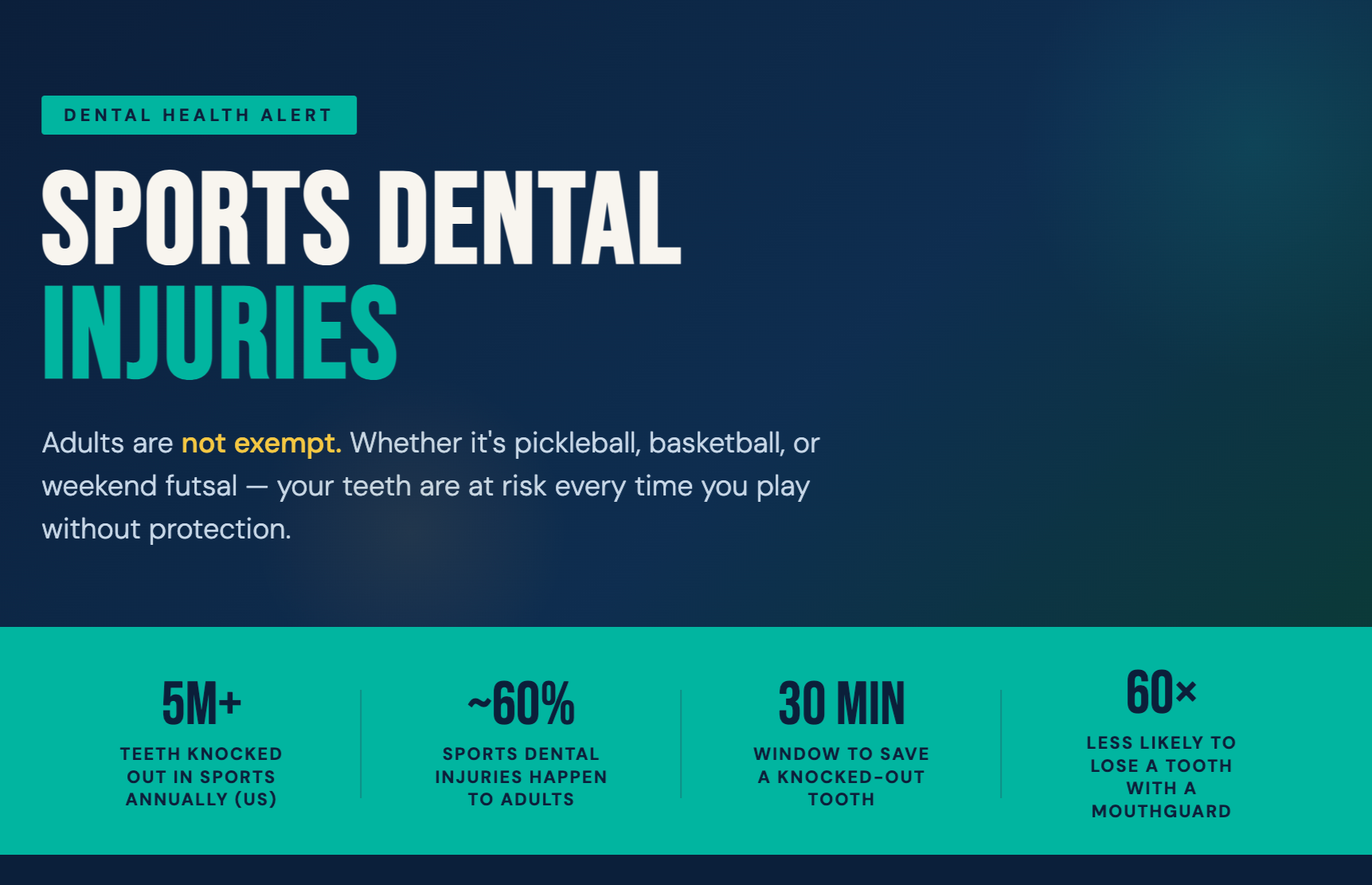
You Wore the Right Shoes. You Stretched. But Did You Protect Your Teeth?
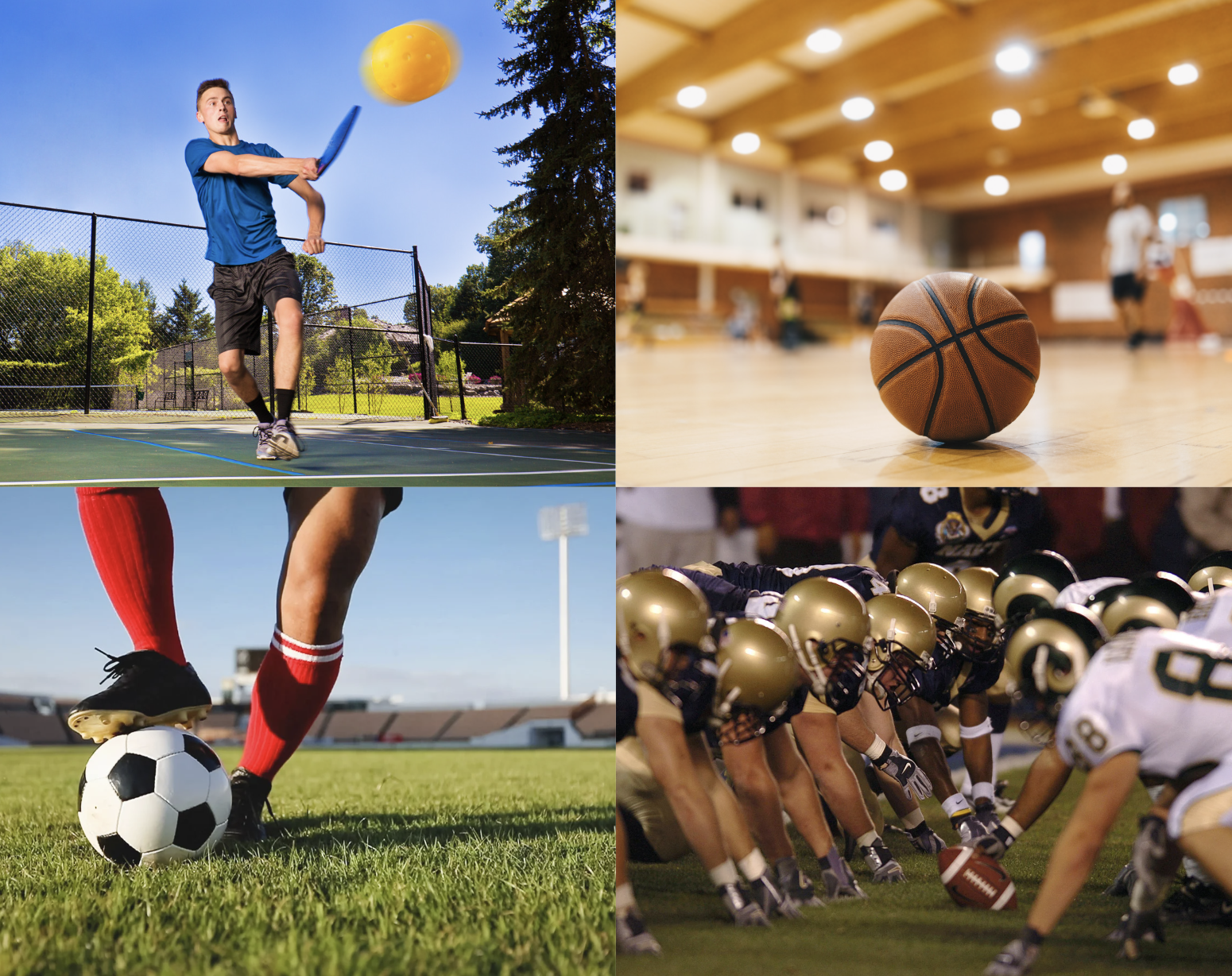
There's a certain pride in being an active adult. Maybe you've got a regular pickleball crew on Tuesday nights. Maybe you're showing the younger generation what's what on the basketball court. Or maybe your weekend futsal league is the highlight of your week.
You've probably thought about hydration, the right gear, maybe even a solid warm-up routine. But here's a question your dentist wants to ask: are you protecting your teeth?
At State Avenue Dental Office in Kansas City, KS, we see it more often than you'd think — adults coming in after a sports collision, a stray elbow, or a fall, with a chipped tooth, a suspicious crack, or a jaw that just doesn't feel right. And almost every time, the first words out of their mouth are: "I didn't think it was that serious."
The Surprising Truth: Sports Dental Injuries Are a Very Adult Problem
There's a common assumption that knocked-out and broken teeth are something that happens to kids playing Little League or teenagers roughhousing on the soccer field. The data — and our daily experience in the dental chair — tells a different story.
According to the American Dental Association, sports-related dental injuries account for a significant portion of dental trauma cases each year, and a growing percentage of those patients are adults. Recreational sports participation among adults over 30 has surged in recent years, with pickleball alone adding millions of new players annually. More players on the court means more elbows, rackets, and hard floors in close proximity to people's faces.
Here in the Kansas City metro — where outdoor courts are packed from spring through fall and indoor leagues run year-round — we see this play out regularly. Amateur doesn't mean low-risk. In fact, adult recreational players are often at higher risk because they may not warm up adequately, may have older dental restorations that are more vulnerable, and — critically — are far less likely to be wearing a mouthguard.
What Happens When You Take a Hit to the Mouth
The biology of dental trauma isn't always intuitive — and that gap between what people expect and what's really happening is where a lot of preventable damage occurs.
What you see on the surface is rarely the whole story.
When you take an impact to the face — from a ball, an elbow, a fall, or even just clenching hard at the wrong moment — several things can happen to your teeth:
1. Chipped or fractured enamel The most obvious type of injury. You can see it, feel it with your tongue, and it's clearly not supposed to look that way. These need to be evaluated promptly, even if they seem minor. Small chips can become stress points for larger fractures.
2. Craze lines and hidden cracks (the sneaky ones) This is what keeps dentists up at night. A tooth can absorb an impact, look completely normal in the mirror, and have a hairline crack running deep into the dentin or toward the nerve. No pain initially — sometimes none for weeks or months. Then, slowly or suddenly, comes sensitivity to temperature, pain when biting, or an ache that seems to come from nowhere.
3. Tooth luxation — when a tooth shifts A hard enough impact can loosen a tooth or shift it slightly in its socket without knocking it out entirely. The tooth may feel a little "off," bite differently, or be mildly tender. These cases require prompt evaluation because the supporting ligaments and bone can be affected.
4. Nerve damage Even without a visible crack, blunt force trauma can damage the nerve inside the tooth — a condition called pulpitis. The tooth may eventually darken in color, become sensitive, or abscess. Root canal treatment is often the only resolution.
5. Jaw stress and TMJ impact A hard blow doesn't just affect the teeth — it can stress the temporomandibular joint (jaw joint) and surrounding muscles, leading to TMJ symptoms like clicking, limited opening, or facial pain that can linger for months.
"But It Felt Fine After…" — The Most Dangerous Phrase in Sports Dentistry
Delayed pain does not mean there was no injury. Dental nerves don't always send an immediate signal, especially when the damage is in the early stages.
The classic pattern we see in the office goes something like this:
Patient takes a hit playing recreational sports
There's some brief soreness, maybe some blood
Things seem to settle down in a day or two
Three weeks later, the tooth starts aching when drinking cold water
Two months later, they're in the chair for a root canal
Would earlier evaluation have changed the outcome? Sometimes yes, sometimes no — but it would have given us more options and more time to intervene before the situation escalated.
If you've taken any kind of impact to the face or mouth during sports — even if you feel fine — it's worth a quick dental check. Think of it like getting an X-ray after a fall: you don't always know what you're dealing with from the surface.
Adults Are at Greater Risk Than Kids — Here's Why
It's counterintuitive, but adult teeth are subject to a few compounding factors that make sports trauma especially consequential:
Bite force Adult jaw muscles are fully developed and significantly stronger than a child's. The average adult bite force is around 162 pounds of pressure — meaning the mechanical forces at play in a collision are simply greater for adults.
Existing restorations Many adults in their 30s, 40s, and 50s have crowns, fillings, root canals, or other dental work from earlier in life. These teeth may look fine, but they've already been through something — and a second insult can compromise a tooth that might otherwise have survived.
Bruxism (teeth grinding) If you grind your teeth — and studies suggest that a significant portion of adults do, often without knowing it — your teeth are already under mechanical stress. Pre-stressed teeth are more susceptible to fracture from external impact.
Bone density changes As we age, subtle changes in bone density and the supporting structures of teeth can affect how well teeth absorb impact. The same hit that causes a bruise in a younger tooth might cause a fracture in an older one.
The Mouthguard: The Most Effective Tool Most Adult Athletes Ignore
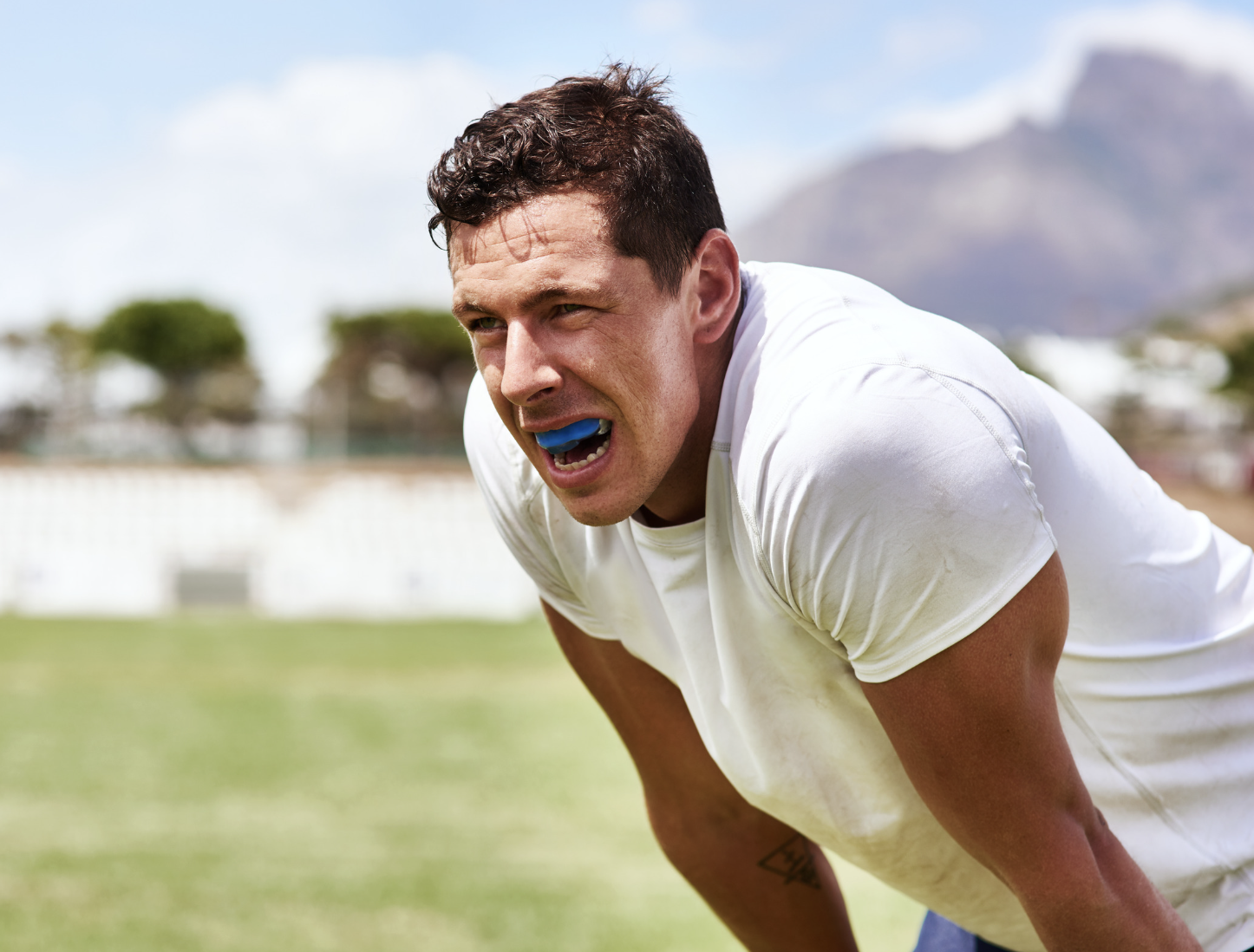
Most people think of mouthguards as something kids wear in Little League. That assumption is costing adults real teeth.
Wearing one doesn't make you look fragile. It means you've done the math.
Here's what a properly fitted mouthguard does:
Distributes impact force across a wider area of the teeth and jaw, reducing the concentration of stress at any single point
Cushions the blow between upper and lower teeth during impact, preventing tooth-on-tooth fractures
Protects soft tissue — the lips, cheeks, and tongue — from being caught between teeth during a collision
Reduces concussion risk — some research suggests mouthguards may help absorb shock before it reaches the brain, though this is an area of ongoing study
Types of mouthguards:
Stock mouthguards (the kind you find at sporting goods stores) offer some protection but don't fit well, can interfere with breathing, and aren't comfortable enough that athletes will actually wear them consistently.
Boil-and-bite mouthguards are better — they mold roughly to your teeth after softening in hot water. Still not ideal, but a step up from stock.
Custom-fitted mouthguards from your dentist are in a different category entirely. Made from a precise impression of your actual teeth, they fit securely, don't interfere with breathing or speaking, and provide optimal protection. And because they're comfortable, athletes actually wear them — which is the whole point.
If you're playing any contact or semi-contact sport — pickleball, basketball, volleyball, hockey, martial arts, soccer, rugby — a custom mouthguard from State Avenue Dental is one of the best investments you can make for your long-term oral health.
What to Do Immediately After a Sports Dental Injury
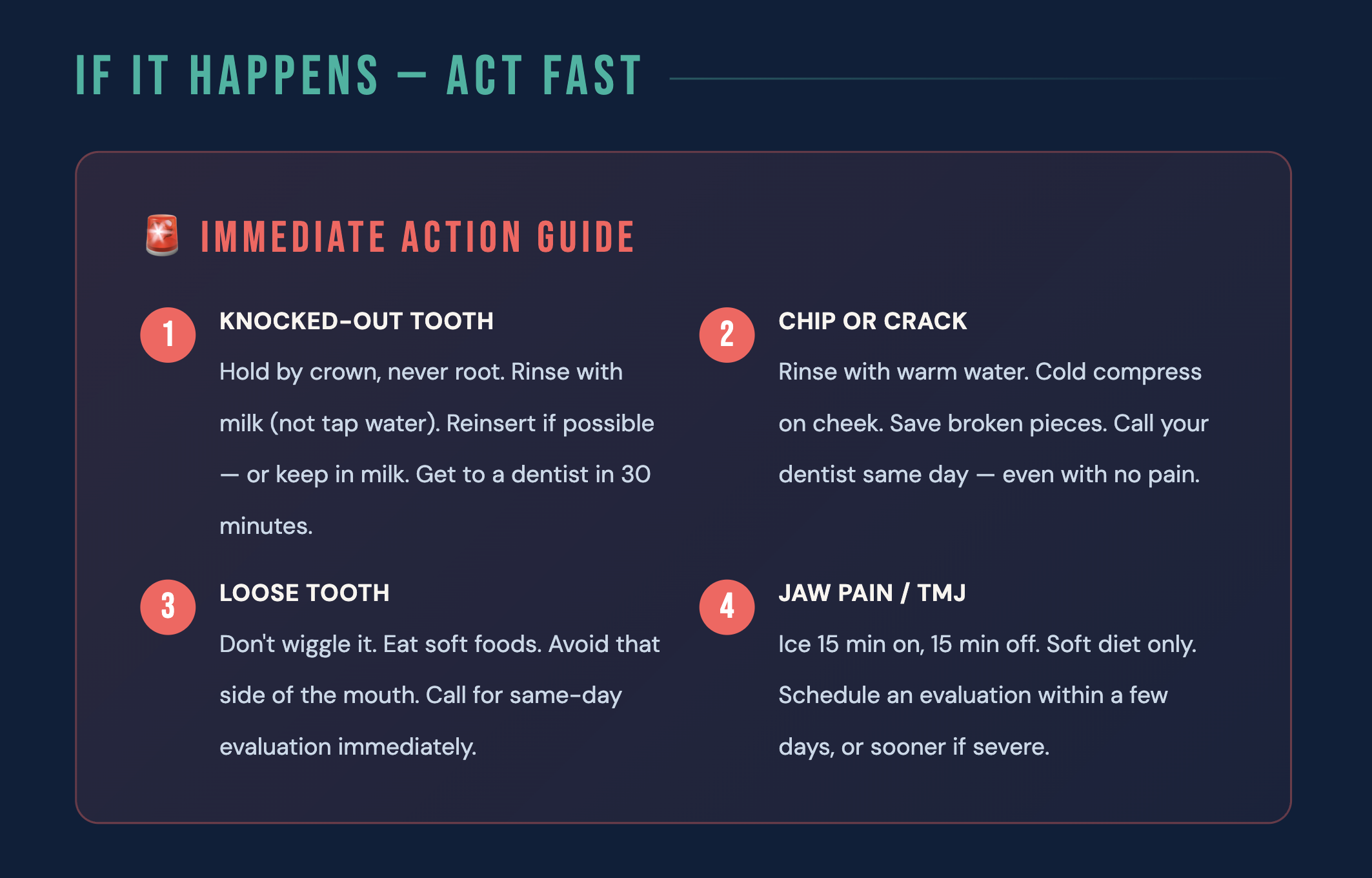
If you or a teammate takes a hit to the mouth during a game, here's what to do:
For a knocked-out tooth (avulsion):
Pick it up by the crown, never the root
If it's dirty, rinse gently with milk or saline — not tap water, not scrubbing
Try to reinsert it in the socket if you can (yes, really — this is the best option)
If reinsertion isn't possible, keep it moist — in a container of milk, saliva, or a specialized tooth-preservation kit
Get to a dentist within 30–60 minutes. This is the window where reimplantation has the best chance.
For a chipped or cracked tooth:
Rinse your mouth with warm water
Apply a cold compress to the outside of the cheek if there's swelling
Save any pieces of the tooth if you can find them
Call your dentist the same day, even if there's no pain
For a loose tooth:
Don't wiggle it or try to push it back into place yourself
Eat soft foods and avoid that side of the mouth
Call your dentist immediately for an evaluation
For jaw pain or suspected TMJ trauma:
Apply ice for 15–20 minutes at a time
Stick to soft foods
Schedule an evaluation within a few days — or sooner if the pain is severe or you're having trouble opening your mouth
Kansas City's Active Lifestyle Deserves Active Dental Protection
We love that Kansas City has such a vibrant sports culture. From the pickleball explosion at community centers across Johnson County and Wyandotte County, to basketball leagues at community gyms, to the soccer fields all over the metro — our patients are active, and that's something to celebrate.
We just want to make sure that your smile keeps up with your lifestyle.
At State Avenue Dental Office, we offer custom sports mouthguards that are designed to fit your teeth precisely, protect you during play, and not get in the way of a good time. We also offer prompt evaluation for sports-related dental injuries — because when something happens, you shouldn't have to wait a week to find out if there's a problem.
Signs You Should Come In After Any Sports Collision (Even If You Feel Fine)
Sensitivity to hot or cold that wasn't there before
A tooth that feels slightly "off" when you bite down
Visible chip, crack, or roughness on a tooth
Mild or moderate tooth soreness that lingers more than a day
A tooth that feels loose or has shifted position
Jaw pain, clicking, or limited opening after a collision
A tooth that is starting to darken in color
None of these are normal, and all of them are worth a conversation with your dentist.
One Last Thing
Play your sport. Play it hard. Just wear the mouthguard.
And if something happens — a stray elbow, a bad fall, a collision you brushed off in the moment — give us a call. You don't need to be in pain to come in. A quick look now is almost always easier, cheaper, and less involved than the conversation we have six months later.
We're at State Avenue Dental Office in Kansas City, KS, and we're always glad to see you — whether it's for a custom mouthguard fitting or a same-day check after a rough game. Call us to schedule — new patients always welcome
📍 State Avenue Dental Office — Kansas City, KS (KCK) 🗣 English • Korean • Spanish Your implant investment deserves ongoing protection. We're here to help.