

Of all the questions we hear from people considering a dental implant, two come up more than any others, usually in the same breath: “How many times will I have to come in?” and “How long is this whole thing going to take?”
They’re excellent questions — and the honest answer is that it depends, in ways that are genuinely worth understanding before you begin. A dental implant isn’t a single appointment where you walk in with a gap and walk out with a tooth. It’s a staged process, carried out in deliberate steps over a period of months, and the reason it works so reliably — implants are one of the most successful procedures in all of dentistry — is precisely because it isn’t rushed. Here’s what each stage involves, and why the timeline looks the way it does.
Why an Implant Is a Process, Not a Single Appointment
It helps to understand what a dental implant actually is, because that explains everything about the timeline.

An implant replaces not just the visible tooth but the root. A small titanium post is placed into the jawbone to serve as an artificial root, and over time the bone grows around and fuses to it — a biological process called osseointegration. That fusion is what makes an implant so strong and permanent: it becomes, in effect, part of your jaw. A natural tooth that’s firmly rooted and an implant that’s fully integrated feel remarkably similar when you bite.
But biology can’t be hurried. Bone heals and fuses on its own schedule, not ours, and that healing is the single biggest reason an implant unfolds over months rather than minutes. Everything in the process is built around giving that fusion the time it needs to happen properly. Understanding the stages, then, is really understanding where that time goes.
Stage 1: Examination, Imaging, and Planning
Every successful implant begins not with drilling, but with a thorough look at what we’re working with.
At this first stage, a clinical examination is paired with a CT scan — three-dimensional imaging that shows us precisely how much jawbone is present and exactly where it sits, including the position of nerves and sinuses we need to work around. A regular dental photo or X-ray simply can’t provide this; implant planning depends on knowing the bone in three dimensions.
With that information, we build a treatment plan tailored to your specific anatomy: where the implant should go, at what angle, what size, and — critically — whether your bone is sufficient as-is or needs reinforcement first. This planning stage is where the entire outcome is set up. A well-placed implant starts with a well-made plan, and no amount of speed later can compensate for skipping it.
Stage 2: Placing the Implant (and Bone Grafting, If Needed)

The second stage is the placement itself — positioning the titanium post into the jawbone according to the plan.
For many patients, this is straightforward. But for some, the planning scan reveals that there isn’t enough bone volume to securely anchor an implant — often because bone has diminished in a spot where a tooth has been missing for a while. When that’s the case, a bone graft is needed to rebuild enough foundation to hold the implant.
Here’s where timelines diverge most. Depending on the situation, grafting may be done at the same time as placement, or it may need to happen first, as its own step, with its own healing period before the implant can go in. Either way, grafting adds time to the overall process — sometimes several months. This is one of the biggest reasons two people can have very different implant timelines, and it’s also one of the strongest arguments for not waiting: the longer a gap goes unaddressed, the more bone is lost, and the more likely grafting becomes.
Stage 3: Healing and Osseointegration — the Part That Can’t Be Rushed
Once the implant is placed, the most important — and most patient-testing — stage begins: waiting for the bone to fuse to it.
This is osseointegration, and it typically takes a few months. There’s no shortcut, because it’s your body doing the work on a biological timeline. And this is also the stage with the most variation between individuals, because how quickly and completely the bone integrates depends on several factors: the quality and density of your bone, the location in the jaw (the lower jaw often integrates faster than the upper), and your overall health, including conditions and habits that affect healing.
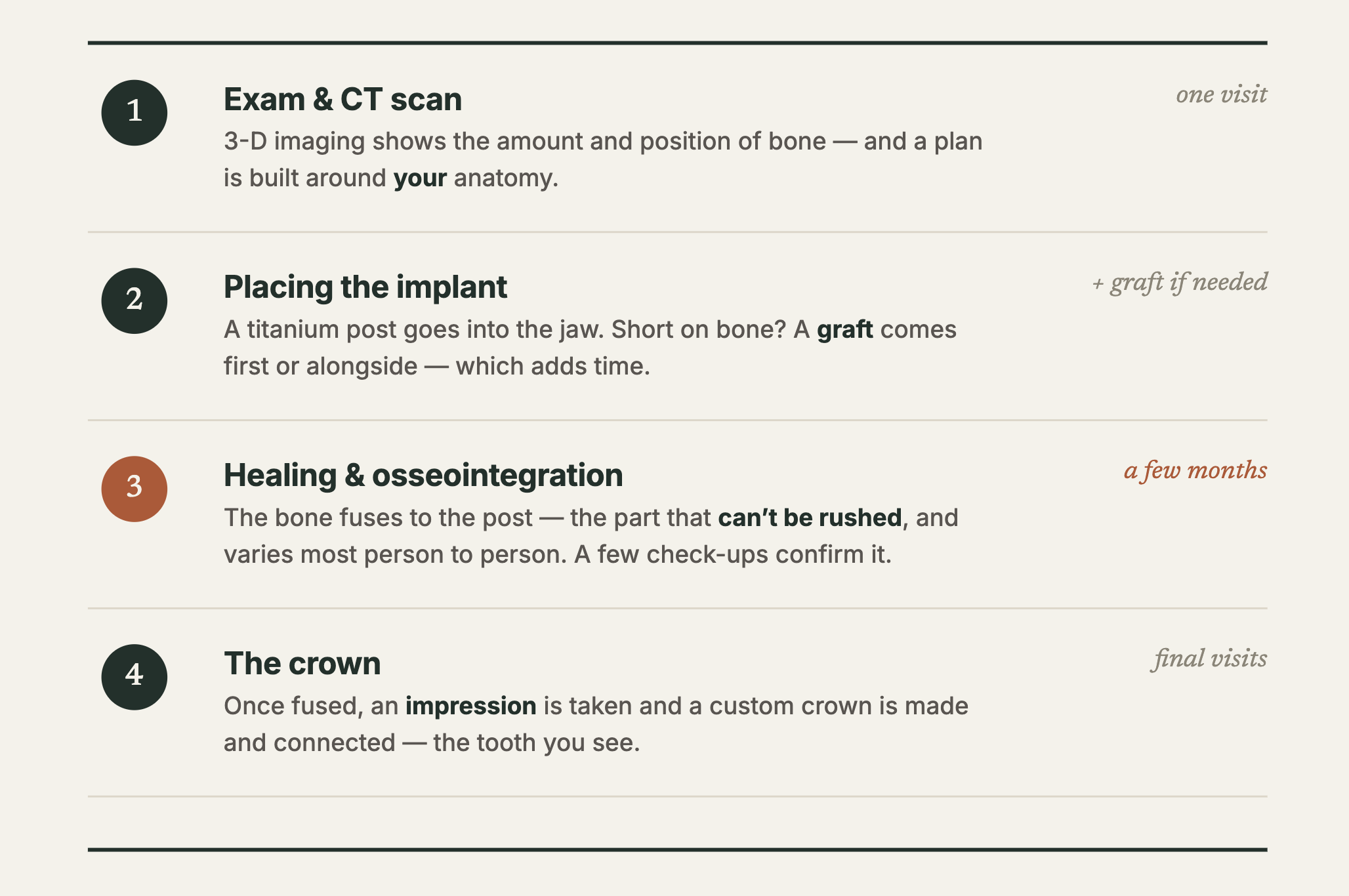
This is why no honest dentist can give you a single universal number for how long an implant takes — the healing stage genuinely differs from person to person. During this period, you’ll return for a few check-up visits so we can confirm the integration is progressing as it should. These visits aren’t busywork; they’re how we make sure the foundation is solid before any weight goes on it.
Stage 4: The Crown — Finally, the Tooth
Only once we’ve confirmed the implant has fused firmly and reliably with the bone do we move to the final stage: the tooth you actually see.
We take an impression of the implant and the surrounding teeth, and use it to fabricate a custom crown — shaped, sized, and color-matched to fit seamlessly with your natural teeth. That crown is then connected to the implant, and the restoration is complete. This is the moment the whole process has been building toward: a replacement tooth that looks natural and functions like it was always there.
Because this stage waits on the successful integration before it, its timing, too, follows the individual course of everything that came before.
So — How Many Visits, and How Long?
Having walked through the stages, the honest answer to the original question comes into focus: both the number of visits and the total timeline necessarily vary from person to person.
Someone with ample, healthy bone and no need for grafting follows a more direct path. Someone who needs a graft first, or whose bone integrates more slowly, follows a longer one. The planning, the placement, the healing check-ups, the final crown — each person’s path through those stages is shaped by their own anatomy and healing. There is no single “implant takes X visits and Y months” that’s true for everyone, and any clinic that promises one hasn’t yet looked at your mouth.
What is universal is the sequence and the logic behind it.
Why Doing It Right Matters More Than Doing It Fast
If there’s one idea to hold onto, it’s this: with implants, the goal is not speed — it’s a foundation that lasts for decades.
Every stage in this process exists for a reason, and the time each one takes is the time it genuinely needs. The planning ensures the implant is placed safely and correctly. The grafting, when needed, builds a foundation strong enough to hold. The healing period lets the bone fuse completely, which is the entire basis of an implant’s durability. Rushing or skipping any of these doesn’t save time in any meaningful sense — it just moves the risk downstream, where a poorly integrated or poorly planned implant can fail and cost far more time to fix than was ever saved.

Done properly, a dental implant can last decades — often a lifetime. That return is worth the patience the process asks for.
The most useful next step isn’t to guess at your own timeline from an article — it’s to find out what your case specifically requires. A consultation, including the imaging that shows your bone, is where that becomes clear: which stages you’ll need, whether grafting is part of the picture, and what a realistic path looks like for you.
If you’ve been wondering what getting an implant would actually involve, come in and let’s map it out together.
Frequently Asked Questions
How many visits does a dental implant take?
It varies from person to person, because an implant is a staged process shaped by your individual anatomy and healing. A typical path includes planning and imaging, implant placement, a few check-up visits during healing, and the final crown — but someone who needs a bone graft first will have additional visits. A consultation with imaging gives you a realistic estimate for your case.
How long does the whole dental implant process take?
Usually several months, driven mainly by the healing stage, where the bone fuses to the implant (osseointegration). This can’t be rushed and varies with bone quality, jaw location, and overall health. If a bone graft is needed, the timeline is longer. There’s no single universal duration — it depends on your specific situation.
Why do dental implants take several months instead of one appointment?
Because an implant replaces the tooth’s root, and the jawbone needs time to grow around and fuse to the titanium post — a biological process called osseointegration that typically takes a few months. That fusion is what makes implants so strong and long-lasting, and it simply can’t be accelerated.
Do you always need a bone graft before an implant?
No — only when there isn’t enough bone to securely anchor the implant, which is common where a tooth has been missing for a while and bone has diminished. When needed, grafting may be done at the same time as placement or as a separate earlier step, which adds to the overall timeline.
Is it worth getting an implant if it takes so long?
For most people, yes. A properly placed and fully healed implant can last decades — often a lifetime — and functions like a natural tooth. The staged timeline is what makes that durability possible, so the patience the process requires pays off over the long term.
📍 State Avenue Dental Office — Kansas City, KS (KCK) 🗣 English • Korean • Spanish