
It’s one of the most common questions we hear from adult patients, and it almost always arrives in the same slightly apologetic tone: “Is it too late for me? Am I too old for braces?”
Here’s the short answer, and we want to be clear about it: no, you’re not too old — there’s no age limit on orthodontic treatment. The longer answer is more interesting, because while age isn’t the barrier most people assume, there is a different set of things that matters for adults. Understanding that shift — from “how old are you?” to “how healthy is your foundation?” — is the key to whether, and how, adult orthodontics works.
Teeth Don’t Know How Old You Are
Let’s start with the biology, because it’s genuinely reassuring.
The mechanism that moves teeth is identical at every age. When steady, gentle pressure is applied to a tooth, the bone on one side gently remodels to let it move, and new bone fills in behind it. This process — the same one orthodontics has always relied on — doesn’t check your birthday. It works in a 20-year-old and it works in a 55-year-old.
That’s why adult orthodontics has become so common. The image of braces as a teenage rite of passage is increasingly out of date; a large and growing share of orthodontic patients are adults, many of them well into their 40s, 50s, and beyond. If you’ve been quietly assuming the window closed years ago, it didn’t. The door is very much open.
But — and this is the important part — being able to move the teeth is only half the question. The other half is whether the foundation those teeth sit in is ready for it.
What Actually Matters: The Health of Your Gums and Bone
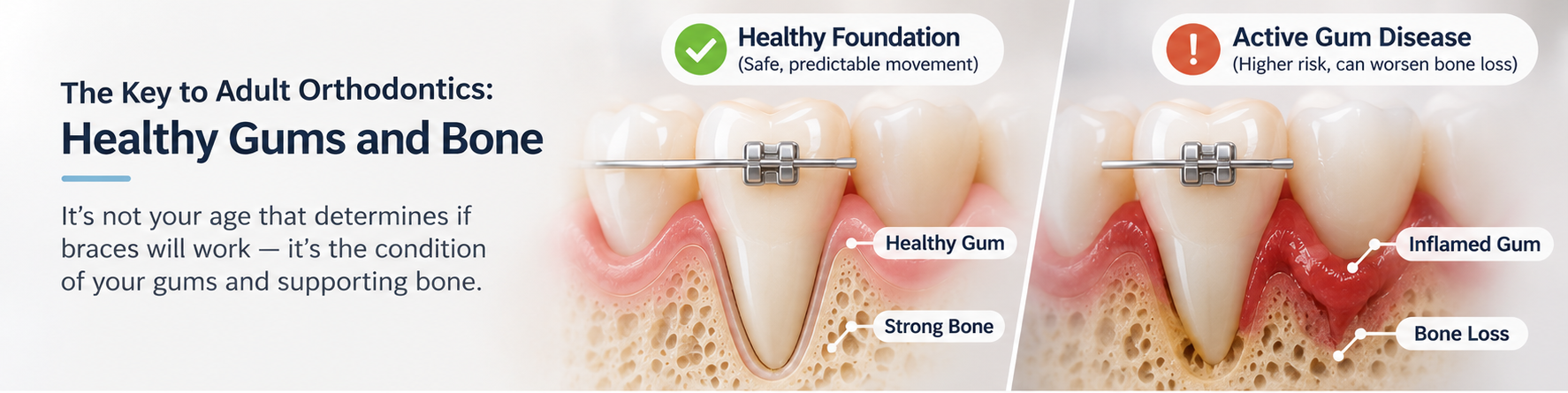
Here is the single most important shift in thinking for adult orthodontics: the deciding factor isn’t your age — it’s the condition of your gums and the bone beneath them.
The reason is mechanical, and it’s worth understanding clearly. Moving a tooth means applying force to it, and that force is ultimately borne by the gum and bone that hold the tooth in place. When those tissues are healthy, they absorb that force and remodel properly, exactly as intended. But when gum disease (periodontitis) is active, the supporting bone is already inflamed and breaking down. Apply orthodontic force to a tooth whose foundation is actively deteriorating, and you don’t get a controlled move — you risk accelerating the very bone loss that threatens the tooth.
This is why the rule in adult orthodontics is firm and non-negotiable: gum disease is treated and brought under control first, and only then does tooth movement begin. It’s not a delay for its own sake; it’s the difference between moving teeth through healthy, supportive bone and pushing them through compromised ground. Get the foundation stable, and orthodontics becomes safe and predictable. Skip that step, and you can do real harm.
For many adults, this is genuinely good news in disguise: the orthodontic consultation becomes the occasion that finally gets a quiet, long-ignored gum problem properly assessed and treated.
Working Around the Dental Work You Already Have
There’s a second reality that sets adult orthodontics apart from a teenager’s: by your 40s or 50s, you’ve likely accumulated some dental work along the way — a crown here, an implant there, a bridge somewhere. None of this rules out orthodontics, but it does require thoughtful sequencing, and one distinction in particular drives the whole plan.
A crowned tooth still moves. A crown is a cap over your natural tooth, and that natural root is still sitting in bone. Apply orthodontic force and the whole unit — root, tooth, and crown — moves together, just like any other tooth. Crowns are not an obstacle.
An implant does not move — at all. This is the critical difference. An implant is fused directly to the jawbone (that’s what makes it so stable), and that same fusion means it cannot be shifted by orthodontic force. An implant is a fixed point. It stays exactly where it is.
That single fact reshapes the entire treatment plan. An existing implant may serve as a fixed anchor to move other teeth against — sometimes a real advantage — or it may sit in a position that other teeth need to be arranged around. And it introduces a crucial question of order: if a space needs an implant eventually, it’s often far better to do the orthodontics first, position everything correctly, and place the implant into its final, planned home — because once that implant is in, it can’t be moved. This is why, for adults, mapping out what gets done and in what sequence — before anything begins — isn’t a formality. It’s the core of a successful outcome.
Why Adults Choose Braces — It’s Often Not About Looks
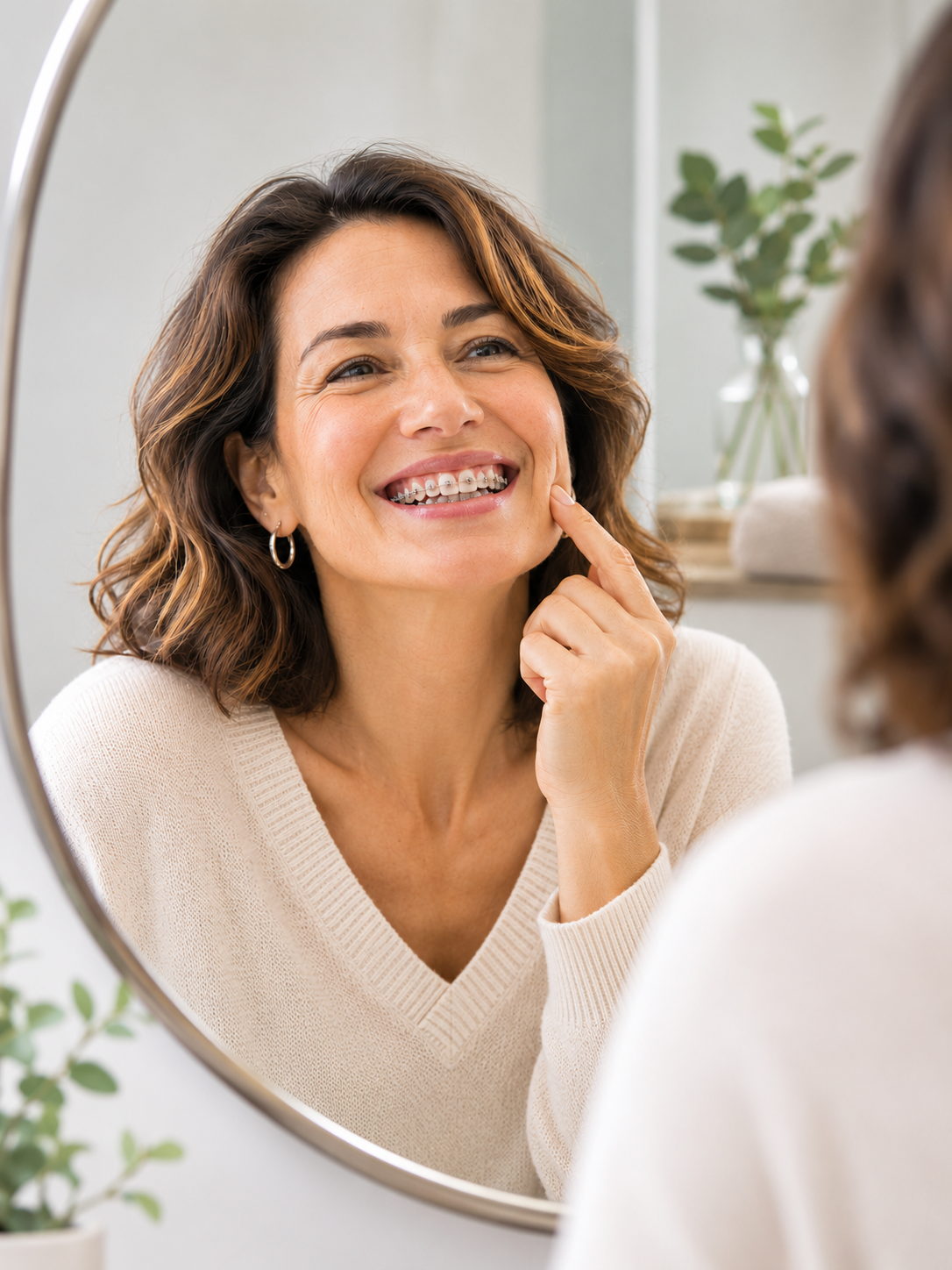
When a teenager gets braces, the goal is usually straightforward: a straighter, more confident smile. Adults often want that too — but when we talk with patients in their 40s and 50s, the deeper motivation is frequently something else entirely, something more practical and, honestly, more compelling.
Clearing out the spots that can’t be cleaned. Crowded, overlapping teeth create tight corners and overlaps that a toothbrush and floss simply can’t reach, no matter how diligent you are. Those are precisely the spots where decay and gum disease take hold. Straightening the teeth opens those areas up and makes them cleanable — which directly lowers the long-term risk to those teeth.
Rebalancing the bite. Over decades, a misaligned bite often concentrates chewing force onto a few teeth or onto one side of the mouth. That overload accelerates wear, raises the risk of cracks, and strains the jaw. Orthodontics can redistribute those forces more evenly across the arch, easing the burden on the teeth that have been carrying too much.
Put those together and a theme emerges: for many adults, orthodontics isn’t primarily cosmetic. It’s a strategic investment in keeping their remaining natural teeth longer — easier to clean, better balanced, and under less destructive stress. The straighter smile is the visible bonus on top of a genuinely health-driven decision.
If the Timeline Feels Daunting
One very real hesitation we hear is about time: the prospect of wearing braces for two or three years feels like a lot when you’re 50. It’s a fair concern, and worth addressing honestly.
For certain cases — particularly those focused on improving the alignment of the front teeth — there are approaches like Fastbraces designed to improve arrangement in a comparatively short timeframe. For the right candidate, that can make the whole prospect far more approachable. But it’s important to be straight about this: not every case is suited to a faster approach. Whether it’s appropriate depends entirely on what your specific situation requires, and a shorter path that isn’t right for your case is no bargain. The only way to know is a proper evaluation.
The One Thing We’d Gently Urge: Don’t Wait Because You Feel It’s “Too Late”
If there’s a single message to take from all of this, it’s this. The instinct that makes someone put off orthodontics — “I’m probably too old, so why bother?” — gets the situation exactly backwards.
Here’s why. The real gatekeeper for adult orthodontics isn’t age; it’s the health of your gums and bone. And gum health, left alone, tends to decline over time, not improve. So the logic flips: you are, in all likelihood, a better candidate today than you will be a few years from now. Waiting doesn’t make the “too late” fear come true on its own — but it does give any underlying gum issues more time to progress and narrow your options.
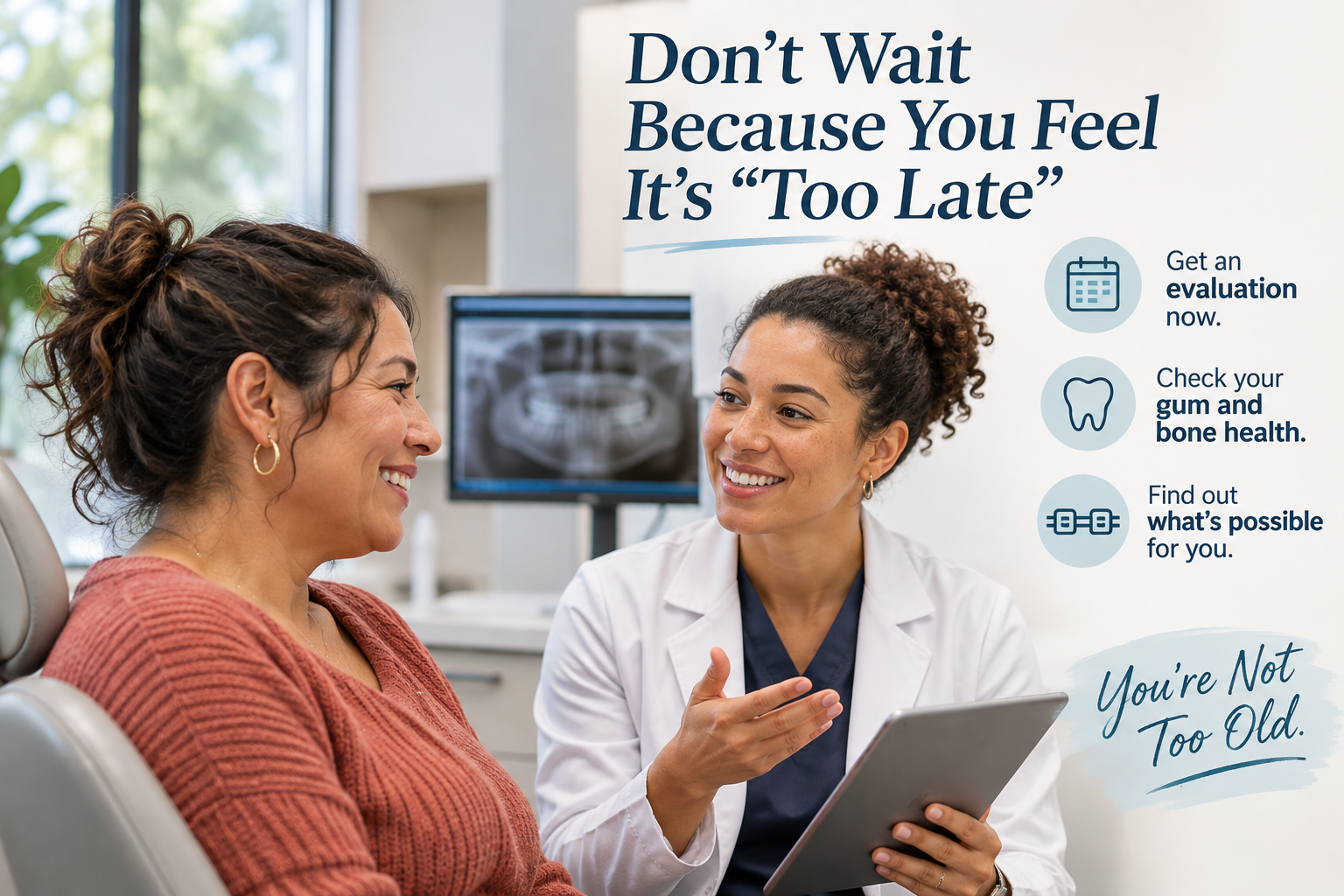
So rather than deciding you’ve missed your chance, the far more useful move is simply to find out. A single evaluation can tell you where your gums and bone stand, what your existing dental work means for a plan, and whether now — while things are at their healthiest — is the right moment. You may be more ready than you think. And the best way to keep that door open is to check while it’s still wide open.
If you’ve ever wondered whether it’s too late to straighten your teeth, let’s answer that question properly. Come in, and we’ll take an honest look at what’s possible for you.
Frequently Asked Questions
Can you get braces in your 40s or 50s?
Yes. There’s no age limit on orthodontic treatment — the biological process that moves teeth works the same at 50 as it does at 20, and adults make up a large and growing share of orthodontic patients. What matters for adults isn’t age but the health of the gums and supporting bone, which is assessed before treatment begins.
Do you need healthy gums before getting braces as an adult?
Yes, and this is the most important factor. Moving teeth places force on the gums and bone that support them. If gum disease is active, that force can accelerate bone loss, so active gum disease must be treated and stabilized first. Once the foundation is healthy, orthodontics becomes safe and predictable.
Can you get braces if you already have crowns or implants?
Yes, with planning. A crowned tooth moves normally, because the natural root underneath is still in bone. An implant, however, is fused to the bone and cannot be moved — it’s a fixed point. Existing implants shape the sequence and plan of treatment, which is why mapping out what’s done and when, in advance, is essential.
Why do adults get braces if not for appearance?
Often to protect their long-term dental health. Straightening crowded teeth opens up areas that couldn’t be cleaned, lowering decay and gum-disease risk, and rebalancing the bite redistributes chewing forces that were overloading certain teeth. For many adults, braces are a strategy to keep their natural teeth longer, with a better smile as a bonus.
Is there a faster option than traditional braces?
Sometimes. For certain cases, especially those focused on front-tooth alignment, approaches like Fastbraces can improve arrangement in a shorter timeframe. But not every case is suited to a faster method — whether it’s appropriate depends on your specific needs, which an evaluation determines.
📍 State Avenue Dental Office — Kansas City, KS (KCK) 🗣 English • Korean • Spanish