
Should You Keep Flossing If Your Gums Bleed?
This is one of the most common questions we hear, and it's a genuinely good one: "When I floss, my gums bleed. Should I keep going, or does the bleeding mean I should stop?"
The instinct behind the question makes complete sense. Bleeding usually means injury — if something bleeds when you touch it, the natural response is to leave it alone. But when it comes to gums and flossing, that instinct leads most people to exactly the wrong conclusion. Here's what bleeding actually means, and why the answer usually isn't what people expect.
What Bleeding Gums Usually Mean
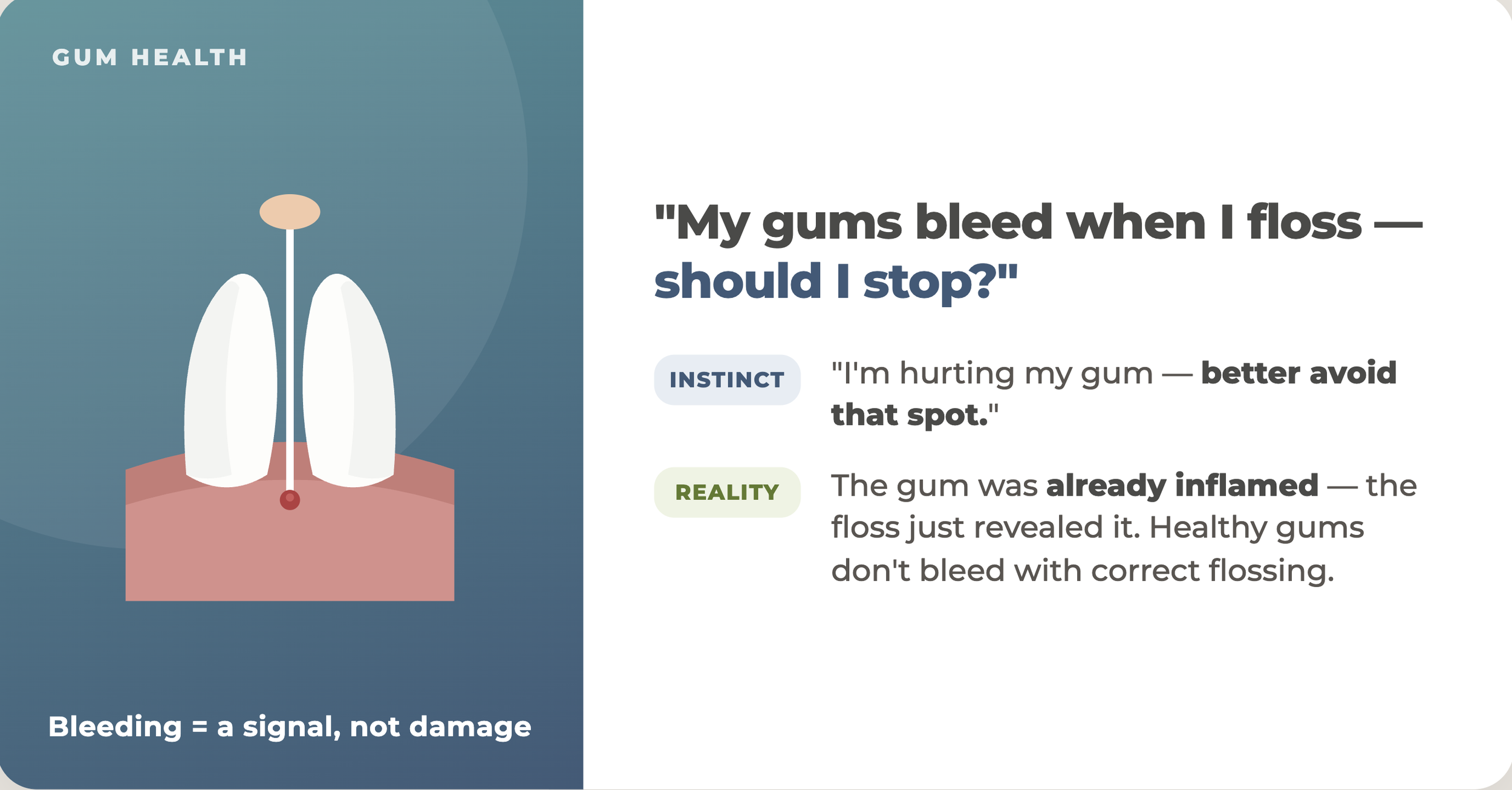
When gums bleed during flossing, the overwhelming majority of the time, it's not because the floss injured healthy tissue. It's because the tissue was already inflamed — and the floss simply revealed it.
The cause is almost always the same: bacteria and plaque accumulating along and just below the gumline, in the space between the teeth where a toothbrush doesn't reach well. This buildup triggers an inflammatory response in the gums — the earliest stage of gum disease, called gingivitis. Inflamed tissue is engorged with blood and fragile, so even the gentle mechanical stimulation of floss makes it bleed easily.
Healthy gums, by contrast, generally don't bleed when you floss correctly. So the bleeding isn't a sign of damage from flossing — it's a sign that inflammation is already present in that spot. The floss isn't causing the problem; it's exposing it.
Why Stopping Makes It Worse
Here's where the common instinct backfires. When people see bleeding and respond by avoiding that area — flossing around it, or stopping altogether — they remove the very thing that addresses the underlying cause.
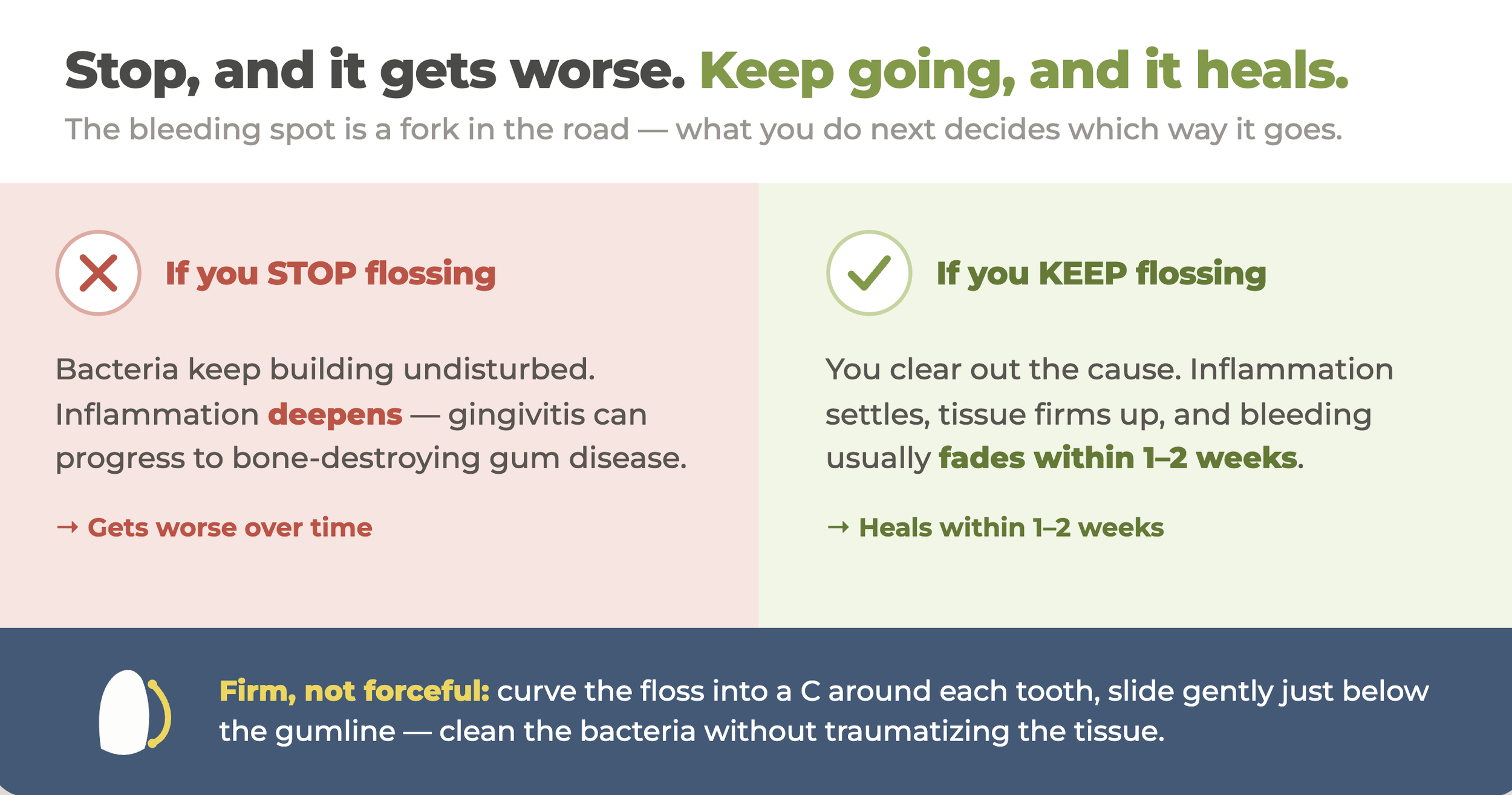
The inflammation is driven by bacterial buildup. Flossing is what disrupts and removes that buildup from between the teeth. So when you stop flossing the bleeding spot, the bacteria continue to accumulate undisturbed, the inflammation deepens, and the situation progresses rather than resolves. Untreated gingivitis can advance over time into periodontitis — the more serious form of gum disease that destroys the bone supporting the teeth.
In other words, avoiding the bleeding lets the actual problem grow. The bleeding was the warning signal, and turning away from it silences the alarm without addressing the fire.
Why Consistent Flossing Usually Makes Bleeding Stop
The counterintuitive truth is that, in most cases of early inflammation, continuing to floss correctly is exactly what makes the bleeding go away.
When you floss that inflamed area consistently, you're removing the bacterial buildup that's driving the inflammation. As the bacteria are cleared out day after day, the inflammatory response settles down, the tissue becomes healthier and firmer, and it stops bleeding. Many people notice that a spot which bled consistently in the first several days of a renewed flossing habit bleeds noticeably less within a week or two, and often stops entirely as the gums return to health.
That progression — bleeding that steadily decreases with consistent, correct flossing — is one of the clearest signs the inflammation is resolving and the gums are recovering.
Technique Matters: Firm but Not Forceful
There's an important balance here, because "keep flossing" doesn't mean "floss aggressively." Being too rough can genuinely irritate or injure healthy gum tissue, which isn't the goal.
The correct approach is gentle and deliberate. Guide the floss down between the teeth without snapping it forcefully against the gums. At the gumline, curve the floss into a C-shape around the side of each tooth and slide it gently just beneath the gum, then move it up and down against the tooth surface to clear the plaque. The aim is to clean thoroughly along and slightly under the gumline — where the bacteria are — without traumatizing the tissue.
Done this way, consistent flossing addresses the inflammation without causing new problems. If you're not sure whether your technique is right, we're happy to demonstrate it at a visit — small adjustments often make a real difference.
When Bleeding Deserves a Closer Look
For most people, bleeding that improves over one to two weeks of consistent, correct flossing is simply early inflammation resolving, exactly as it should. But bleeding that doesn't follow this pattern is worth having evaluated.
Specifically, it's worth a call if the bleeding persists or worsens despite two weeks of consistent, proper flossing; if it's heavy, spontaneous, or happens without any obvious trigger; or if it comes alongside other signs like persistent bad breath, gum recession, loose teeth, or gums that are swollen and tender. These can indicate more advanced gum disease that needs professional treatment — a deep cleaning to remove hardened deposits below the gumline that flossing alone can't address. Certain medical conditions and medications can also cause gum bleeding, which is another reason persistent bleeding is worth discussing.
Frequently Asked Questions

Should I keep flossing if my gums bleed?
In most cases, yes. Bleeding usually indicates early gum inflammation from bacterial buildup, not injury from the floss. Continuing to floss correctly removes that buildup, and the bleeding typically decreases and stops within one to two weeks as the gums return to health.
Why do my gums bleed when I floss?
Most often because the tissue is already inflamed from plaque and bacteria accumulating along the gumline — the early stage of gum disease called gingivitis. Inflamed gums are fragile and bleed easily, so the floss is revealing existing inflammation rather than causing damage.
Does bleeding mean I'm flossing too hard?
Usually not — it typically means inflammation is present. That said, excessive force can irritate healthy tissue, so the goal is gentle, correct technique: curving the floss around each tooth and cleaning just below the gumline without snapping it against the gums.
How long until bleeding gums stop when I start flossing?
For early inflammation, bleeding often decreases noticeably within one to two weeks of consistent, correct flossing, and may stop entirely as the gums heal. If it persists or worsens beyond that, it's worth having evaluated.
When should I see a dentist about bleeding gums?
If bleeding persists or worsens despite two weeks of consistent proper flossing, is heavy or spontaneous, or comes with bad breath, recession, loose teeth, or swollen tender gums. These can signal more advanced gum disease that needs professional cleaning.
The Thing About Warning Signals

Bleeding gums are easy to misread because bleeding almost always means "stop, you're hurting something." But gums are a case where the signal means nearly the opposite: not "stop touching me," but "there's inflammation here that needs attention." Turning away from it feels protective, but it lets the real problem continue quietly.
The better response to the signal is to address what's causing it — consistent, gentle flossing that clears out the bacteria at the root of the inflammation. In most cases, that's all it takes, and the bleeding fades as the gums get healthy. When it doesn't, that's useful information too, and a sign it's time for a professional look.
If your gums have been bleeding and you're not sure whether it's the ordinary kind that resolves or the kind that needs attention, give us a call. It's a simple thing to check, and knowing the difference is worth the visit.
📍 State Avenue Dental Office — Kansas City, KS (KCK) 🗣 English • Korean • Spanish